
Share this publication
Send this Chervil resource to someone who may find it useful.
What is real-estate depreciation?
Depreciation is the process of recovering the cost or other basis of qualifying income-producing property through annual tax deductions over a period established by federal tax law.
Although a rental building may increase in market value, the federal tax system generally treats the structure as an asset that wears out, deteriorates or becomes obsolete over time. An eligible owner may therefore recover the building’s depreciable basis through annual deductions.
Property generally must meet all of the following requirements to be depreciable:
- You own the property.
- The property is used in a business or income-producing activity.
- The property has a determinable useful life.
- The property is expected to last longer than one year.
Only the portion used for rental or business purposes can generally be depreciated. Property used exclusively as a personal residence is not depreciable.
How long is rental real estate depreciated?
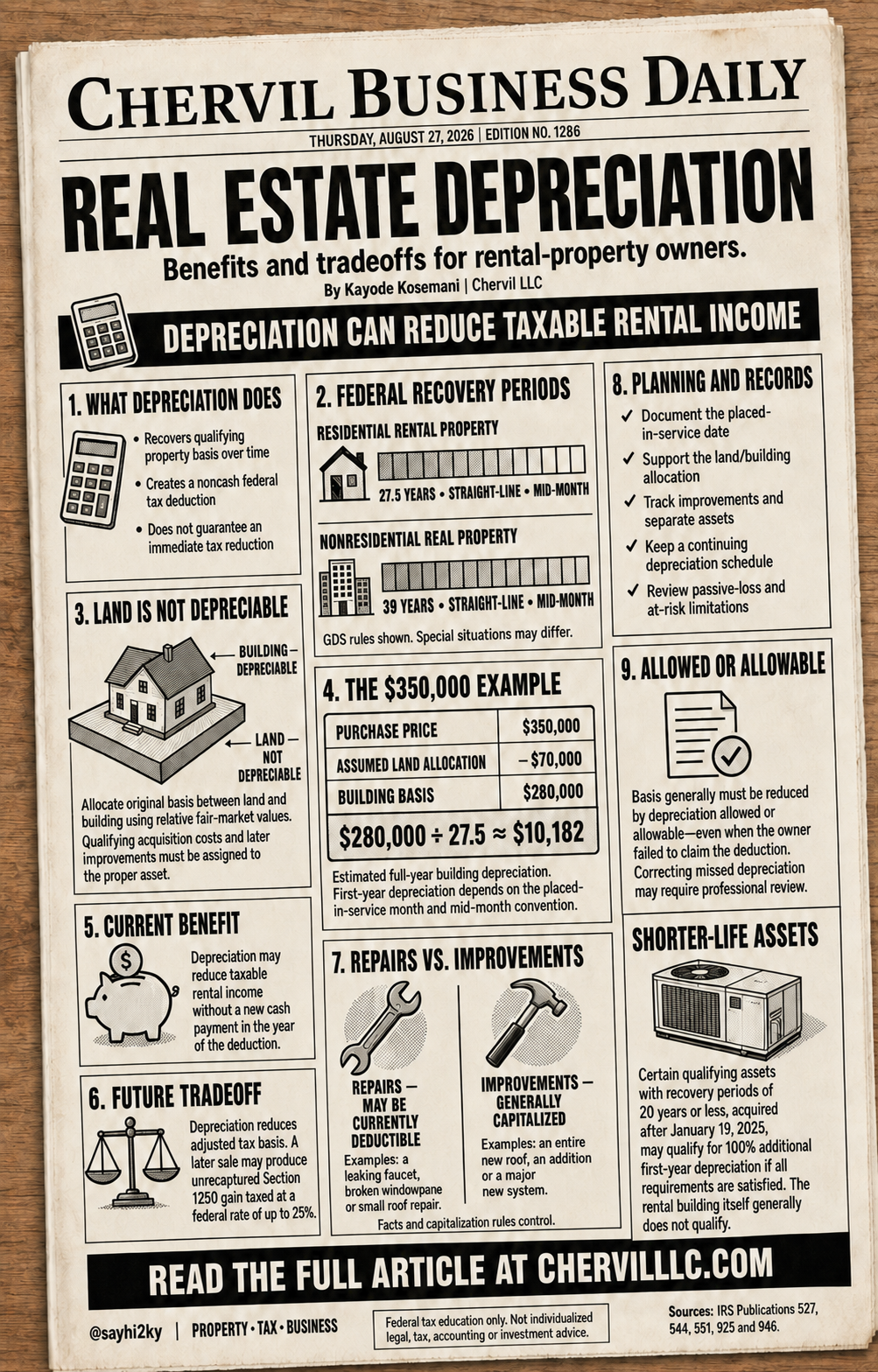
Under the federal General Depreciation System, commonly called GDS:
- Residential rental property is generally depreciated over 27.5 years.
- Nonresidential real property is generally depreciated over 39 years.
- Land is not depreciable.
- Residential rental and nonresidential real property generally use the straight-line method and mid-month convention.
For this purpose, a building is generally classified as residential rental property when 80% or more of its gross rental income for the year comes from dwelling units. Mixed-use buildings and properties subject to the Alternative Depreciation System may require different treatment.
Not every asset associated with a rental property follows the building’s 27.5-year or 39-year schedule. Appliances, furniture, carpeting, fencing and certain land improvements may have shorter recovery periods and should be classified separately when appropriate.
Current-law note on accelerated depreciation
Certain qualifying assets with a MACRS recovery period of 20 years or less may be eligible for 100% additional first-year depreciation under current federal law if the acquisition, placed-in-service and other eligibility requirements are satisfied.
The residential or nonresidential building itself generally does not qualify for this treatment because its standard recovery period exceeds 20 years. Elections, related-party restrictions, business-use requirements and other limitations may apply. A property owner should not perform an aggressive asset reclassification or cost-segregation analysis without appropriate professional support.
When does depreciation begin?
Depreciation does not necessarily begin on the purchase or closing date. It generally begins when the property is placed in service, meaning it is ready and available for its intended income-producing use.
For example, suppose an investor purchases a rental house in March but performs substantial renovations through June. If the property is not ready and available for rent until July, depreciation would generally begin in July.
The property does not necessarily need to have an occupying tenant. It must be ready and genuinely available for rent.
Once a rental property has been placed in service, depreciation may generally continue while it is temporarily idle. For example, temporary vacancy or repairs between tenants do not necessarily stop depreciation if the property remains held for rental use.
How is depreciable basis determined?
Determining depreciable basis generally involves several steps:
- Determine the property’s original tax basis, including qualifying acquisition costs. Costs incurred to obtain financing are generally not included in the property’s basis.
- Allocate the original property basis between land and building using their relative fair-market values. If those values are uncertain, an appropriate real-estate tax assessment may help support the allocation.
- Add capital improvements to the basis of the building or separately depreciable asset that was improved.
- Subtract any applicable basis reductions, including certain credits, deductions or other adjustments.
- Exclude the basis allocated to land because land is generally not depreciable.
Costs directly connected to land, the building or another asset should be allocated appropriately rather than automatically assigned to the building.
Property converted from personal to rental use
When a former personal residence is converted to rental use, the depreciable basis is generally the lower of the property’s adjusted basis or its fair-market value on the conversion date, after properly excluding the land.
This rule can produce a different result from simply using the original purchase price. It is especially important when a property declined in value before being converted to a rental.
A simplified depreciation example
Consider a residential rental property purchased for $350,000.
Assume a reasonable and supportable allocation shows:
- Land value: $70,000
- Building value: $280,000
Because land is not depreciable, the starting building basis in this simplified example would be:
$350,000 − $70,000 = $280,000
Using the 27.5-year residential recovery period:
$280,000 ÷ 27.5 = approximately $10,182
The $10,182 represents an estimated full-year straight-line amount before applying the first-year mid-month convention. The actual first-year deduction depends on the month the property becomes ready and available for rent.
For example, if the property were placed in service in July, the standard mid-month calculation would produce a first-year building depreciation deduction of approximately $4,668, rather than the full-year amount. Separately depreciated assets and other individual circumstances could change the total depreciation reported.
Why is depreciation valuable?
Suppose the property produces the following full-year results:
- Rental income: $30,000
- Other deductible rental expenses: $12,000
- Building depreciation: $10,182
Before depreciation, the property shows $18,000 of rental income after the other expenses.
After depreciation:
$30,000 − $12,000 − $10,182 = $7,818
In this simplified illustration, depreciation reduces the rental income potentially subject to tax from $18,000 to $7,818.
The owner did not pay an additional $10,182 in cash during that year to claim the deduction. This is why depreciation is often described as a noncash deduction.
However, a deduction does not guarantee an immediate dollar-for-dollar reduction in tax. The owner’s filing status, income, basis, at-risk amount, level of participation and passive-activity limitations can affect when the benefit may be used.
The important tradeoff: depreciation reduces basis
Depreciation generally reduces the property’s adjusted tax basis. A lower adjusted basis can produce a larger taxable gain when the property is sold.
For qualifying property held longer than one year, the portion of gain attributable to depreciation may be treated as unrecaptured Section 1250 gain and taxed at a federal rate of up to 25%. This is a maximum rate, not an automatic flat 25% tax on every sale or on every dollar of depreciation.
The final treatment depends on factors including:
- The property’s adjusted basis
- Selling price and selling expenses
- Holding period
- Total gain or loss
- Prior depreciation
- Suspended passive losses
- The owner’s overall tax situation
- Potential state taxes and, when applicable, the federal Net Investment Income Tax
What does “allowed or allowable” mean?
Property owners sometimes believe they can avoid the future effect of depreciation by choosing not to claim it. That is generally incorrect.
When calculating gain on a later sale, the property’s basis may still have to be reduced by depreciation that was allowable, even when the owner failed to claim the deduction on an earlier return.
This can produce an unfavorable result: the owner misses the annual deduction but may still face a reduced basis when the property is sold.
If depreciation was missed, the appropriate correction depends on the facts and the number of affected years. In some situations, an amended return may be appropriate. When an incorrect depreciation treatment has been used for multiple years, it may constitute an accounting-method issue requiring Form 3115 and a Section 481(a) adjustment.
Property owners should obtain professional guidance rather than automatically amending several returns.
Repairs and improvements are not treated the same
Correctly distinguishing repairs from improvements is an important part of rental-property tax reporting.
A repair generally keeps the property in ordinarily efficient operating condition without materially improving it. Depending on the facts and applicable capitalization rules, a qualifying repair may be deductible in the year paid or incurred.
Possible examples include:
- Repairing a leaking faucet
- Replacing a broken windowpane
- Fixing a damaged section of drywall
- Repairing a small section of a roof
An improvement generally betters the property, restores it or adapts it to a new or different use. Improvements are normally capitalized and recovered through depreciation unless a specific tax rule or properly made safe-harbor election applies.
Possible examples include:
- Replacing an entire roof
- Adding a new room
- Installing a major new system
- Completing a substantial property renovation
The facts surrounding the work matter. The amount paid by itself does not determine whether an expenditure is a repair or an improvement.
Can depreciation create a rental-property loss?
Yes. Depreciation can reduce rental income or contribute to a tax loss even when the property has positive cash flow.
However, most rental activities are generally treated as passive activities. Passive losses may be limited and carried forward instead of being currently deductible against wages or other nonpassive income.
An individual who actively participates and owns the required interest may qualify for a special rental-real-estate loss allowance of up to $25,000. For many taxpayers, the allowance begins phasing out when modified adjusted gross income exceeds $100,000 and is generally eliminated at $150,000. Married taxpayers filing separately are subject to different and often more restrictive rules.
Different rules may apply to a taxpayer who qualifies as a real-estate professional and materially participates in the rental activity. Merely working in real estate or holding a professional license does not automatically make every rental loss nonpassive.
How is depreciation reported?
Individual owners commonly report residential rental income, expenses and depreciation on Schedule E of Form 1040.
Form 4562 is generally required when claiming depreciation on property first placed in service during the current tax year, claiming depreciation on listed property, claiming a Section 179 deduction or beginning certain amortization deductions.
Partnerships and S corporations generally report rental real-estate activity through Form 8825, with the resulting amounts passed through to their owners. Other ownership structures may have different reporting requirements.
Records rental-property owners should maintain
Owners should retain organized records supporting:
- The property’s purchase price
- Closing and settlement documents
- Qualifying acquisition costs
- The allocation between land and building
- The date the property became ready and available for rent
- Capital improvements and major renovations
- Appliances, furniture and other separately depreciated assets
- Rental and personal-use percentages
- Prior depreciation schedules
- Rental income and operating expenses
- Tax credits or other adjustments affecting basis
- Sale documents and selling expenses
A continuing depreciation schedule is especially important because depreciation can affect the property over many tax years and again when it is sold.
Frequently asked questions
Can land ever be depreciated?
Land itself generally cannot be depreciated because it does not have a determinable useful life. Certain improvements associated with land may qualify for separate depreciation treatment.
Can I begin depreciation before finding a tenant?
Potentially. Depreciation can generally begin when the property is ready and available for rent, even if the first tenant has not moved in.
Can I depreciate my personal residence?
A property used exclusively as a personal residence is generally not depreciable. If part of the property is legitimately used for rental or qualifying business purposes, only the qualifying portion may be depreciable.
Does depreciation reduce the property’s market value?
No. Depreciation is a tax-accounting concept. It does not determine the property’s appraisal or market value.
Will depreciation always lower my current tax bill?
Not necessarily. Passive-activity, at-risk, basis, personal-use and other limitations can restrict the amount currently deductible.
What happens if I forgot to claim depreciation?
The property’s basis may still have to be reduced by depreciation that was allowable. The appropriate correction may involve an amended return or a change in accounting method, depending on the circumstances.
The practical takeaway
Depreciation can provide a valuable current federal tax benefit, but it should be calculated, reported and documented carefully.
Rental-property owners should understand:
- What portion of the property is depreciable
- How land and building basis were allocated
- When the property was placed in service
- Which costs belong to the building or separate assets
- How depreciation affects annual rental income
- How passive-loss rules may limit the current deduction
- How accumulated depreciation can affect a future sale
A properly maintained depreciation schedule allows an investor to claim available deductions while preparing for possible future tax consequences.
Need help reviewing your rental-property tax records?
Chervil LLC can help rental-property owners identify the information needed for accurate tax reporting and review whether important purchase, improvement and depreciation records have been organized properly.
Please do not submit Social Security numbers, complete tax returns or other sensitive tax documents through the general website contact form.
Educational disclaimer
This material is provided for educational and informational purposes only. It is not individualized legal, tax, investment, accounting, lending or other professional advice. Tax laws, interpretations and individual circumstances can change. Readers should verify current information and obtain appropriate professional guidance before acting.
Sources and further reading
- IRS Publication 527: Residential Rental Property
- IRS Publication 946: How to Depreciate Property
- IRS Publication 551: Basis of Assets
- IRS Publication 925: Passive Activity and At-Risk Rules
- IRS Publication 544: Sales and Other Dispositions of Assets
- IRS Instructions for Schedule E
- IRS Instructions for Form 4562
- IRS Form 3115 and Instructions
- IRS Notice 2026-11: Additional First-Year Depreciation Guidance
Last reviewed: August 27, 2026
CONNECT WITH CHERVIL LLC
Have a question about this topic?
Use this resource as a starting point, then contact Chervil LLC when you need guidance connected to your individual circumstances.