
Share this publication
Send this Chervil resource to someone who may find it useful.
Documentation, filing responsibilities and practical tax education
Last reviewed: September 1, 2026
Tax preparation starts before someone enters numbers into a return. It starts with understanding what happened during your year, gathering the evidence, and asking questions before a deadline becomes urgent.
Use this guide to organize your next conversation with Chervil LLC. It is designed primarily for individual and family returns, including self-employment and rental activity. Partnerships, corporations, estates, trusts and other specialized returns require additional records and their own filing review.
Start here: Identify the tax year, list every income source, and make a separate list of missing documents. You can begin preparing now even when you are not yet ready to file.
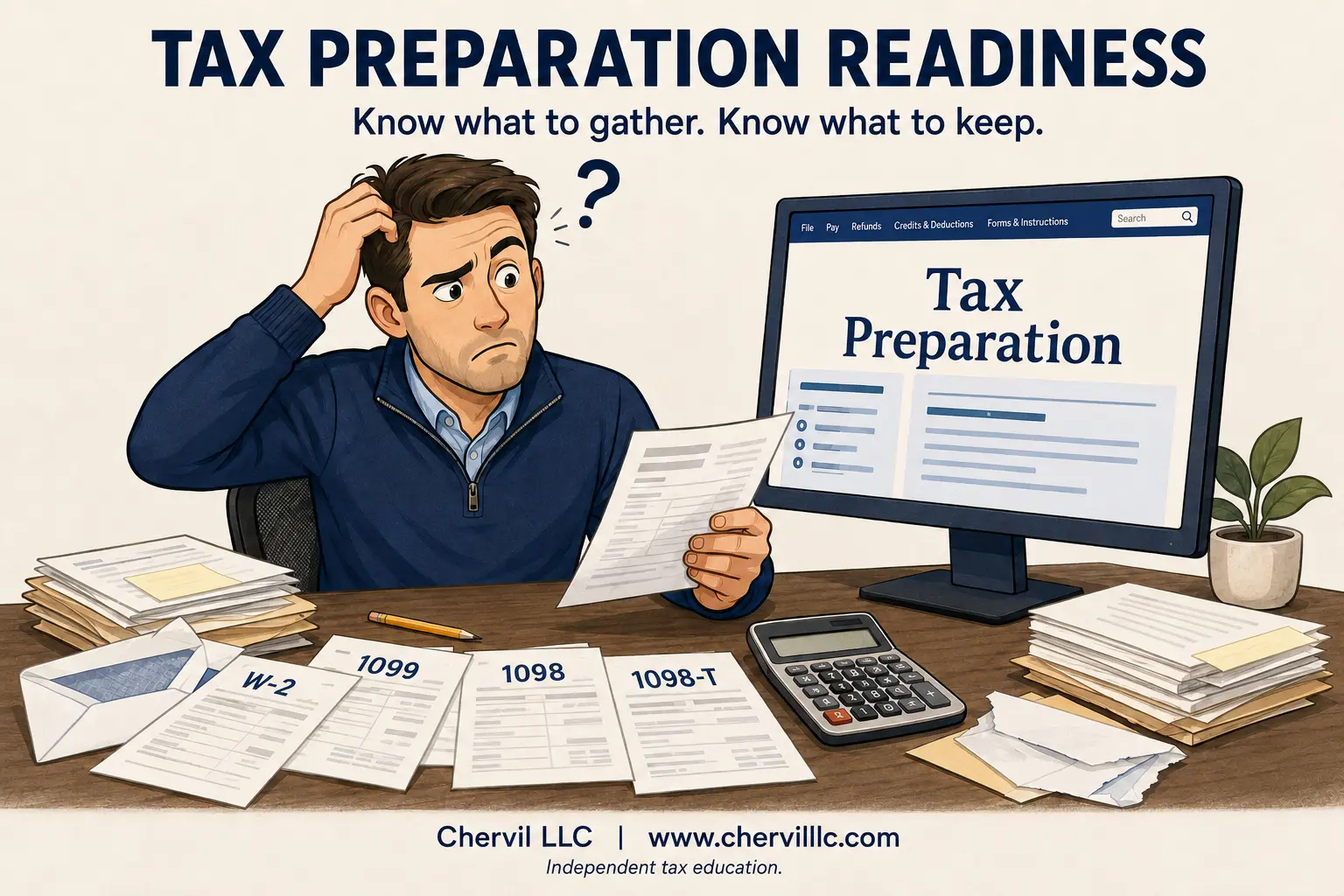
Choose the right tax year and explain what changed
Keep each year's records in its own folder. A return filed in 2026 may report 2025 income, while your current 2026 records ordinarily support a return filed in 2027. An overdue or amended return needs the rules and forms for the year being corrected—not whichever figures appear in the latest social-media post. IRS: When to file
Before your appointment, write a short update covering changes such as marriage, separation, a new child, a move, a new job, starting a business, buying or selling property, retirement, or a notice from a tax agency. Flag any prior return you believe is wrong or any year that remains unfiled.
Bring the prior-year federal and state returns, including schedules, if available. Tell your preparer about carryovers and earlier elections instead of assuming that last year's refund tells the whole story.
What to do now: September through December 2026
Do not wait for next year's tax forms to begin. Use this planning checklist now; keep the current-year records separate from any 2025 return you are still completing.
| When | Practical action |
|---|---|
| September | Review year-to-date pay, withholding, side income and business results through August. Gather payment confirmations and identify missing records. |
| Before September 15, 2026 | Review the third 2026 federal estimated-tax installment if it applies to you. An individual filing extension for an earlier year does not replace current-year payments. |
| Every month | Save receipts, reconcile income and expenses, update mileage and rental records, and read tax-agency notices promptly. |
| Before the final payrolls | Review withholding with all household jobs and other income in mind. If needed, submit an updated Form W-4 early enough for payroll to process it. |
| Before year-end decisions | Discuss retirement contributions, charitable gifts, education payments, property transactions and business purchases before committing. Confirm the applicable timing and eligibility rules; do not assume every action has the same December 31 deadline. |
| January onward | Collect annual statements from mail and online accounts, compare them with your records, and request corrections before filing. |
The September 15 installment date is confirmed in the IRS third-quarter tax calendar. Under the usual individual schedule, the next 2026 estimated-tax installment is due January 15, 2027; exceptions and relief can apply. IRS Publication 505: Payment periods
Planning principle: A purchase is not automatically a good decision because it might be deductible. Ask about the after-tax cost and your actual need before spending.
Gather your core documents
Prepare the following for review through an agreed secure method. Not every item applies to every household.
| Category | What to have ready |
|---|---|
| Identity and household | Correct legal names, taxpayer identification details, current address, dependent information and any name changes |
| Prior filings | Last year's complete returns, amendments and unresolved IRS or state letters |
| Income | All employer and payer statements, plus records of income not reported on a form |
| Payments | Federal and state estimated payments, extension payments, dates and confirmation numbers |
| Refund or payment account | Verified routing and account information, provided securely—not in a public message |
| Tax benefits | Supporting records for childcare, education, retirement contributions, health expenses and other potentially eligible items |
IRS document-gathering checklist
If the IRS issued an Identity Protection PIN to you, your spouse or a dependent, flag it before filing. Use the PIN valid for the calendar year you are filing in, including when submitting an older return; a new PIN is generated each year. Share it only through the verified filing arrangement. IRS IP PIN guidance
A useful habit: Mark each document “received,” “not applicable,” or “requested.” An empty folder does not tell your preparer whether an item is missing or simply does not apply.
W-2 employees: prepare before your annual statement arrives
- Keep recent pay statements and your final pay statement for the year. List every employer, including jobs you left.
- Confirm your employer has your correct legal name and mailing address, and make sure you can still access former employers' payroll portals.
- Review federal withholding using current pay statements for you and your spouse, when applicable, plus other income. A second job, marriage, new dependent or side business may change the result. Use the IRS Tax Withholding Estimator and review the suggested Form W-4 changes.
- Collect every Form W-2 and any Form W-2c correction. Compare them with your records; raise unexplained discrepancies with payroll. A final pay statement is not normally a substitute for the W-2 when preparing a complete return. IRS: Form W-2
- If you receive tips or overtime, retain detailed payroll and employer reporting. The current deductions have specific definitions and eligibility rules; they do not make all tips or all overtime exempt from every tax. IRS: Qualified overtime guidance IRS: 2026 W-2 reporting instructions
Changing withholding affects payments toward tax; it does not by itself reduce the tax you ultimately owe. If you change withholding partway through the year, review it again for the next year. IRS withholding review
Watch your mailbox and online accounts: income documents
Tax documents may arrive on paper or only through an employer, bank, school, insurer or investment portal. Check both. Receiving a form does not mean every dollar on it is taxable; the underlying transaction and applicable rules still matter.
| Form to recognize | Usually provided by | What to keep with it |
|---|---|---|
| W-2 / W-2c | Employer | Pay statements and the corrected version, if issued |
| 1099-NEC | Business paying nonemployee compensation | Invoices, payment history and related business records |
| 1099-MISC | Payer of certain rents, royalties or other payments | Records showing the payment's actual purpose; not every 1099-MISC is self-employment income |
| 1099-K | Payment processor or marketplace | Transaction exports, fees, refunds and records separating business receipts from personal transfers |
| 1099-INT / 1099-DIV / 1099-OID | Bank, broker or other payer | Interest, dividend and relevant investment statements |
| 1099-B | Broker | Sales statements, purchase dates, cost basis, fees and transferred-account records |
| 1099-R / SSA-1099 / RRB-1099 | Retirement payer, Social Security or Railroad Retirement Board | Distribution, rollover and benefit records; a distribution is not necessarily all taxable |
| 1099-G | Government agency | Unemployment or state-refund details and related withholding records |
| Schedule K-1 | Partnership, S corporation, estate or trust | All accompanying schedules, basis information and prior carryovers |
| W-2G | Gambling payer | A complete gambling activity and win/loss record—not just the forms received |
IRS guide to information returns and form names IRS Publication 17: Income guidance
For digital assets, watch for Form 1099-DA from a reporting broker. Also preserve your own acquisition costs, fees, sales and wallet-transfer records: a form may not contain all the basis information needed. Taxable transactions can require reporting without a form. IRS: Understanding Form 1099-DA
No tax form does not mean no taxable income. Report taxable receipts even if a payer or platform was not required to issue a form. Conversely, a genuine personal gift or reimbursement of a shared personal expense is not automatically business income because it passed through a payment app. Keep evidence showing what each payment represents. IRS: Understanding Form 1099-K
For example, moving a customer's payment from an app to your own bank account does not create a second sale. Match the original transaction to the transfer rather than adding both deposits as separate revenue. Reconcile platform totals, bank deposits, refunds and processing fees before filing. Ask about incorrect or overlapping forms instead of silently omitting them.
Homeowners and real-estate owners: forms plus property records
| Form or document | What it concerns | What else to save |
|---|---|---|
| Form 1098, Mortgage Interest Statement | Mortgage interest and certain other mortgage information from the lender or servicer | Statements from each servicer, purchase/refinance closing papers, points and loan-use records; receiving the form does not guarantee deductibility |
| Form 1099-S, Proceeds from Real Estate Transactions | Reported proceeds from a property sale | Closing Disclosure or settlement statement, original purchase records, improvements, selling expenses and ownership/use dates; gross proceeds are not the same as taxable gain |
| Property-tax bills and payment records | Real-estate taxes assessed and paid | County receipts and escrow disbursements showing actual tax payments; money merely placed in escrow is not itself proof that a tax was paid |
| Rental records and depreciation schedules | Rental income, operating expenses and depreciable assets | Leases, rent ledger, invoices, repairs versus improvements, land/building allocation and business/personal-use details |
IRS: Form 1098 IRS: Form 1099-S IRS Publication 530: Homeowner records and taxes
Keep acquisition and improvement records throughout ownership, not just until the next return is filed. If you sold a home, provide residence dates and any rental or business use even if you believe a home-sale exclusion will apply. IRS Publication 523: Selling Your Home
If you receive Form 1099-A for acquisition or abandonment of secured property, or Form 1099-C for canceled debt, flag it for individual review. Debt cancellation and foreclosure can have different reporting consequences; an exclusion may apply but should not be assumed. IRS Publication 4681
Students and families: tuition is Form 1098-T
| Form | Who usually provides it | Records to keep alongside it |
|---|---|---|
| 1098-T, Tuition Statement | College or other eligible educational institution | Detailed student-account ledger, tuition payments, required books/supplies receipts, enrollment information, scholarships, grants and refunds |
| 1098-E, Student Loan Interest Statement | Student-loan lender or servicer | Interest-payment history, borrower information and any employer repayment assistance |
| 1099-Q, Payments from Qualified Education Programs | 529 plan or Coverdell ESA administrator | Distribution dates and recipients, tuition and other eligible expense records, and the student's enrollment details |
IRS: Form 1098-T IRS: Form 1098-E IRS: Form 1099-Q
A tuition statement is a starting point, not an automatic credit. The amount on Form 1098-T may differ from the expenses eligible for a particular benefit. Your preparer needs actual payment, scholarship and refund records. Education credits and tax-free education-account distributions generally cannot use the same expenses twice. Room and board may qualify for certain education-account distributions but not the education credits. IRS Publication 970: Education benefits
Coordinate the student's and parents' returns before filing. Who can claim the student as a dependent matters, and a student with a job may still be someone else's dependent. Bring prior education-credit information and tell your preparer who paid the expenses. Student-loan principal repayments are not the student-loan interest deduction. IRS Publication 970
Health, retirement and other records to watch for
| Document | Why to keep it |
|---|---|
| Form 1095-A from the Marketplace | Used to reconcile applicable advance premium tax credits; save corrected versions too |
| Forms 1095-B / 1095-C from coverage providers or employers | Health-coverage records; these are not substitutes for Marketplace Form 1095-A |
| Form 1099-SA | HSA or other covered medical-account distributions; keep medical receipts and reimbursement records |
| Form 5498-SA | HSA and related contribution information; keep your own contribution confirmations too |
| Form 5498 | IRA contribution and other account information; retain confirmations identifying the contribution's tax year and any rollover/conversion records |
| Charitable acknowledgments | Cash-gift payment records and noncash donation descriptions, dates and valuation support; additional documentation may be required |
| Childcare statements | Provider details, dates, amounts paid and employer dependent-care benefit information |
IRS: Form 1095-B IRS: Form 1095-C IRS health-account reporting instructions IRS IRA reporting instructions IRS charitable acknowledgments IRS noncash donation records
Timing matters: Many statements arrive early in the following year, while brokerage statements, corrections and K-1s can come later. Forms 5498 and 5498-SA can arrive after the usual individual filing deadline. Keep your own contribution records and ask your preparer whether a missing statement actually prevents filing; do not assume every document arrives in January. IRS information-return timing IRS Form 5498 instructions IRS Form 5498-SA instructions
Open tax-agency mail promptly. Save every page of IRS and state notices and note the response deadline. A balance-due letter, identity-verification request or proposed adjustment may need action now—not at tax season. Check official online accounts when you have elected electronic notices. Verify unfamiliar messages through a known agency website or verified phone number. IRS: Understanding your notice or letter
1099, self-employment and rental records to maintain all year
Self-employed people and small-business owners
Prepare an income-and-expense summary backed by records. Separate personal spending from business costs and identify the business purpose of each claimed expense. A bank withdrawal alone may not establish what you purchased or why it was deductible.
Gather invoices, receipts, payment evidence, inventory records when relevant, vehicle-use records, equipment purchases and disposal information. For major assets, record the cost, purchase date, business-use details and date the asset became available for business use. Bring prior depreciation schedules. IRS: Business records to keep IRS business recordkeeping guidance
For work-related vehicle use, maintain timely records of trip dates, destinations, business purpose and mileage, with total annual miles and personal use identified. Ordinary commuting generally is not deductible business mileage. Do not reconstruct an unsupported mileage total at filing time. IRS Publication 463: Travel and vehicle records
Reconcile your books throughout the year, keep federal and state estimated-payment confirmations, and download platform reports before access expires. If you pay workers, ask whether payroll or information-return duties apply; collect appropriate information securely rather than waiting until January. A Form W-9 requests a payee's taxpayer identification and certification information; it is not the contractor's income tax return. IRS: About Form W-9
Important distinction: Receiving a 1099 does not describe one uniform kind of worker. A 1099-INT from a bank, a 1099-R from a retirement plan and a 1099-NEC for contract services can lead to different tax treatment. Give your preparer the actual form and transaction details, not just “I have a 1099.”
Tell your preparer whether the business has other owners, employees or a corporate tax election. “I have an LLC” is not enough to determine its federal return type. A sole proprietorship, partnership and corporation can have different returns and responsibilities. IRS: Business income
Rental-property owners
Organize records by property: rent received, deposits, operating costs, mortgage interest, taxes, insurance, repairs, improvements and purchase or sale documents. Include personal-use days, rental-use information, the date the property was ready and available for rent, and prior depreciation records.
Do not treat every renovation as an immediate repair deduction. Improvements may need capitalization and depreciation. Land is not depreciable, and rental-loss limitations can affect when a loss is deductible. IRS Publication 527: Residential Rental Property
Dependents, childcare and filing status: bring the facts
Filing status and dependent claims are determined by facts, not by selecting the option with the largest refund. Explain marital status, household costs, where children lived, support arrangements and whether another person may claim the same dependent. Head of Household has specific requirements; paying bills or being a parent alone does not establish eligibility. IRS Publication 501
Prepare a separate checklist for each potential dependent:
- Correct legal name, date of birth, relationship and identification details, shared securely.
- Where the person lived during the year, including nights with each parent, temporary school absences and relevant school, medical or childcare records.
- Student enrollment and full-time status when relevant; the dependent's income and whether they plan to file their own return.
- Support information, including what the person paid themselves and what other people contributed. Different dependency categories have different tests.
- Custody, separation or adoption information, and whether another taxpayer may make a competing claim.
These facts support an eligibility review; they do not guarantee a dependent claim. IRS Publication 501: Dependent rules
If parents are divorced or separated, bring any applicable Form 8332 release or revocation and relevant agreements. A qualifying release does not transfer every child-related benefit; Head of Household and the Earned Income Tax Credit have separate rules. Do not assume a custody agreement alone settles federal tax eligibility. IRS: Form 8332 and instructions
For childcare, gather the provider's name, address and taxpayer identification information, plus amounts paid for each qualifying person. Form W-10 can help obtain provider identification. Your preparer uses the applicable information when evaluating Form 2441, Child and Dependent Care Expenses. Provide dependent-care benefits shown on your W-2 as well, so expenses are not used twice. IRS: Form W-10 IRS: Form 2441
For possible deductions or credits, bring the records that show both the expense and eligibility. Examples include care-provider details and payments, tuition statements and supporting education expenses, charitable acknowledgments, mortgage and property-tax records, and retirement or health-account information. A receipt does not by itself guarantee a tax benefit. IRS document checklist
Marketplace insurance deserves special attention. Bring every applicable Form 1095-A, including corrected forms. Advance premium tax credits generally must be reconciled on Form 8962, even when you would not otherwise need to file an income tax return. Omitting this reconciliation can delay a refund. IRS premium tax credit guidance
Understand your filing and payment responsibilities
Check whether you must file
Federal filing requirements depend on factors including income, filing status, age, dependency and special circumstances. Do not apply one general income threshold to everyone. Filing can also be worthwhile below a mandatory threshold when a refund or eligible refundable credit is available. IRS: Check if you need to file
Net earnings from self-employment of $400 or more generally create a federal filing obligation. This is a self-employment rule—not a universal tax-free allowance for business receipts, and not the threshold for receiving a Form 1099. IRS Self-Employed Individuals Tax Center
Separate filing from paying
| Situation | Practical responsibility |
|---|---|
| Ready to file | Review the complete return, approve it, and confirm acceptance |
| Missing information near a deadline | Discuss a timely extension and estimate any payment due |
| Unable to pay in full | File on time, pay what you can and review payment arrangements |
| Income without sufficient withholding | Review whether estimated payments or a withholding adjustment are needed |
A filing extension generally gives more time to submit the return, not more time to pay. Interest can continue on unpaid tax, including during an installment agreement. Penalties may also apply. Confirm federal, state and entity-specific deadlines, including any applicable disaster relief. IRS filing guidance IRS interest guidance
Income taxes are generally paid during the year through withholding or estimated payments. An estimated-payment requirement is a separate calculation from the $400 self-employment filing rule. Keep payment confirmations and identify the correct tax year for each payment. IRS: Estimated taxes
Do not overlook Indiana or another state's return
Federal and state filing obligations are separate. Indiana residents, part-year residents and nonresidents with Indiana-source income may have different requirements and forms. Full-year residents generally use IT-40; part-year and nonresident circumstances often involve IT-40PNR, with special reciprocal-state rules in some cases. Indiana DOR: Individual income tax overview
Provide move dates, states where you lived or worked, state withholding, and your Indiana county information as of January 1 of the tax year. Indiana county tax generally depends on January 1 residence, or principal business/employment location for relevant nonresidents. Do not assume that a federal deduction automatically receives the same Indiana treatment. Indiana DOR: Individual FAQs
If you lived or earned income elsewhere, request a review of that state's rules rather than assuming an Indiana-only return is sufficient.
Learn the numbers on your return
| Term | What it means in practice |
|---|---|
| Adjusted gross income (AGI) | Income included in the federal calculation after eligible adjustments to income |
| Taxable income | The amount remaining after applicable deductions from AGI, subject to the return's rules |
| Deduction | Reduces income subject to tax; it is not usually a dollar-for-dollar tax refund |
| Credit | Reduces tax; whether an unused amount can be refunded depends on the credit |
| Refund or balance due | The reconciliation of tax, payments and applicable credits—not a simple measure of how well someone prepared the return |
Standard or itemized deductions generally reduce taxable income after AGI. Eligibility rules, filing status and the tax year control which deduction is available. IRS Publication 17 IRS: Credits and deductions
Illustration: A fully usable $1,000 deduction that reduces income otherwise taxed at 12% saves $120 of federal income tax in that simplified example. A fully usable $1,000 tax credit reduces tax by $1,000. Actual results can differ because of limits, phaseouts, other taxes and interactions. This is an explanation, not a personalized estimate.
Ask: “What changed in my income, deductions, credits or payments?” That question is more useful than comparing your refund with someone else's.
Review carefully and share documents securely
You remain responsible for the information on your return even when someone else prepares it. Review the full return—not only the refund—and ask about anything you do not understand. Never sign a blank or incomplete return. A paid preparer generally must sign and include a valid PTIN. IRS: Tax preparer responsibilities and warning signs
Before approving filing, verify names, filing status, dependents, income, payments and bank details. Keep a complete copy and confirm both federal and state filing acceptance. Payment authorization and filing acceptance are separate matters; verify that the intended payment actually occurred.
Chervil's public contact form is for requesting a conversation—not submitting tax documents. Do not place Social Security numbers, bank information, identity documents, tax returns or IP PINs in the form, ordinary email, social-media messages or public comments. Contact Chervil LLC to agree on a verified secure delivery method. Never share passwords or verification codes.
If a document is missing, contact its issuer. IRS transcripts may help reconstruct information, but do not assume a transcript contains every record needed for a complete return. Wage-and-income transcripts reflect information reported to the IRS and may not yet show all documents. IRS: Get tax records and transcripts
If a corrected statement arrives after filing, tell your preparer so they can assess whether an amendment or other action is needed. Do not simply submit the original return again.
Keep records after filing
The filing date is not a signal to discard supporting documents. A common federal retention period is three years, but exceptions apply: certain substantial omissions can involve six years, bad-debt or worthless-security refund claims can involve seven, and unfiled or fraudulent returns do not have the ordinary assessment limit. IRS Topic 305: Recordkeeping
Keep property purchase, improvement and depreciation records through ownership and the applicable period after disposition. Employment-tax records generally need at least four years. State rules and other obligations may require longer retention. Ask before destroying older records, and protect digital copies with strong access controls. IRS: How long to keep records
Your appointment-readiness worksheet
Use this as a private checklist. Do not enter personal information on the public website.
| Checkpoint | Your next action |
|---|---|
| Tax year and return type | Identify the year and whether this is an original, overdue or amended return |
| Household changes | Write a short summary of changes and dependent questions |
| Income completeness | Match each income source to its records; flag gaps and possible duplicates |
| Expenses and benefits | Organize proof and write down eligibility questions |
| Payments and notices | Gather confirmations and every page of unresolved notices |
| State review | List residence/work locations and any moves |
| Secure handoff | Confirm how documents will be delivered and who will receive them |
| Final approval | Plan time to review the return, ask questions and confirm filing/payment outcomes |
Your next step: Choose the three items preventing you from being ready. Write down who can provide each one and when you will follow up. A clear missing-item list is more useful than waiting until you believe everything is perfect.
Explore Chervil LLC tax services or request a tax-preparation conversation. Share only general contact information and the type of help you need in the public form.
Sources and scope
Official IRS and Indiana Department of Revenue references are linked beside the relevant guidance. Sources were reviewed September 1, 2026. Some linked publications currently address tax year 2025; use the edition and enacted rules applicable to the return being prepared. This readiness guide does not establish anyone's filing status, guarantee a deduction or refund, or replace an individualized review. Annual amounts, deadlines and state rules should be confirmed before filing.
CONNECT WITH CHERVIL LLC
Have a question about this topic?
Use this resource as a starting point, then contact Chervil LLC when you need guidance connected to your individual circumstances.