
Share this publication
Send this Chervil resource to someone who may find it useful.
By Kayode Kosemani, REALTOR®, PMP Clubhouse RE, brokered by eXp Realty Chervil LLC • Real Estate Education • Reviewed September 3, 2026
A seller wants $350,000. An online estimate shows $338,000. The property tax record lists $305,000. Then an appraisal comes back at $340,000.
Which number should you believe?
Before choosing one, ask what each number is measuring, when it was prepared, and what evidence supports it. My goal with this guide is to help you ask better questions before you commit your money.
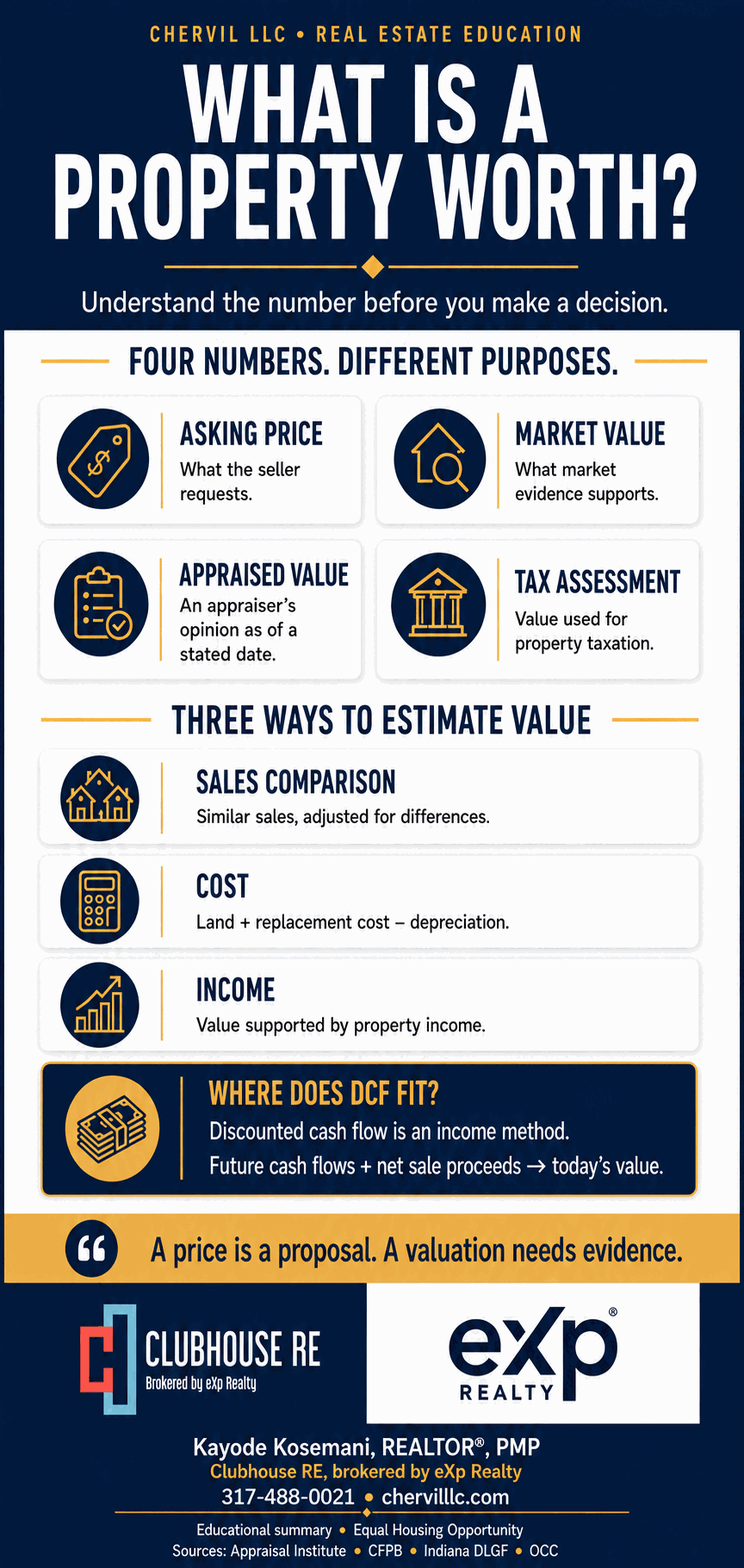
A price is a proposal. A valuation needs evidence.
The scenarios below are original, hypothetical teaching examples. They are not actual comparable sales, appraisals, local rent estimates, recommended investment returns, or current Central Indiana market statistics. Each example stands on its own unless stated otherwise.
Your reading route: Buyers and sellers can start with the four numbers, comparable sales, and appraisal sections. Investors should also work through income and discounted cash flow. Finish with the checklist for your next property conversation.
1. Four numbers that answer different questions
| Number | What it means | How to use it |
|---|---|---|
| Asking price | The amount the seller is requesting. | Treat it as the starting point for a pricing conversation. |
| Market value | The probable price under defined open-market conditions, supported by evidence as of a date. | Ask what comparable transactions and assumptions support the estimate. |
| Appraised value | The appraiser’s opinion of value for the assignment and effective date. | Read the report’s purpose, evidence, assumptions and conditions. |
| Tax assessment | The value established through the property tax assessment system. | Review the assessment record and applicable tax rules; do not use it as an automatic offer price. |
Market value assumes an informed buyer and seller, reasonable market exposure, and a transaction without unusual pressure or financing that distorts the price. An appraisal is one professional way to estimate value; it is not a promise about a future sale. Sources: Fannie Mae—Market Value, CFPB—Appraisals, and Indiana DLGF—Assessment Overview.
Put the opening example into context
The hypothetical $350,000 asking price tells you what the seller wants. The $340,000 appraisal tells you what one appraisal assignment concluded. The $305,000 assessment belongs to the tax system and its valuation date. The online estimate needs its own explanation of data and timing.
Those numbers do not prove that $340,000 is your correct offer. I would first ask: Is the condition accurately described? Are the comparable properties genuinely competitive? Are there repairs, concessions or financing limitations to consider? What does your own budget allow?
Keep affordability separate. Even a well-supported purchase price can be too expensive for your household once taxes, insurance, maintenance and other obligations are included.
2. Start with the property, purpose and date
A useful valuation conversation begins with a precise question: “What interest in this property are we valuing, in what condition, for what purpose, and as of what date?”
For your preparation, collect the address and parcel information, floor plan or measurements, condition notes, renovation records, and any relevant leases. List uncertainties rather than filling them with assumptions. For example: Is the basement finished? Is the garage included in the reported living area? Is the property occupied under a lease? Is an addition documented?
Appraisers investigate property characteristics and select relevant valuation approaches. The scope of a particular assignment determines the work performed; do not assume every valuation includes the same type of physical visit. Source: Appraisal Institute—Interacting With Appraisers.
My suggested habit: Write the valuation date at the top of your notes. “What was it worth last year?” and “What might it sell for now?” are different assignments.
3. Sales comparison: what did similar properties sell for?
The sales comparison approach studies relevant completed sales and accounts for differences from the property being valued. Location, size, condition and features affect comparability. Source: Appraisal Institute.
Adjustments should reflect evidence of buyer behavior, not a fixed dollar amount assigned by habit. Seller concessions and changes in market conditions also require analysis. Source: Fannie Mae—Adjustments to Comparable Sales.
A simple adjustment example
Imagine we are evaluating a home against these three fictional sales. The adjustments below are invented solely to show the arithmetic; they are not recommended adjustment amounts.
| Fictional sale | Sale price | Difference from the subject | Illustrative adjustment | Adjusted indication |
|---|---|---|---|---|
| A | $330,000 | Inferior overall condition | Add $10,000 | $340,000 |
| B | $355,000 | Superior finished space | Subtract $15,000 | $340,000 |
| C | $345,000 | Superior garage feature | Subtract $5,000 | $340,000 |
Adjust the comparable toward the subject. In this illustration, Sale A would need an upward adjustment because it is inferior. Sales B and C would need downward adjustments because they are superior.
I deliberately made all three results equal so the direction is easy to see. Actual results rarely align so neatly. The final conclusion requires weighing the evidence and explaining which sales deserve more weight; it is not automatically a simple average. Source: Fannie Mae—Comparable Sales Adjustments.
Questions I want you to ask
- Why were these sales selected?
- What makes them alternatives a buyer would realistically consider?
- Were the properties in similar condition at the time of sale?
- What supports each adjustment?
- Did financing concessions affect the sale price?
- Does the evidence reflect the valuation date?
Avoid this shortcut: “The neighborhood average is $180 per square foot, so my 2,000-square-foot home must be worth $360,000.” That calculation gives $360,000 mathematically, but the conclusion still needs evidence that the properties are comparable and that the rate is appropriate.
4. Cost approach: what would it cost to replace the improvements?
The cost approach combines land value and the cost of improvements, with a deduction for depreciation. Here, depreciation means loss in value considered in the valuation, rather than a tax-return deduction. Source: Appraisal Institute.
Hypothetical cost example
| Component | Illustrative amount |
|---|---|
| Land value | $70,000 |
| Replacement cost of improvements | $320,000 |
| Less estimated depreciation | −$50,000 |
| Indicated property value | $340,000 |
The calculation is $70,000 + $320,000 − $50,000 = $340,000.
This is a complete simplified model: the $320,000 represents the assumed replacement cost of all improvements included in the example. In a real assignment, ask what costs and improvements were included and how depreciation was supported.
Suppose a seller says, “I spent $40,000 remodeling, so I added $40,000 to the price.” My next question would be: What evidence shows that buyers will pay an additional $40,000? A spending receipt explains the cost. It does not, by itself, establish the market contribution.
Do not substitute an insurance figure without checking its basis. Ask your insurance professional what the rebuilding estimate includes and how coverage is calculated. This guide’s cost example is not an insurance estimate.
5. Income approach: what income supports the value?
For an income-producing property, direct capitalization converts a stabilized annual net operating income into a value indication using a supported capitalization rate. The formula is value = annual NOI ÷ cap rate. Source: OCC—Commercial Real Estate Lending, “Value Analysis,” page 43.
First, work out income after property expenses
Consider a fictional rental with the following annual assumptions:
| Item | Annual amount |
|---|---|
| Scheduled rent: $2,500 × 12 | $30,000 |
| Vacancy and collection allowance: 5% | −$1,500 |
| Effective rental income | $28,500 |
| Property taxes | −$3,000 |
| Insurance | −$1,200 |
| Repairs and routine maintenance | −$1,500 |
| Management | −$2,400 |
| Owner-paid utilities and other operating costs | −$600 |
| NOI before replacement reserves | $19,800 |
| Separately budgeted replacement reserve | −$1,800 |
| Income after replacement reserve, before debt service | $18,000 |
The example includes management even if an owner plans to self-manage, so the economics acknowledge that work. No HOA fee or additional income is assumed. All expenses and allowances require property-specific verification.
NOI excludes loan principal and interest, income taxes and accounting depreciation. Reserve conventions differ: the OCC’s underwriting definition includes replacement reserves. This example deliberately labels its $19,800 as before reserves and shows the reserve separately. Always match the income definition to the cap-rate evidence. Source: OCC—Glossary, “Net operating income,” page 140.
Then apply a consistent rate
Assume, purely for teaching, that 6% is supported for an NOI-before-reserves convention:
$19,800 ÷ 0.06 = $330,000.
The 6% is not a Central Indiana market quote or a promised return. If the cap-rate source uses after-reserve income, this example must be rebuilt on that same basis.
| Hypothetical cap rate, using the same $19,800 | Calculated value |
|---|---|
| 5% | $396,000 |
| 6% | $330,000 |
| 7% | About $282,857 |
This sensitivity exercise changes only the rate. It shows why a casually selected cap rate can create a very different valuation.
Value is not the same as spendable cash
If the example has $15,000 in annual debt service, cash remaining after that payment and the separately budgeted reserve would be:
$19,800 − $1,800 − $15,000 = $3,000 per year, before income taxes and any additional unbudgeted capital costs.
Now stress it: if vacancy and collection losses increase from 5% to 10%, with all other assumptions unchanged, cash remaining falls to $1,500 per year. A further $2,000 unbudgeted expense would take it to negative $500.
I want an investor to understand that operating picture before focusing on a projected sale price.
6. Where discounted cash flow fits
Discounted cash flow—DCF—is a method within the income approach. It converts future property cash flows and expected net sale proceeds into present value. It can be useful when income changes substantially over the holding period. Source: OCC—Value Analysis, page 43.
Direct capitalization uses a representative annual income and cap rate. DCF makes a series of future assumptions explicit: what arrives, when it arrives, and the rate used to bring it back to today. The discount rate must be consistent with the cash flows and the valuation objective. Source: RICS—DCF Valuation.
Start with one future payment
At a hypothetical 10% annual discount rate, receiving $11,000 one year from now has a present value of $10,000:
$11,000 ÷ 1.10 = $10,000.
The arithmetic reverses one year of growth at 10%. It does not claim that 10% is the right return for your property.
A five-year DCF example
This is a separate fictional property. Assume cash arrives at each year-end. The property cash flows below are after assumed operating costs and capital outlays, before financing and income taxes. The year-five net sale proceeds are after selling costs, before any mortgage payoff or income taxes. No separate reserve deduction is made in this model, so capital costs are not counted twice.
Assume a 10% annual discount rate consistent with that simplified cash-flow basis.
| Timing | Assumed future cash received | Present value at 10% |
|---|---|---|
| End of year 1 | $18,000 | $16,364 |
| End of year 2 | $19,000 | $15,702 |
| End of year 3 | $20,000 | $15,026 |
| End of year 4 | $21,000 | $14,343 |
| End of year 5: property cash flow | $22,000 | $13,660 |
| End of year 5: net sale proceeds | $320,000 | $198,695 |
| Total present value | About $273,791 |
Each row is calculated as future cash ÷ (1 + discount rate) raised to the number of years. The total uses unrounded figures, so adding the displayed rounded rows differs by $1.
For example, the net sale proceeds contribute $320,000 ÷ 1.10⁵ = about $198,695 today. Year-five operating cash flow and the sale proceeds are separate receipts in this example; neither includes the other.
The resulting $273,791 is the modeled present value under these assumptions. It is before acquisition costs, and it is not automatically market value or a recommended offer. A market-value analysis needs market-supported assumptions, while a model using your personal return target may measure your investment worth. Source: RICS—Explicit DCF Models.
How sensitive is the answer?
Holding every cash-flow and sale assumption fixed:
| Hypothetical discount rate | Calculated present value |
|---|---|
| 8% | About $297,028 |
| 10% | About $273,791 |
| 12% | About $252,860 |
At 10%, the expected sale contributes about 73% of the total present value. That makes the $320,000 exit assumption especially important. If net sale proceeds fall to $280,000 instead, keeping everything else unchanged, modeled present value falls to about $248,954.
My questions before trusting a DCF: Why does income increase each year? What supports the sale estimate? Where are vacancy, lease rollover and major repairs reflected? Is the discount rate appropriate? What happens if the property sells later or for less?
A detailed spreadsheet can make an assumption look authoritative. Ask for the evidence behind it. RICS likewise emphasizes the importance of assumptions and professional judgment; DCF is not mandatory for every valuation. Sources: RICS—Explicit DCF Models and RICS—DCF Valuation.
7. What an appraisal does—and what to do if it is low
An appraisal communicates an independent opinion of value. In a mortgage transaction, read the report rather than focusing only on the final number. Source: CFPB—What Are Appraisals?.
It is also different from a home inspection, which examines physical condition. An appraisal should not be treated as a substitute for an inspection. Source: CFPB—Schedule a Home Inspection.
Suppose a fictional purchase contract is $350,000 and the appraisal is $340,000. There is a $10,000 difference between those two numbers. That difference alone does not tell you your revised cash-to-close requirement; ask the lender to calculate the actual financing impact.
Possible next steps include reviewing the report for errors, discussing a price adjustment, and evaluating your contract options. The seller does not automatically have to reduce the price, and cancellation rights depend on the agreement. Source: CFPB—When the Appraisal Is Below the Sale Price.
If you spot a material error, ask the lender about its review or reconsideration process. Prepare a short factual explanation and supporting documents. The goal should be a well-supported result, not pressure to reach a preferred number.
8. Indiana tax assessments: another purpose, another process
Indiana’s assessment system uses market value-in-use. Annual adjustments, often called trending, use sales evidence to update assessed values. An assessment is therefore not an arbitrary figure unrelated to the market, but neither is it a live offer or an individual buyer’s budget. Source: Indiana DLGF—Assessment Overview.
An assessed value and a tax bill are also different things. Net assessed value reflects applicable deductions; rates and applicable credits affect the tax calculation. Source: Indiana DLGF—Property Tax Terms.
For your own review, gather the property record card, assessment notice and current tax bill. Check the recorded characteristics and valuation date. Ask the assessor about discrepancies and the applicable review process. Ask the lender or closing professional for a property-specific tax estimate when buying, rather than assuming the seller’s bill will be your bill.
This guide does not quote deduction amounts, assessment-appeal deadlines or tax-cap calculations. Verify the rules for the relevant assessment and tax year before acting.
9. How I suggest using this as a buyer, seller or investor
| Your role | Start with this question | Bring this evidence |
|---|---|---|
| Buyer | Does the evidence support the price, and can I comfortably carry the property? | Comparable sales, condition findings, financing details and a complete housing budget. |
| Seller | What supports my asking strategy, and what would cause me to revise it? | Property details, improvement records, competing homes and relevant sales. |
| Investor | What verified income, expenses and risks support my maximum purchase price? | Leases, rent collection records, operating statements, repair estimates and downside scenarios. |
| Current owner | Am I checking sale value, equity, insurance or an assessment? | The record or report relevant to that specific purpose. |
For Central Indiana, I would begin with properties that genuinely compete with the subject. A sale in another city or county needs an explanation of comparability, not simply a similar price or bedroom count.
This guide does not contain a CMA or a formal appraisal. If you need a pricing discussion, I can help organize the comparable-sale questions. If you need a formal appraisal for a particular purpose, the assignment should go to an appropriately qualified appraiser.
10. Your property-value conversation checklist
Use these questions before relying on any number:
- What is this figure: asking price, market-value estimate, appraisal, assessment, or an investor’s calculation?
- What is the effective date?
- What property interest and condition does it assume?
- Which facts were verified, and what remains uncertain?
- Why were these comparable properties selected?
- What supports adjustments and the weight given to each sale?
- If income is involved, are vacancy and all relevant expenses included?
- Are reserves, capital costs and financing treated consistently?
- What evidence supports the cap rate or discount rate?
- How much does the result depend on a future sale?
- What happens in a realistic downside case?
- Who needs to verify the remaining questions before I act?
You do not need to become an appraiser to make a better decision. You do need to understand what a number represents and why it deserves your confidence.
Talk through your next step
Planning to buy, sell or evaluate an investment in Central Indiana? Bring the property details and the numbers you have received. We can identify the questions that matter and the professional input your situation needs.
Kayode Kosemani, REALTOR®, PMP Clubhouse RE, brokered by eXp Realty 317-488-0021 • kayode.kosemani@exprealty.com Chervil LLC
Educational information only. This resource and its hypothetical examples are not an appraisal, a property-specific valuation, legal or tax advice, a financing commitment, or a guarantee of investment performance. Verify property facts, current requirements and transaction terms with the appropriate professionals. Equal Housing Opportunity.
Sources and review notes
Reviewed September 3, 2026. These sources support the concepts; they did not supply the fictional properties or numerical assumptions. Fannie Mae guidance describes its lending context. OCC guidance is written for bank supervision. RICS provides international valuation guidance, not Indiana law.
- Fannie Mae—Definition of Market Value.
- CFPB—What Are Appraisals and Why Do I Need to Look at Them?.
- Appraisal Institute—Interacting With Appraisers.
- Fannie Mae—Adjustments to Comparable Sales.
- OCC—Commercial Real Estate Lending, Version 2.0, March 2022, with March 2025 revisions noted by OCC; printed pages 43 and 140 for value analysis and NOI.
- RICS—Discounted Cash Flow Valuation.
- RICS—Global Explicit DCF Models for Valuing Real Estate, recorded January 25, 2023.
- CFPB—Schedule a Home Inspection.
- CFPB—My Appraisal Is Less Than the Sale Price.
- Indiana DLGF—Assessment Overview.
- Indiana DLGF—Property Tax Terms.
CONNECT WITH CHERVIL LLC
Have a question about this topic?
Use this resource as a starting point, then contact Chervil LLC when you need guidance connected to your individual circumstances.