
Share this publication
Send this Chervil resource to someone who may find it useful.
A practical guide for self-employed workers, gig earners, investors, landlords, retirees, and households with multiple income streams.
By Kayode Kosemani. Last reviewed: September 7, 2026. Primary focus: federal individual estimated tax for tax year 2026, with an Indiana reminder for state estimated-tax obligations.
The short version
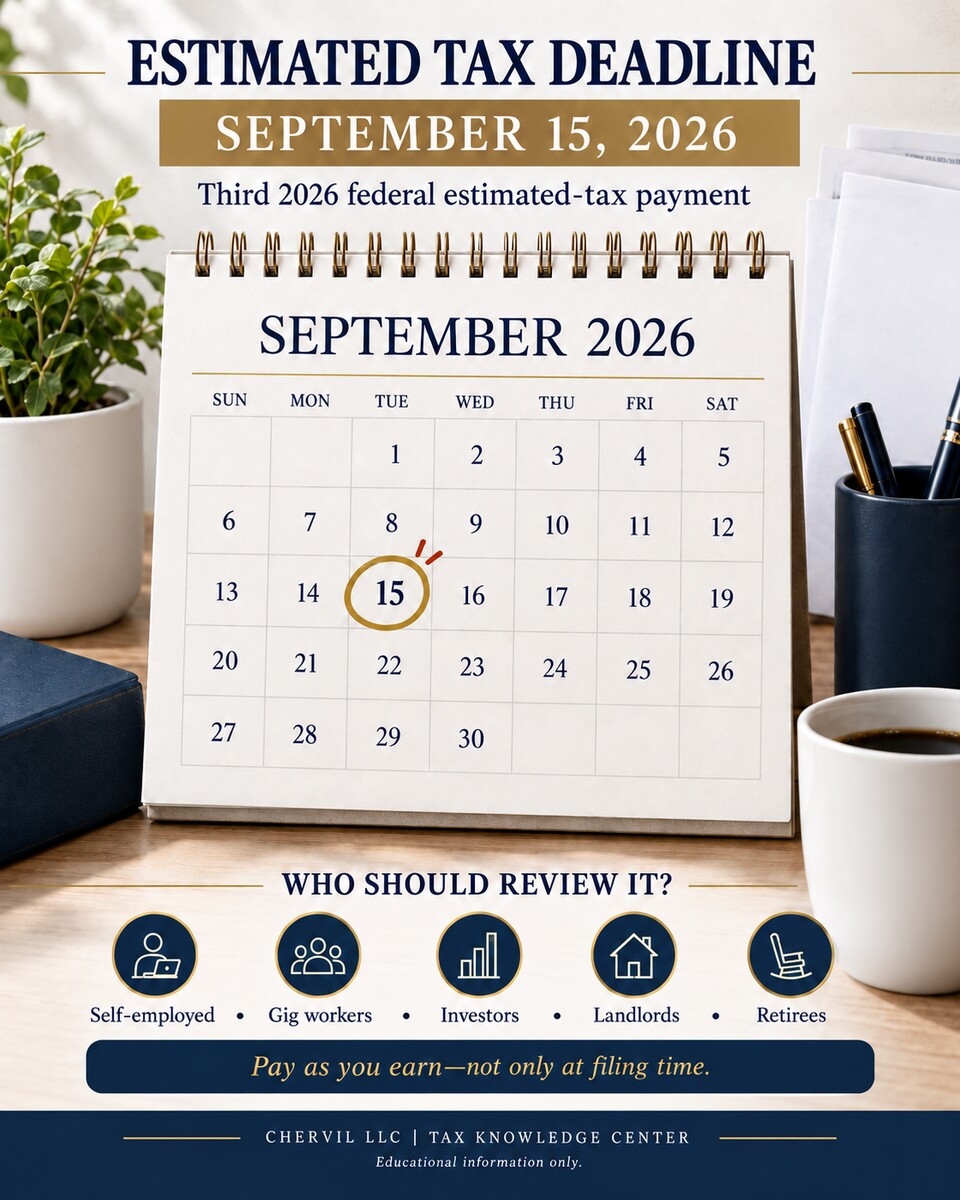
The third federal estimated-tax payment for the 2026 tax year is due Tuesday, September 15, 2026. The payment period associated with this deadline runs from June 1 through August 31, 2026.
This deadline deserves attention if you received income that was not fully covered by federal withholding—for example, self-employment or gig income, rental income, interest, dividends, capital gains, taxable retirement distributions, royalties, or other taxable income.
Having income without withholding does not automatically mean that a separate estimated-tax payment is required. The decision depends on your projected full-year tax, expected withholding and refundable credits, prior-year tax, and any payments already made.
Chervil takeaway: Estimated tax is part of the federal pay-as-you-go system. The goal is to pay enough during the year—not merely to settle the balance when the return is filed.
Who should review the September deadline?
You should make a fresh calculation before September 15 if any of the following occurred during 2026:
- You earned net income from a sole proprietorship, freelance work, consulting, contract work, or app-based gig work.
- You collected rental income that was not offset by deductible rental expenses.
- You realized taxable gains from stocks, funds, cryptocurrency, real estate, or other investments.
- You received significant interest, dividends, royalties, prizes, or other taxable income.
- You took a taxable pension, IRA, or 401(k) distribution with little or no federal withholding.
- You have W-2 wages but also earn substantial side income.
- Your income rose, your deductions or credits fell, or your filing situation changed after your earlier 2026 estimates were prepared.
The tax result is based on the character and taxable amount of the income. For example, an investor generally reviews the gain, not simply the gross sale proceeds. A business owner generally estimates tax using net business profit after eligible expenses, not gross deposits alone.
The federal test: when estimated payments are generally required
Under the general rule in the 2026 Form 1040-ES instructions, an individual generally must make estimated-tax payments when both of these conditions apply:
- The individual expects to owe at least $1,000 for 2026 after subtracting federal income-tax withholding and refundable credits; and
- Expected withholding and refundable credits are less than the smaller of:
- 90% of the tax shown on the 2026 return, or
- 100% of the tax shown on the 2025 return, provided the 2025 return covered a full 12-month year.
There is also a prior-year exception. A person generally does not have to pay 2026 estimated tax if the person was a U.S. citizen or resident alien for all of 2025, had no 2025 tax liability, and the 2025 tax year covered 12 months.
These rules are more precise than simply asking, “Will I owe $1,000?” The withholding-and-credit comparison must also be completed.
Understanding the 90%, 100%, and 110% safe-harbor rules
A safe harbor can protect a taxpayer from the federal estimated-tax underpayment penalty even when the final return still shows a balance due.
For many taxpayers, the required annual payment is based on the smaller of:
- 90% of the current-year tax; or
- 100% of the prior-year tax.
For a higher-income taxpayer whose 2025 adjusted gross income exceeded $150,000, or $75,000 if married filing separately for 2026, the prior-year percentage generally rises from 100% to 110%. Special rules apply to farmers and fishers.
A simple example
Assume a taxpayer’s 2025 return showed $8,000 of total tax, the return covered 12 months, and the higher-income 110% rule does not apply. If the prior-year safe harbor is the smaller applicable target, the annual safe-harbor amount would be $8,000 before accounting for 2026 withholding and refundable credits.
If that amount were being paid through four equal estimated-tax installments, the ordinary schedule would be:
| Due date | Installment | Cumulative target |
|---|---|---|
| April 15, 2026 | $2,000 | $2,000 |
| June 15, 2026 | $2,000 | $4,000 |
| September 15, 2026 | $2,000 | $6,000 |
| January 15, 2027 | $2,000 | $8,000 |
This illustration assumes no withholding, refundable credits, prior-year overpayment applied to 2026, or special calculation. Reaching the $8,000 safe harbor would not erase any additional 2026 tax. It would generally address the underpayment-penalty target; the remaining balance would still be due with the return.
Why a refund does not always eliminate an underpayment penalty
Estimated-tax compliance is measured by payment period, not only by the final balance on the annual return. The IRS explains that a taxpayer may face an underpayment penalty for failing to pay enough by an installment deadline even if the completed return later shows a refund.
This can happen when payments were made too late or were not aligned with the required installments. Catching up in September may reduce further exposure, but it does not automatically remove an underpayment that already occurred for an earlier period.
The IRS’s underpayment rate is set quarterly. For the third calendar quarter of 2026, the rate applicable to individual underpayments is 7% per year, compounded daily. The actual addition to tax depends on the amount and length of the underpayment; it is not a flat 7% charge on the entire annual tax bill. See the IRS quarterly interest-rate table.
When income arrives unevenly
Four equal installments are not always the best representation of a taxpayer’s year. A seasonal business may earn most of its profit in the summer. An investor may realize a large gain in July. A landlord may begin receiving rent halfway through the year.
In these situations, the annualized income installment method may reduce or eliminate a penalty by matching required payments more closely to when income was earned. The method requires careful period-by-period calculations. A taxpayer who uses it generally files Form 2210, including Schedule AI, with the 2026 return even when no penalty is due.
Do not assume that adding up receipts from June through August produces the correct payment. The calculation can also involve deductions, credits, self-employment tax, capital-gain rates, withholding, and payments made for earlier periods. The 2026 Form 1040-ES worksheet and IRS Publication 505 are the starting points.
A practical September review
Before making the third payment, review the following:
- Project full-year income. Include wages, net business profit, net rental income, taxable retirement income, interest, dividends, capital gains, and other taxable income.
- Update deductions and credits. Use reasonable, supportable full-year estimates.
- Estimate total federal tax. Remember that estimated tax may cover income tax, self-employment tax, alternative minimum tax, and certain other taxes.
- Enter expected withholding and refundable credits. Include amounts already withheld and amounts reasonably expected through year-end.
- Compare the current-year and prior-year safe harbors. Apply the 110% prior-year rule when required.
- Reconcile prior payments. Confirm the amounts and dates of all 2026 estimated payments and any 2025 overpayment applied forward.
- Consider annualization. Use it when income is materially uneven rather than forcing the facts into four equal installments.
- Check state and local requirements separately. A federal payment does not satisfy an Indiana or other state obligation.
If a taxpayer also receives wages, increasing federal withholding by submitting a new Form W-4 may be an alternative to separate estimated payments. Pension and certain retirement-payment withholding may be adjusted using the applicable IRS withholding form. The best choice depends on the taxpayer’s timing and cash flow.
How to make the federal payment
The IRS currently offers several methods:
- IRS Direct Pay: Pay from a checking or savings account without a fee. Direct Pay provides payment confirmation and allows advance scheduling.
- IRS Individual Online Account: Make or schedule an estimated-tax payment and review payment history.
- Debit card, credit card, or digital wallet: Available through IRS-authorized processors; processing fees generally apply.
- IRS2Go mobile app or phone payment: Available options depend on the payment method selected.
- EFTPS: Existing individual users may continue to use the Electronic Federal Tax Payment System. The IRS states that new EFTPS enrollment is no longer available to individual taxpayers, who should generally use an IRS Online Account or Direct Pay.
- Mail: Send a check or money order with the appropriate 2026 Form 1040-ES voucher to the current address listed for your location.
Start from the IRS Payments page rather than a payment link received by email or text.
Important 2026 mailing caution
The screenshots that inspired this publication stated that a mailed check arriving after September 15 would be late regardless of the postmark. That statement is not correct.
The 2026 Form 1040-ES instructions say that when a mailed payment is postmarked by the due date, the U.S. postmark date is treated as the payment date. However, the instructions also warn that under updated USPS practices, the postmark can reflect the date the item is processed—not necessarily the date it was placed in a mailbox or handed over at a postal location.
Electronic payment is the clearest way to obtain a timely confirmation. Anyone mailing near the deadline should consider presenting the envelope at a postal counter and obtaining a dated postmark and proof of mailing. The envelope must also be properly addressed and carry sufficient postage.
Can the penalty be reduced or waived?
Relief is limited and fact-specific. According to the IRS underpayment-penalty guidance, relief may be available when:
- An underpayment resulted from a casualty, disaster, or other unusual circumstance and imposing the penalty would be inequitable;
- The taxpayer retired after reaching age 62 or became disabled during the tax year or the preceding year, and the underpayment resulted from reasonable cause rather than willful neglect; or
- Income varied during the year and the annualized income installment method supports a lower required payment for one or more periods.
Retirement after age 62 or disability does not create an automatic waiver. The taxpayer must meet the stated conditions and follow the Form 2210 procedures. Farmers and fishers also have separate estimated-tax rules and should not rely on the general installment schedule without reviewing those rules.
Indiana taxpayers: do not overlook the state payment
Indiana has its own estimated-tax system and the ordinary third installment is also due September 15. Indiana residents may need to account for both state and county income tax.
The Indiana Department of Revenue says Schedule IT-2210 or IT-2210A should be reviewed when the amount owed after credits is $1,000 or more or when a minimum installment was underpaid, including situations in which the return ultimately shows a refund. Indiana also provides an annualized-income method for uneven income.
Payments can be made through INTIME, including a no-fee bank payment option, or by mail using the applicable voucher and current instructions. Federal and Indiana payments are separate transactions.
Final reminder
The right September payment is not necessarily one-fourth of a rough annual guess. It should be based on a current projection, the safe-harbor rules, actual withholding and prior payments, and the timing of income.
If 2026 has included a new side business, a large investment sale, rental income, a retirement distribution, or another major change, this is the moment to recalculate—not next April.
Need help reviewing your estimate?
Chervil LLC can help you organize your year-to-date information, review the federal and Indiana estimated-tax rules, and prepare a supportable payment calculation based on your facts.
Contact: sayhi2ky@chervilllc.com
Sources and review notes
This publication was independently written and fact-checked using current official guidance. Key sources reviewed:
- IRS — 2026 Form 1040-ES, Estimated Tax for Individuals
- IRS — Estimated Taxes
- IRS — Publication 505, Tax Withholding and Estimated Tax (2026)
- IRS — Underpayment of Estimated Tax by Individuals Penalty
- IRS — Quarterly Interest Rates
- IRS — Payment Options
- IRS — Electronic Federal Tax Payment System
- Indiana Department of Revenue — Estimated Payments
- Indiana Department of Revenue — Payments and Billing
Next scheduled review: January 2027, or earlier if the IRS or Indiana Department of Revenue publishes a material update.
Educational-use disclaimer
This material is for general educational and informational purposes only. It is not individualized tax, legal, accounting, or financial advice and does not create a preparer-client relationship. Tax outcomes depend on each taxpayer’s complete facts, filing status, income, deductions, credits, jurisdiction, prior payments, and current law. Verify requirements with the IRS, the applicable state or local tax agency, and a qualified professional before acting.
CONNECT WITH CHERVIL LLC
Have a question about this topic?
Use this resource as a starting point, then contact Chervil LLC when you need guidance connected to your individual circumstances.