Share this publication
Send this Chervil resource to someone who may find it useful.
Buying a home is not only about finding a property. A buyer also has to qualify for financing, understand the cash required at closing, and choose a program that still makes sense years after the keys are delivered.
Indiana buyers may have access to statewide assistance, local grants or loans, matched savings, lender-based programs, and mortgage options that reduce the amount required upfront. But “down payment assistance” is not one single program—and it is not always free money. Some assistance is a repayable second mortgage. Some is limited to a city or county. Some funding opens and closes during the year. Some options help with closing costs but come with a different interest rate, lien, occupancy rule, or repayment trigger.
This guide explains the major verified resources available to Indiana homebuyers and the structured process Chervil LLC uses to help a buyer become ready to apply. It is a statewide starting point, not a promise that every program will be available for every address or buyer.
Ready to find out which paths may fit?
Start your Chervil Homebuyer Readiness & Down Payment Assistance Review. Complete the real-estate contact form and select Real Estate as the service. We will help organize your next steps and connect you with appropriate participating lenders or housing counselors. Submitting the form is not a loan application and does not guarantee program eligibility, funding, financing, or a home purchase.
First, understand what down payment assistance is
Down payment assistance, often shortened to DPA, can help cover some combination of a buyer’s down payment, closing costs, and eligible prepaid expenses. Depending on the program, the assistance may be:
- a repayable second mortgage that remains due when the home is sold, refinanced, no longer owner-occupied, or the loan reaches maturity;
- a forgivable or deferred loan, subject to occupancy and time requirements;
- a grant that generally does not require repayment when all program rules are met;
- a matched-savings benefit, earned after the buyer saves and completes counseling; or
- a feature offered through a participating bank, credit union, housing agency, employer, or local government.
The amount displayed in an advertisement is not necessarily the amount a buyer will receive. The final benefit can depend on household income, household size, location, purchase price, loan type, available funding, and the buyer’s documented need.
Indiana’s statewide homebuyer programs
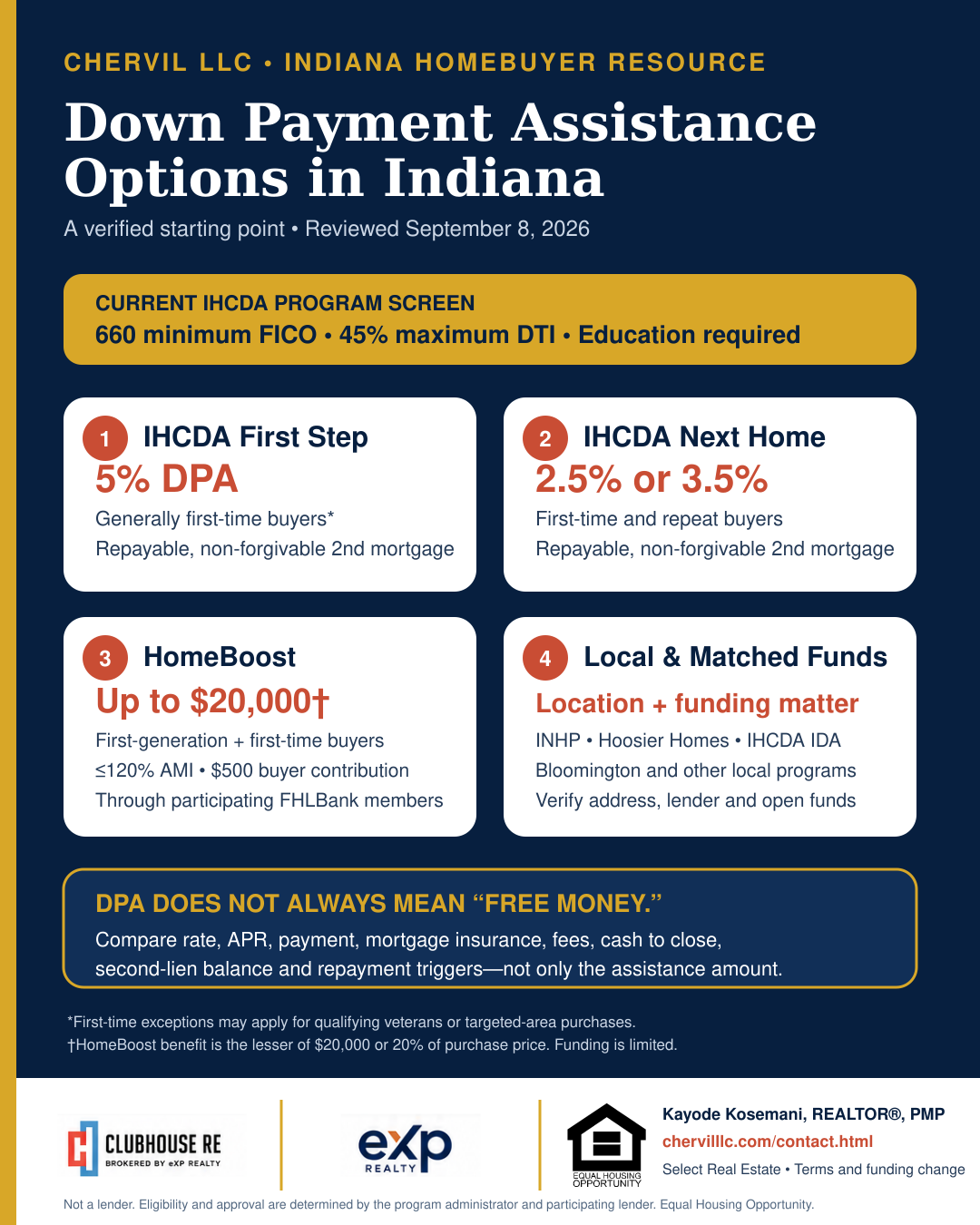
The Indiana Housing and Community Development Authority (IHCDA) currently lists purchase programs available through participating lenders in all 92 Indiana counties. Buyers do not apply directly to IHCDA; the first-mortgage lender originates the loan and reserves the program.
| Program | Current assistance | Who it is designed for | Important features |
|---|---|---|---|
| First Step | 5% of the purchase price | Generally first-time buyers; qualifying veterans and eligible targeted-area purchases may be exempt from the first-time rule | 30-year fixed FHA, Fannie Mae, or Freddie Mac first mortgage; assistance is a non-forgivable second mortgage |
| Step Down | No DPA | Same first-time-buyer framework and exemptions as First Step | Reduced-rate first-mortgage option; useful as a comparison when assistance is not the lowest-cost choice |
| Next Home | 2.5% or 3.5% of the purchase price | First-time and repeat buyers | 30-year fixed FHA or conventional first mortgage; assistance is a non-forgivable second mortgage |
| Next Step | Not a purchase-assistance program | Eligible existing borrowers refinancing | Included on IHCDA’s current matrix, but it is not a home-purchase DPA option |
Under IHCDA’s July 2026 lender matrix, the current purchase-program screen includes a minimum FICO score of 660, a maximum debt-to-income ratio of 45%, homebuyer education, and a 30-year fixed-rate first mortgage. A lender may impose stricter underwriting standards, and an automated underwriting system can approve less than the published maximum.
IHCDA’s Universal Program Guide states that its DPA is a non-forgivable second mortgage. It generally becomes due upon the earliest of events such as sale, refinance, ceasing to use the home as the primary residence, certain additional liens, default, or the end of the mortgage term. The balance is not automatically prorated away over time. Buyers should read the note and mortgage before closing.
Key IHCDA rules to know
- The home must be in Indiana and used as the buyer’s primary residence. Occupancy is generally required within 60 days.
- Eligible properties may include qualifying single-family homes, townhomes, approved condominiums, planned-unit developments, and qualifying permanently affixed double-wide manufactured homes.
- Income and, for some products, acquisition-cost limits apply. Limits differ by county, household size, loan type, and targeted-area status.
- A “first-time homebuyer” generally means a buyer who has not had a present ownership interest in a principal residence during the prior three years. The program guide describes exceptions for qualified veterans and purchases in federally designated targeted areas.
- Buyers must work with an IHCDA participating lender.
- The lender reserves the program after an accepted purchase contract. IHCDA locks are currently 60 days, and the reservation fee is currently $250 and nonrefundable.
- Assistance cannot create unrestricted cash back at closing. Other assistance may sometimes be layered when the lender, lien positions, underwriting system, insurer, and program rules all allow it.
The current IHCDA income and purchase-price tables became effective in May 2026. For example, the regular First Step, Step Down, and Next Home FHA income limits for Hamilton, Hendricks, Boone, Johnson, Morgan, and Marion counties are presently $110,300 for a one- or two-person household and $126,845 for a household of three or more, with a regular-area acquisition-cost limit of $566,355. Targeted census tracts can have different limits. For current figures, use IHCDA’s official FHA/bond-program limits, conventional-program limits, and targeted-area lookup.
Important tax note: First Step and Step Down are mortgage-revenue-bond programs and may expose some borrowers to federal recapture tax if the home is sold within nine years, at a gain, and the borrower’s income exceeds the applicable threshold. Not every sale triggers it. A buyer considering a bond program should review the IHCDA notice and consult a qualified tax professional about their facts.
Other verified assistance paths in Indiana
Statewide programs are only part of the picture. These resources may fit certain buyers, locations, or funding cycles.
FHLBank Indianapolis programs through member institutions
FHLBank Indianapolis does not work directly with buyers. Its assistance is delivered through participating member financial institutions, and funds are limited.
- HomeBoost: The 2026 guidelines provide up to the lesser of $20,000 or 20% of the purchase price for qualifying first-generation, first-time buyers at or below 120% of area median income purchasing an Indiana or Michigan primary residence. A $500 buyer contribution and homebuyer education are required. Availability must be confirmed with a participating member.
- Launch: This annual program can provide up to $20,000 for qualifying first-time buyers at or below 80% of area median income, through a member institution. The 2026 allocation is listed as exhausted, illustrating why buyers must verify funding before relying on an assistance amount in an offer. See the official Launch page.
IHCDA Individual Development Account
Indiana’s Individual Development Account is a limited-availability matched-savings program administered through local organizations. Qualifying participants may receive up to $4,500 in state match, at a minimum 3-to-1 match, after meeting program requirements that include financial education. Funds may be used toward an Indiana primary residence. This is a planning tool, not usually a last-minute closing solution.
Indianapolis Neighborhood Housing Partnership
INHP serves eligible buyers using an INHP mortgage, subject to income certification, underwriting, property requirements, and available funding. Its current page states that eligible clients may receive thousands of dollars in assistance but does not publish a fixed benefit amount in the program text; buyers should obtain the current figure directly from INHP. INHP also offers HUD-certified advising and an individual development account with matched savings. This can be particularly useful for Marion County buyers who need a longer preparation runway.
Hoosier Homes
The Fort Wayne Housing Authority’s Hoosier Homes program advertises up to 5% assistance for down payment and closing costs through participating lenders. It serves first-time and repeat buyers in a defined group of approved counties, including Marion, Allen, Lake, Porter, Vigo, Montgomery, and others. The current published minimum credit score is 640, but lender overlays, income limits, purchase-price limits, property rules, and available funding still apply.
City and county programs
Local assistance can be valuable, but it changes frequently with annual appropriations and federal grant cycles. Verified examples include:
- Bloomington HAND, which currently describes assistance of up to $10,000 for eligible first-time buyers and connects preparation to its Home Buyers Club;
- South Bend neighborhood housing resources, which direct buyers to local homeownership and assistance partners;
- Lake County Community Economic Development, which lists homebuyer and down-payment assistance resources; and
- local housing authorities and nonprofit partners that may periodically offer HOME, CDBG, or other funds.
These examples are not a promise of open funding. For every buyer, Chervil’s review should check the property address, city and county, current application window, approved lender or administrator, and whether the funds can be combined with the selected mortgage.
Low-down-payment and no-down-payment mortgages
These are not grants, but they can reduce the amount a qualified buyer needs upfront:
- A USDA guaranteed loan may offer 100% financing for an income-eligible buyer purchasing an eligible rural-area home through an approved lender.
- A USDA direct loan may help qualifying low- and very-low-income rural buyers, subject to funding and agency requirements.
- An eligible veteran, service member, or surviving spouse may obtain a VA purchase loan with no down payment when the purchase price does not exceed the appraised value, subject to entitlement, lender approval, funding-fee rules, and occupancy.
- An FHA-insured loan can allow a 3.5% down payment for a qualifying borrower. FHA is mortgage insurance, not DPA.
- A public housing agency may elect to operate the Housing Choice Voucher Homeownership option. Availability and eligibility are local.
The Chervil Homeowner-Ready Pathway
Chervil LLC is not a lender and does not underwrite or approve assistance. Our role is to help the buyer understand the path, organize a strong file, make informed comparisons, and coordinate the real-estate steps with the buyer’s chosen lender and housing professionals.
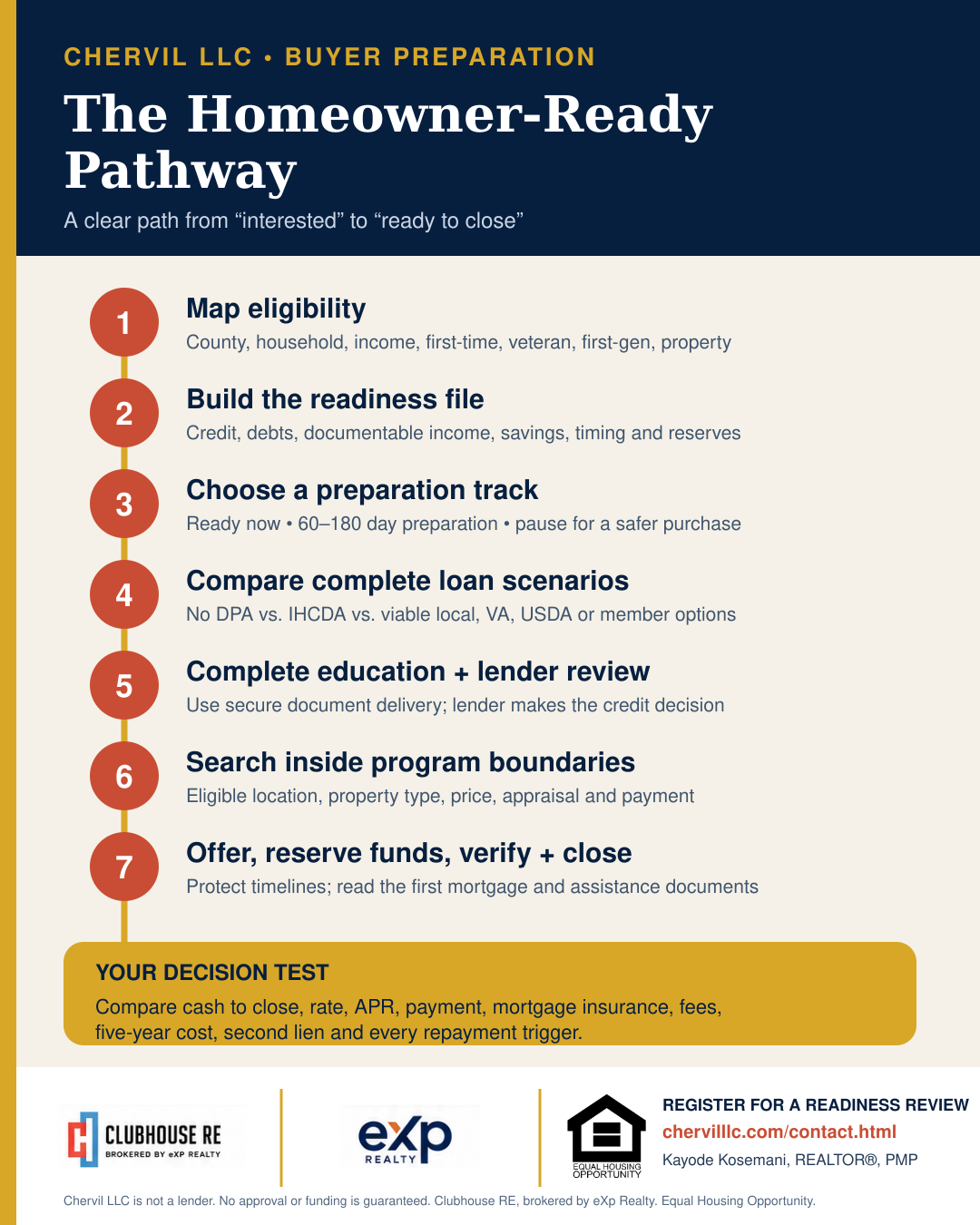
1. Build the buyer’s eligibility map
We begin with the facts that change program eligibility: intended county and city, household size, estimated household income, current housing status, first-time-buyer history, veteran status, first-generation status, voucher participation, estimated purchase price, and preferred property type.
This is a screening conversation—not an approval. We do not ask a buyer to send Social Security numbers, bank passwords, or unredacted sensitive documents through ordinary email.
2. Establish the readiness baseline
With the buyer’s permission, we create a working checklist covering credit, recurring monthly debts, stable and documentable income, funds available, employment or self-employment documentation, and expected timing.
For current IHCDA purchase programs, 660 is the published minimum FICO score and 45% is the maximum DTI. Those are program ceilings and floors, not goals or guarantees. A stronger credit profile, lower debt ratio, and additional reserves can improve the buyer’s options and resilience.
The buyer should also plan separately for costs that assistance may not cover, including earnest money, inspection, appraisal, moving expenses, immediate repairs, utility deposits, and post-closing reserves.
3. Choose the right preparation track
A buyer may be:
- Ready for lender review now;
- Close, but better served by a 60- to 180-day preparation period; or
- Not yet positioned for a safe purchase.
Preparation may include correcting documented credit-report errors, building a record of on-time payments, lowering revolving balances, avoiding new debt, documenting income, creating a savings plan, or working with a HUD-approved counselor. No ethical professional should promise a specific credit-score increase or guaranteed approval.
4. Compare lenders and program scenarios
The buyer selects the lender. When a program requires a participating lender, we help the buyer locate eligible options without limiting the buyer’s right to shop.
At minimum, compare:
- a standard mortgage without DPA;
- an applicable IHCDA option; and
- any viable local, FHLBank-member, USDA, VA, or other specialized option.
Do not compare only the assistance amount. Compare the interest rate, APR, monthly principal and interest, mortgage insurance, lender fees, cash to close, second-lien balance, repayment triggers, prepayment restrictions, and estimated five-year cost. The Consumer Financial Protection Bureau provides tools to review and compare Loan Estimates.
5. Complete education and lender qualification
The buyer completes the education or counseling required by the selected program, submits documents through the lender’s secure process, and receives a qualification or preapproval based on verified information. Program education should happen early enough to influence the decision—not merely as a closing condition.
6. Search within the approved boundaries
Once the lender confirms the working budget and program rules, the home search should respect the approved property types, geography, purchase-price ceiling, appraisal requirements, and realistic monthly-payment comfort zone. An attractive property is not a workable purchase if it causes the buyer to lose the selected assistance.
7. Write the offer and protect the timeline
The offer strategy should account for financing, appraisal, inspection, earnest money, any lender-approved seller credit, and the program timeline. Seller credits do not replace the need for lender approval and cannot create prohibited cash back.
For IHCDA, the lender can reserve the program after the buyer has an executed purchase agreement. Current locks run 60 days, so contract and closing dates matter.
8. Verify again before closing
Before signing, the buyer should know:
- the exact assistance amount and where it appears on the Closing Disclosure;
- whether the assistance is a grant, deferred loan, forgivable loan, or repayable second mortgage;
- the interest rate and payment on the first mortgage;
- every event that can trigger repayment;
- occupancy and resale requirements;
- whether a refinance or home-equity loan would require payoff; and
- whom to contact after closing.
The final decision should be based on the written loan documents—not a social-media post, old flyer, or verbal estimate.
Questions every buyer should ask
- Is this assistance a grant or a recorded second mortgage?
- Is any portion forgiven over time? If so, on what schedule?
- What causes repayment, and is the payoff amount reduced over time?
- Does the DPA mortgage have interest or monthly payments?
- Is the first-mortgage rate different because I am using assistance?
- Are there reservation, origination, counseling, or other program fees?
- What happens if I sell, refinance, move out, rent the home, or obtain a home-equity loan?
- Can this program be combined with another grant, seller credit, or gift?
- Is funding actually reserved for me, and when does the reservation expire?
- What is my total cash to close and estimated five-year borrowing cost with and without DPA?
Common mistakes to avoid
- Treating the maximum advertised assistance as guaranteed cash.
- Using an outdated article for a discontinued program. For example, IHCDA’s former First Place program ended in 2023, and older Indiana pages may still mention programs that are not on the current lineup.
- Shopping for homes before confirming the county, property, price, and lender are eligible.
- Assuming “first-time buyer” always means never owning a home.
- Opening a new account, financing furniture, changing jobs, or moving money without first speaking with the lender.
- Spending every available dollar at closing and keeping no reserve for ownership.
- Choosing the largest assistance amount without comparing rate, payment, mortgage insurance, and second-lien consequences.
- Sending sensitive financial information through an insecure channel.
Start with a readiness review
Start your Chervil Homebuyer Readiness & Down Payment Assistance Review. Complete the contact form and select Real Estate.
Chervil will help you:
- identify programs that may match your location and household profile;
- build a preparation checklist;
- understand which questions to take to lenders and counselors;
- compare assistance with non-assistance financing; and
- align the home search and offer strategy with verified program rules.
Contact Kayode Kosemani, REALTOR®, PMP kayode.kosemani@exprealty.com Real Estate Contact Form
Consumer and real-estate disclosures
Educational information only. This publication is not legal, tax, lending, credit-repair, or financial advice and does not establish an agency relationship or offer mortgage credit. Chervil LLC and Kayode Kosemani are not lenders and do not approve or guarantee financing, credit improvement, program eligibility, funds, rates, terms, or closing.
Program terms, interest rates, income limits, purchase-price limits, geographic coverage, lender participation, and funding availability may change without notice. Eligibility and final approval are determined by the program administrator, participating lender, insurer, investor, and applicable underwriting requirements. Verify current written terms before making an offer or financial commitment. Buyers may choose their own qualified service providers, subject to program participation requirements. Chervil LLC is not affiliated with or endorsed by IHCDA, FHLBank Indianapolis, HUD, USDA, VA, or any local program administrator identified in this guide.
Real estate brokerage services are provided through Clubhouse RE, brokered by eXp Realty. Equal Housing Opportunity. Chervil LLC and its real-estate affiliates support the Fair Housing Act and do not discriminate based on race, color, national origin, religion, sex, familial status, disability, or any other characteristic protected by applicable federal, state, or local law.
Official sources and verification links
- IHCDA Homebuyer Programs
- IHCDA Universal Program Guide — revised February 2026
- IHCDA STEPS Lender Matrix — July 2026
- IHCDA Participating Lenders
- IHCDA Individual Development Accounts
- FHLBank Indianapolis HomeBoost
- FHLBank Indianapolis Launch
- Indianapolis Neighborhood Housing Partnership
- Fort Wayne Housing Authority — Hoosier Homes
- HUD-approved housing counselor search
- CFPB Loan Estimate comparison guide
Editorial scope: Indiana has no single live registry containing every municipal, nonprofit, employer, bank, and credit-union offer. This publication covers the principal statewide programs and representative verified regional resources available on the review date. A buyer-specific review should include a fresh search using the exact property location and participating lender.
CONNECT WITH CHERVIL LLC
Start with a Chervil homebuyer readiness review
Tell us where you are in the buying process. The Real Estate contact form is already selected, and no loan approval or funding is promised.