
Share this publication
Send this Chervil resource to someone who may find it useful.
A new tax deduction may change what you owe for the year without automatically changing what comes out of each paycheck. That difference could affect your take-home pay, refund or balance due.
By Kayode Kosemani. Last reviewed: September 8, 2026. Primary focus: federal individual income-tax withholding for tax year 2026.
The short version
The IRS is encouraging workers to review their federal income tax withholding during National Payroll Week, September 7–11, 2026. This year’s checkup is especially relevant for people whose tax situation has changed because of qualified overtime, qualified tips, a second job, marriage, divorce, a new child or another major income or family change.
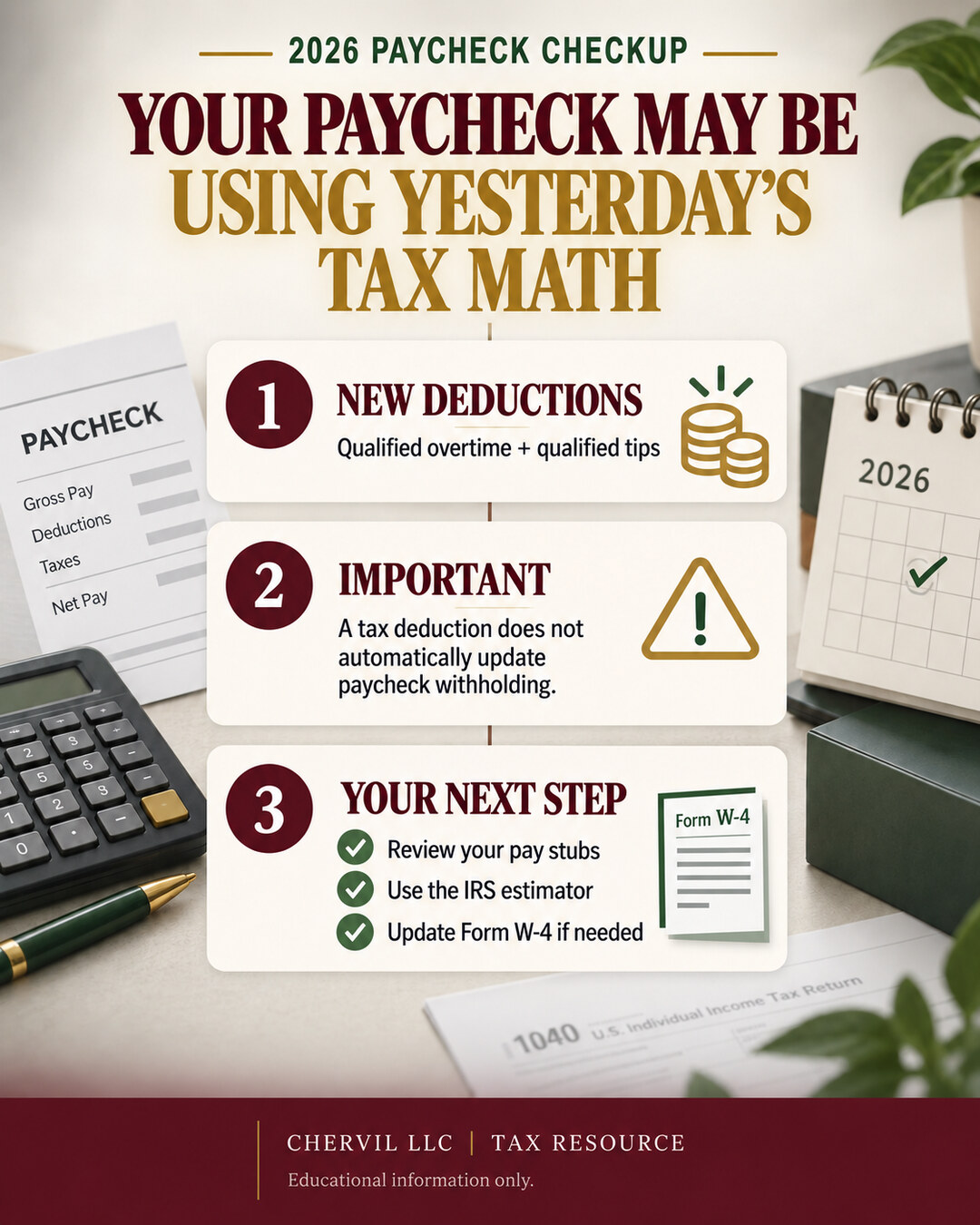
The key point is simple: a deduction on your tax return does not automatically rewrite the Form W-4 already on file with your employer. If your current withholding no longer matches your expected 2026 tax, you may need to submit an updated Form W-4.
“No tax on overtime” does not mean all overtime pay is tax-free
The phrase “no tax on overtime” can create the wrong impression. The federal provision is a deduction for qualified overtime compensation, not an exclusion for every dollar earned during overtime hours.
For an employee paid time-and-a-half under the Fair Labor Standards Act, the qualifying amount is generally the extra one-half portion above the regular rate—not the full overtime payment. The annual deduction is limited to $12,500 per return, or $25,000 for a married couple filing jointly, and it begins to phase out when modified adjusted gross income exceeds $150,000, or $300,000 for joint filers. Other eligibility requirements also apply.
That means two employees who both work overtime may not receive the same deduction. Eligibility depends on how the overtime was earned, whether it was required under the FLSA, income level, filing status and other facts.
Why your paycheck may not reflect the new deductions
Payroll departments calculate federal income tax withholding from the information employees provide on Form W-4 and the applicable IRS withholding rules. A new deduction can reduce projected annual income tax, but an employer generally cannot assume that every worker qualifies or determine the worker’s full household tax picture.
The 2026 Form W-4 allows a worker to account for expected deductions—including qualified tips and qualified overtime—through the deductions worksheet and Step 4(b). The IRS Tax Withholding Estimator has also been updated to consider these and other recent tax-law changes.
Do not reduce withholding simply because a headline says you qualify. A W-4 adjustment should be based on a reasonable estimate that considers the entire return.
A practical paycheck checkup
Before using the IRS estimator, gather:
- A recent pay stub for each job
- Year-to-date wages and federal income tax withheld
- Your spouse’s income and withholding if you expect to file jointly
- Expected qualified overtime or qualified tip income
- Other income, deductions and tax credits you expect for 2026
- Your most recent federal tax return for reference
Then use the IRS Tax Withholding Estimator to compare projected withholding with projected federal income tax. If the estimator recommends a change, it can help prepare a Form W-4 to submit to your employer or payroll department.
What can happen if the numbers are off?
If too little federal income tax is withheld, you may face a balance due and, in some cases, an underpayment penalty. If too much is withheld, your take-home pay may be smaller than necessary and you generally must wait until filing your return to recover the excess as a refund.
The goal is not automatically to produce the largest paycheck or the largest refund. The goal is to bring withholding reasonably close to the tax you expect to owe, based on accurate information and your preferred level of cushion.
Who should take a closer look now?
A 2026 withholding review may be especially useful if you:
- Earn qualified overtime or qualified tips
- Started a new job or added a second job
- Have a spouse who also works
- Had a significant increase or decrease in income
- Married, divorced or separated
- Welcomed a child through birth or adoption
- Bought a home
- Expect materially different deductions or credits
- Received a large refund or owed an unexpected balance last filing season
One more step: revisit the change for 2027
A W-4 adjustment made late in 2026 is designed around the pay periods remaining in this year. The IRS advises workers who make a midyear change to review their withholding again and, when appropriate, submit a new Form W-4 in January. Leaving a late-year adjustment unchanged could produce the wrong result over a full calendar year.
Chervil’s takeaway
New deductions can be valuable, but the slogan and the paycheck are not the same thing. Review your actual numbers, use the current IRS tools and make a W-4 change only after considering your complete tax situation. A short checkup now may help prevent an unpleasant surprise when you file.
Sources and review notes
This publication was independently written and fact-checked using current official IRS guidance. Key sources reviewed:
- IRS: National Payroll Week is time for a paycheck checkup
- IRS Tax Withholding Estimator
- 2026 Form W-4
- IRS FAQs on the qualified overtime deduction
- IRS Publication 505: Tax Withholding and Estimated Tax
Next scheduled review: January 2027, or earlier if the IRS publishes a material update.
Educational-use disclaimer
This material is for general educational and informational purposes only. It is not individualized tax, legal, accounting, or financial advice and does not create a preparer-client relationship. Tax outcomes depend on each taxpayer’s complete facts, filing status, income, deductions, credits, jurisdiction, prior payments, withholding, and current law. Verify requirements with the IRS, the applicable state or local tax agency, and a qualified professional before acting.
CONNECT WITH CHERVIL LLC
Would you like help reviewing your 2026 withholding?
Chervil LLC can help you organize your year-to-date information and review how the federal withholding rules may apply to your circumstances.