
Share this publication
Send this Chervil resource to someone who may find it useful.
Indiana is often described as the Crossroads of America, but its appeal is about more than geography. The state combines major employment centers, established suburbs, university communities, manufacturing corridors, farmland, small towns, lakefront communities and growing regional markets. For people already living here, that variety creates options. For someone considering relocation or investment, it means Indiana should be studied as a collection of distinct local markets—not as one uniform place.
This statewide edition of the Indiana Living Report provides a starting point. It examines Indiana’s population, housing market, cost environment, employment base, transportation network, public-safety considerations and quality of life. It also explains what buyers and investors should verify before choosing a county, city, town, neighborhood or property.
Indiana’s opportunity is not that every community offers the same experience. It is that people can choose among urban, suburban, small-town and rural settings while remaining connected to a diverse statewide economy.
Indiana at a glance
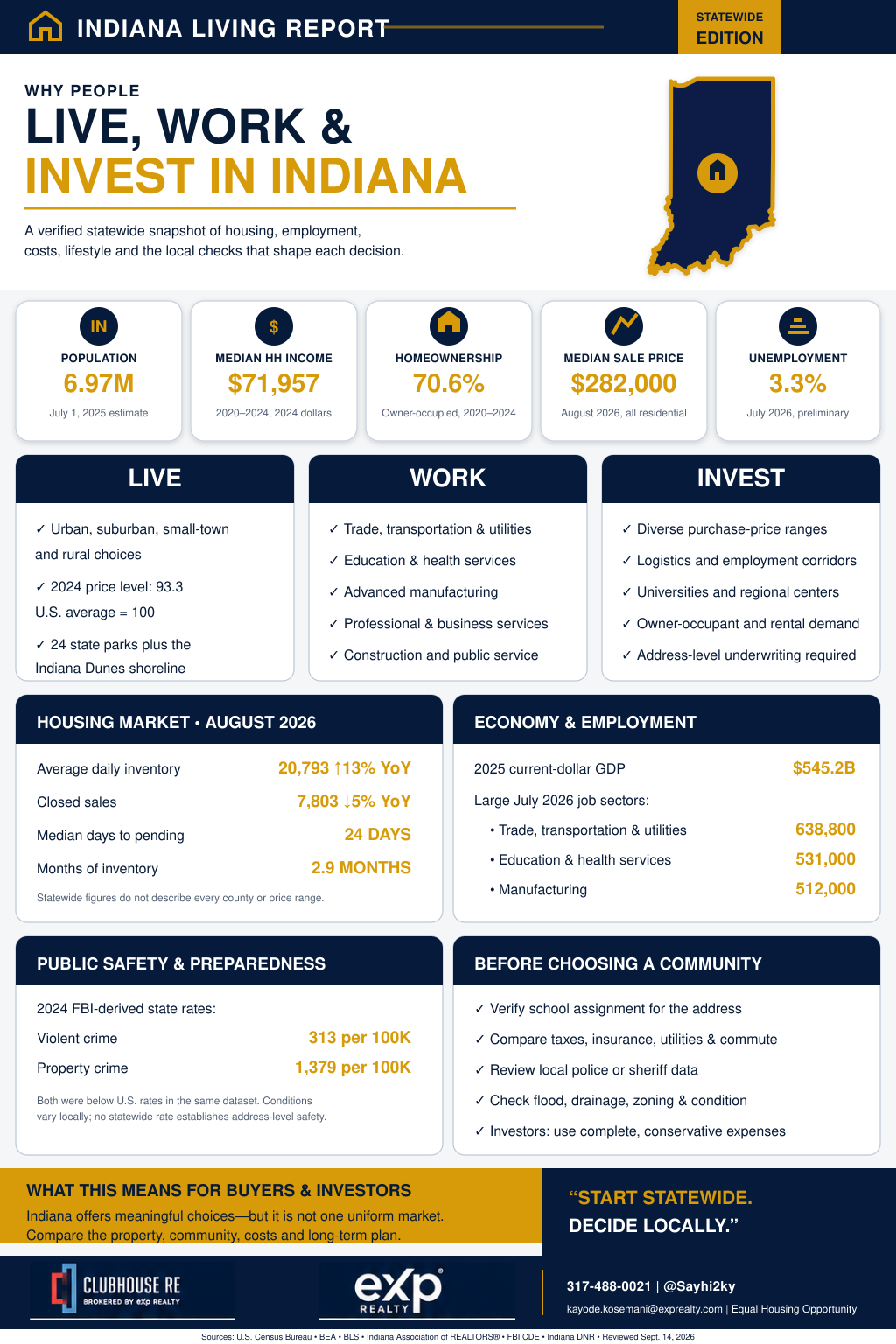
Indiana had an estimated 6,973,333 residents on July 1, 2025, an increase of 2.8% from the state’s April 2020 population estimate base. The Census Bureau’s 2020–2024 profile reports a 70.6% owner-occupied housing rate, a $71,957 median household income, a $1,062 median gross rent and a 24.1-minute mean commute. These figures describe the state as a whole; actual costs and conditions vary substantially by region and household. (U.S. Census Bureau)
The Bureau of Economic Analysis placed Indiana’s 2024 Regional Price Parity at 93.329, with the national price level set at 100. In plain language, average consumer price levels in Indiana were about 6.7% below the national level in that dataset. That is a useful relocation benchmark, but it does not mean every expense—or every Indiana community—is 6.7% less costly. Housing, utilities, transportation, childcare and healthcare can produce very different household budgets. (BEA; Federal Reserve Bank of St. Louis)
Why people choose to live in Indiana
A range of community settings
Indiana offers several different versions of daily life. Indianapolis provides the state’s largest urban employment and cultural center. Central Indiana suburbs and towns offer established neighborhoods, new construction and access to the Indianapolis economy. Northwest Indiana connects to the Chicago metropolitan area and Lake Michigan. Fort Wayne anchors Northeast Indiana, while South Bend–Elkhart, Lafayette–West Lafayette, Bloomington, Columbus, Terre Haute and Evansville each combine their own employers, institutions and housing markets.
Smaller towns and rural counties may offer more space, lower purchase prices or a slower pace, but they can also involve longer drives, fewer nearby services, limited public transportation and different broadband or healthcare access. Relocation decisions should therefore compare the complete routine—home, work, school, healthcare, shopping and transportation—not simply the listing price.
A cost environment that can support homeownership
Indiana’s 70.6% homeownership rate indicates that ownership remains a significant part of the state’s housing pattern. The statewide market also remains less expensive than many higher-cost U.S. markets, although affordability has tightened as prices, mortgage rates, taxes, insurance and maintenance costs have changed.
The Indiana Association of REALTORS® August 2026 all-residential report recorded:
| Statewide housing indicator | August 2026 | Year-over-year change |
|---|---|---|
| Median sale price | $282,000 | +3% |
| Closed sales | 7,803 | −5% |
| Average daily inventory | 20,793 | +13% |
| Median days on market | 24 days | +14% |
| Months of inventory | 2.9 months | +11% |
| Average sale-to-list price | 95.8% | Approximately unchanged |
Source: Indiana Association of REALTORS®, August 2026 Monthly Market Report.
The picture is balanced. Inventory was higher than one year earlier, giving some buyers more choice, while closed sales were lower and the typical time from listing to pending was longer. The median sale price was still higher year over year. None of these statewide numbers predicts the value or negotiating conditions of an individual property: county, price range, property type, condition and local supply can change the result considerably.
Indiana also faces a mismatch between the homes many households need and the homes being built. In August 2026, IAR reported that Indiana had added approximately 146,000 households since 2019 and that 76% of those additional households consisted of one or two people. At the same time, 54% of newly built homes had four or more bedrooms, while new starter homes below $250,000 had fallen from roughly one in three new builds to one in twenty. This helps explain why “affordable state” does not mean every buyer can easily find the right home. (Indiana Association of REALTORS®)
Four seasons and extensive recreation
Residents experience four distinct seasons. Summers can be warm and humid, winters can bring snow and ice, and severe thunderstorms, tornadoes and flooding are real planning considerations. A relocation budget should include appropriate insurance review, emergency preparation and property-specific flood and drainage investigation.
Indiana’s recreation choices range from local greenways and reservoirs to forests, caves, rivers and Lake Michigan. The Indiana Department of Natural Resources manages 24 state parks, along with reservoir properties and other recreation areas. Indiana Dunes National Park protects 15 miles of Lake Michigan shoreline and includes more than 50 miles of trails. (Indiana DNR; National Park Service)
Professional and college sports, the Indianapolis Motor Speedway, museums, festivals and university-centered arts and athletics add to the state’s cultural life. Access differs by location, so households should decide whether they value proximity to major venues or prefer quieter communities with occasional travel for entertainment.
Working in Indiana
Indiana’s labor market is broader than any single industry. The Bureau of Labor Statistics reported a 3.3% statewide unemployment rate in July 2026, based on preliminary, seasonally adjusted data. Total nonfarm employment was approximately 3.252 million jobs. (U.S. Bureau of Labor Statistics)
Several broad sectors accounted for substantial employment in July 2026:
- Trade, transportation and utilities: approximately 638,800 jobs
- Education and health services: approximately 531,000 jobs
- Manufacturing: approximately 512,000 jobs
- Government: approximately 417,300 jobs
- Professional and business services: approximately 356,500 jobs
- Leisure and hospitality: approximately 298,700 jobs
- Construction: approximately 180,900 jobs
These are broad BLS categories, not vacancy counts. A large sector does not guarantee that a particular job, salary or work arrangement is available in every region.
Major employment and investment clusters
Indiana’s manufacturing base supports work in automotive and mobility, machinery, metals, pharmaceuticals, medical devices and other advanced production. Healthcare and education provide employment across hospital systems, clinics, universities, schools and support services. The state also promotes life sciences, semiconductors, defense, artificial intelligence, agribusiness, logistics and transportation as strategic economic sectors. (Indiana Economic Development Corporation)
Geography strengthens the logistics case. Indiana’s highway and rail networks connect the Great Lakes, Midwest and Ohio–Mississippi river system. The state also has access to a statewide international port system and major air-cargo operations. Those assets support warehousing, distribution, manufacturing and supply-chain activity, although individual facilities and projects should be evaluated on their own status and local impact. (IEDC Logistics and Transportation)
For job seekers, Indiana Career Connect provides job-search, résumé and training tools, while regional WorkOne offices offer workforce assistance. A relocating household should compare the actual job offer, wages, benefits, commute and housing costs in the same regional market before deciding whether Indiana is affordable for that household. (Indiana Department of Workforce Development; Indiana Career Connect)
Indiana’s economy: scale, strengths and tradeoffs
Indiana’s current-dollar gross domestic product totaled approximately $545.2 billion in 2025, according to BEA data published through the Federal Reserve Bank of St. Louis. Real state GDP increased from an annualized $425.9 billion in the fourth quarter of 2025 to $428.2 billion in the first quarter of 2026, measured in chained 2017 dollars. These figures show the scale and recent direction of the economy; they are not forecasts of future growth or individual investment performance. (BEA/FRED current-dollar GDP; BEA/FRED real GDP)
Indiana’s practical economic advantage is its mix: production, distribution, healthcare, education, professional services, agriculture and research are spread across several regional centers. That diversification can create multiple career and business paths. The tradeoff is that wages, job growth and access to high-paying specialized work differ significantly by occupation and location. Some households may find that a lower housing cost is accompanied by a longer commute or fewer nearby employment choices.
Public safety and security: use local evidence
Statewide crime statistics provide context, but they cannot determine whether a particular address is appropriate for a household. FBI-derived 2024 data reported approximately 313 violent crimes and 1,379 property crimes per 100,000 Indiana residents, both below the corresponding national rates for that year. The FBI’s 2025 national release later reported further national declines, but statewide and local patterns should be checked separately rather than assumed. (FBI Crime Data Explorer; FBI 2025 release; USAFacts compilation of FBI state data)
Crime data also have limitations. Agencies submit data to the FBI, coverage and reporting practices can change, and statewide rates combine very different communities. Buyers and relocating households should review the most recent local police or sheriff data, compare consistent periods and definitions, visit the area at different times, examine roadway and environmental risks, and consider the specific daily routine. A real-estate professional can help locate public information but should not promise that an area is “safe” or “crime-free.”
Security also includes non-crime risks. Flood exposure, severe weather, drainage, road safety, building condition, insurance availability and emergency-service access can materially affect both quality of life and property costs. Property-specific investigation may require FEMA mapping, local drainage and planning information, an inspection and an insurance professional’s review.
Education, healthcare and transportation
Indiana contains public, private and charter K–12 options, career and technical education, community colleges and nationally known universities. School performance, programming, enrollment rules and attendance boundaries vary locally. The Indiana GPS dashboard provides official school and district profiles, but buyers should confirm the assigned schools directly for the exact address and applicable school year. (Indiana Department of Education—Indiana GPS)
Healthcare access also varies. Major metropolitan areas generally provide more hospital systems and specialized care, while some rural communities may require longer travel. Anyone managing ongoing medical needs should compare providers, insurance networks and travel time before relocating.
The Census Bureau reports a statewide mean commute of 24.1 minutes, but that average hides meaningful differences. Automobile travel remains essential in many communities. Public transportation is more available in certain urban areas, and Northwest Indiana has rail access toward Chicago, but service levels and schedules must be verified for the actual home and workplace.
Where opportunities differ across Indiana
| Region | Common strengths to investigate | Important local checks |
|---|---|---|
| Central Indiana | Broad employment base, state government, healthcare, logistics, life sciences, urban and suburban housing | County-level price differences, commute corridors, school assignment, taxes and neighborhood supply |
| Northwest Indiana | Chicago-market access, Lake Michigan, manufacturing and logistics | Cross-state commute, property taxes, environmental history, flood risk and transit schedule |
| Northeast Indiana | Fort Wayne employment center, manufacturing, healthcare and defense-related activity | Employer concentration, commute distance, inventory and local school boundaries |
| North-central Indiana | South Bend–Elkhart economy, universities, healthcare and advanced manufacturing | Industry cycle exposure, winter travel and community-specific housing conditions |
| West-central Indiana | Higher education, manufacturing, agriculture and regional services | Job-to-housing distance, rental demand drivers and smaller-market sales volume |
| South-central Indiana | Bloomington and Columbus employment, education, healthcare, engineering and manufacturing | Student-market effects, topography, inventory and commute routes |
| Southern Indiana | Evansville and Louisville-area connections, healthcare, manufacturing, logistics and river access | County and state-line differences, flood exposure, utilities and local economic drivers |
This table is a starting framework, not a ranking. Each region contains communities with different prices, amenities, public services, risks and investment fundamentals.
Why investors consider Indiana—and what they must verify
Indiana can attract investors because of its range of purchase prices, large renter and homeowner markets, logistics corridors, universities, healthcare employment and growing suburban communities. However, statewide affordability is not an investment thesis by itself.
Before purchasing an Indiana investment property, evaluate:
- Address-level demand: Who is likely to rent or buy this specific property, and what verified employment, education or lifestyle driver supports that demand?
- Actual comparable evidence: Use recent closed sales and signed or verified rental evidence—not asking prices alone.
- Complete operating costs: Include realistic vacancy, maintenance, capital reserves, management, utilities, property taxes, insurance and association expenses.
- Property condition: Older housing may require careful evaluation of roofing, foundations, electrical systems, plumbing, drainage, sewer or septic systems and prior renovations.
- Rules and jurisdiction: Confirm zoning, permitted use, occupancy, rental registration or inspection requirements, short-term-rental rules and any HOA or condominium restrictions.
- Risk concentration: Consider dependence on a single employer, student population, project announcement or speculative appreciation.
- Exit options: Evaluate whether the property would appeal to future owner-occupants, investors or both.
Investment returns, appreciation and tenant demand are never guaranteed. Property management, local regulation and transaction requirements can differ by jurisdiction, and legal or tax questions should be reviewed with the appropriate professional.
A practical relocation checklist
Before deciding where to live in Indiana:
- Confirm employment location, expected commute and remote-work requirements.
- Compare purchase price or rent with taxes, insurance, utilities, transportation and maintenance.
- Verify school assignment directly for the address when schools matter to the decision.
- Review current local public-safety information without relying on a statewide label or online ranking.
- Investigate flood, drainage, environmental and severe-weather considerations.
- Visit the community at different times and test the real daily routes.
- Compare healthcare access, internet service, recreation and essential services.
- For buyers, obtain financing guidance before treating a listing price as affordable.
- For investors, underwrite the property using conservative, address-specific income and expenses.
The Indiana Living Report continues locally
Indiana may be the starting point, but the final decision is local. The Indiana Living Report series examines individual counties, cities and towns so readers can move from statewide context to the details that shape an actual real-estate decision.
Whether you are already a Hoosier, relocating to Indiana, preparing to buy your first home, planning a move-up purchase or evaluating an investment, the goal is the same: understand both the opportunity and the property-specific facts before committing.
Ready to explore the Indiana community that fits your goals? Use the Chervil LLC real-estate contact form to begin a conversation.
Kayode Kosemani, REALTOR®, PMP Clubhouse RE, brokered by eXp Realty @Sayhi2ky · kayode.kosemani@exprealty.com
This publication is for general educational purposes and is not an appraisal, legal or tax advice, a financing commitment, a guarantee of safety, or a promise of investment performance. Market data and public records may change. Verify property facts, school assignments, taxes, insurance, financing, zoning, rental requirements and other material conditions for the specific address. Equal Housing Opportunity.
Sources and review notes
Reviewed September 14, 2026. Data periods differ because official sources publish on different schedules. Census household measures use 2020–2024 data; the population estimate is for July 1, 2025; cost comparisons use 2024 BEA data; labor statistics are preliminary July 2026 values; and housing statistics cover August 2026.
- U.S. Census Bureau. QuickFacts: Indiana. Population estimate vintage 2025; household measures 2020–2024.
- U.S. Bureau of Economic Analysis. Regional Price Parities by State and Metro Area. Current release February 19, 2026; data year 2024.
- Federal Reserve Bank of St. Louis. Indiana regional price parity dashboard. Underlying source: BEA; data year 2024.
- Indiana Association of REALTORS®. Indiana Monthly Market Report—August 2026. All residential.
- Indiana Association of REALTORS®. Latest Research. Housing-form and construction analysis published August 26, 2026.
- U.S. Bureau of Labor Statistics. Indiana Economy at a Glance. July 2026 preliminary labor data extracted September 11, 2026.
- U.S. Bureau of Economic Analysis via FRED. Indiana current-dollar GDP and Indiana real quarterly GDP. 2025 annual and first-quarter 2026 data.
- Indiana Economic Development Corporation. Indiana economic-development sectors and Logistics and Transportation. Accessed September 14, 2026.
- Indiana Department of Workforce Development. Job Seeker Resources and Indiana Career Connect. Accessed September 14, 2026.
- FBI. Crime Data Explorer and 2025 Reported Crimes in the Nation release. State comparison supplemented by USAFacts’ compilation of 2024 FBI state data.
- Indiana Department of Natural Resources. Indiana State Parks and Lakes. Accessed September 14, 2026.
- National Park Service. Indiana Dunes National Park. Accessed September 14, 2026.
- Indiana Department of Education. Indiana Graduates Prepared to Succeed Dashboard. Accessed September 14, 2026.
- Indiana Department of Local Government Finance. Understanding Your Tax Bill. Accessed September 14, 2026.
CONNECT WITH CHERVIL LLC
Explore an Indiana community with Chervil LLC
Tell us whether you are relocating, buying, selling or evaluating an investment. We will help you move from statewide context to address-level research.