
Share this publication
Send this Chervil resource to someone who may find it useful.
Social media advice sometimes makes an LLC sound like a tax shortcut: create a company, place a house, vehicle, phone, meals, travel and other purchases under its name, and turn everyday spending into business deductions.
That is not how the tax law works.
An LLC can be a valuable legal and business structure. It can help separate business ownership from personal ownership, organize operations, support cleaner accounting and provide liability protection under state law. But the letters “LLC” on a title, receipt or bank card do not make an expense deductible.
For federal income-tax purposes, the central question is generally not who swiped the card. It is whether the cost was an ordinary and necessary expense of carrying on a genuine trade or business, whether any personal portion was removed, whether special deduction or capitalization rules were followed, and whether the taxpayer can prove the claim.
The short answer: myth or fact?
Myth: “If my LLC owns it or pays for it, I can write it off.”
Fact: An LLC does not convert a personal expense into a business expense. Federal law generally permits ordinary and necessary trade-or-business expenses and generally disallows personal, living and family expenses. Mixed-use costs must usually be divided between business and personal use.
This distinction matters because an LLC is a state-law entity, while its federal tax treatment depends on its ownership and any tax election it makes.
- A one-owner LLC is generally disregarded for federal income-tax purposes unless it elects corporate treatment. Its activity commonly appears on the owner’s Schedule C, Schedule E or Schedule F.
- A domestic LLC with two or more owners is generally treated as a partnership unless it elects corporate treatment.
- An LLC may qualify to elect taxation as a corporation or S corporation, but forming the LLC does not make that election automatic.
An Indiana note for married couples: Indiana is not a community-property state. When both spouses are owners of an Indiana LLC, the IRS generally treats the LLC as a partnership unless it elects corporate treatment. Simply being married does not ordinarily make a jointly owned Indiana LLC a disregarded single-owner entity.
In other words, an LLC is a legal container. The tax rules still examine what actually happened inside that container.
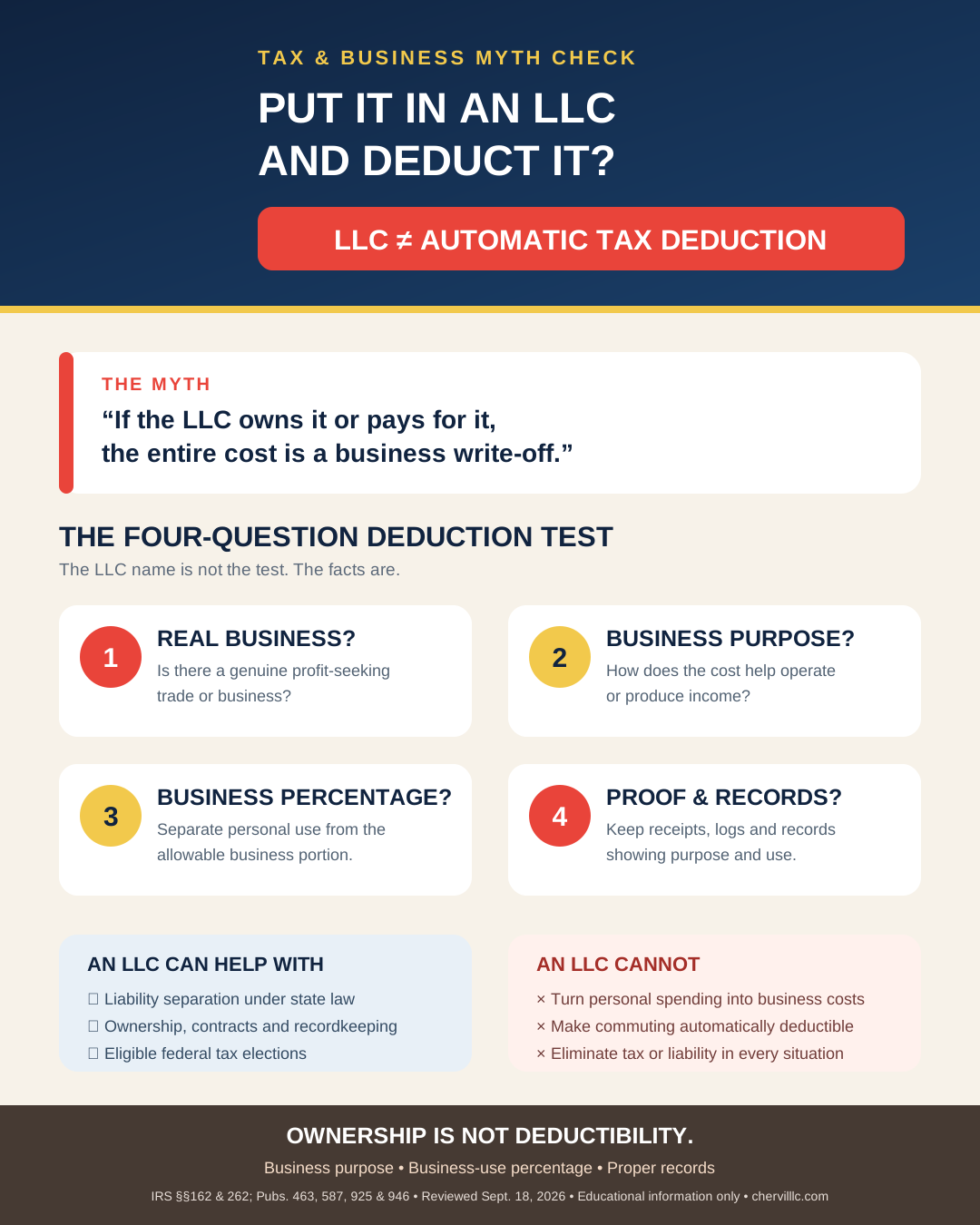
The four-question test before claiming a deduction
Before treating an asset or payment as a business deduction, ask:
- Is there a real business activity? Forming an LLC does not, by itself, prove that an activity is a trade or business. The activity should be conducted in a businesslike manner and with a genuine profit objective.
- What is the business purpose? The expense should have a clear connection to producing income or operating the business—not merely a personal benefit described in business language.
- What percentage is business use? When an item is used for both business and personal reasons, only the allowable business portion is generally considered.
- Can the taxpayer prove it? Receipts alone may show that money was spent, but not necessarily why it was spent. Mileage logs, calendars, invoices, contracts, meeting notes and other timely records can establish business purpose and use.
If the answer to one of these questions is weak, placing the item in an LLC usually does not fix the underlying problem.
What an LLC can legitimately do
Used properly, an LLC may provide several meaningful benefits.
Separate business liabilities from an owner’s personal affairs
Indiana describes an LLC as a formal association that combines pass-through tax treatment, when applicable, with limited-liability features. That protection is important, but it is not unlimited. An owner may still face personal exposure for personal wrongdoing, personal guarantees or other obligations imposed directly on the owner. Liability protection also depends on the facts, governing documents, contracts, insurance and applicable law.
Create clearer ownership and operating rules
An operating agreement can document ownership, decision-making, distributions, transfers and what happens when an owner leaves or dies. This can be especially helpful for jointly owned businesses and investment properties.
Improve financial organization
A separate business bank account, bookkeeping system, contracts and supporting records make it easier to distinguish business activity from personal activity. That separation does not create deductions, but it can make valid deductions easier to identify and substantiate.
Provide federal tax-classification choices
Depending on eligibility and elections, an LLC may be taxed as a disregarded entity, partnership, C corporation or S corporation. Each treatment carries different filing, payroll, basis, distribution and self-employment-tax consequences. The best choice depends on the business—not on a slogan.
What an LLC does not do
An LLC does not automatically:
- make personal spending deductible;
- eliminate self-employment tax;
- allow the owner to deduct 100% of a mixed-use vehicle, phone or home;
- turn commuting into business mileage;
- make a hobby a trade or business;
- allow every purchase to be deducted immediately;
- permit rental losses to offset any kind of income without limitation;
- protect an owner from every lawsuit, debt, guarantee or personal act; or
- replace appropriate business insurance, bookkeeping and professional advice.
Common assets and expenses: what really matters
Vehicles
Putting a vehicle in an LLC’s name does not make every mile deductible. When a vehicle has business and personal use, the expenses must generally be divided. Ordinary travel between home and a regular workplace is generally personal commuting, even when the driver takes business calls, carries tools or displays the company’s advertising on the vehicle. In limited circumstances, additional costs caused by hauling tools may be deductible, but the ordinary commuting cost remains personal.
Taxpayers using the actual-expense method generally allocate operating costs by business use. Eligible taxpayers may instead use the standard mileage method, subject to its rules. A contemporaneous mileage log should identify the date, destination, mileage and business purpose.
Buying an expensive vehicle also does not guarantee a full first-year deduction. Depreciation, Section 179, business-use thresholds, vehicle limitations and possible later recapture may apply.
A personal residence and home office
Transferring a primary residence to an LLC is not required to claim a qualifying home-office deduction, and the transfer does not make the home fully deductible.
Under the general home-office rules, the business area ordinarily must be used regularly and exclusively for business, with limited exceptions such as certain inventory storage or daycare use. The amount may also be limited.
Moving a residence into an LLC can create questions beyond the annual deduction, including mortgage terms, insurance coverage, title and closing requirements, Indiana property-tax treatment, estate planning and the federal exclusion that may apply when an individual sells a principal residence. Those issues should be reviewed before—not after—the deed is changed.
Rental real estate
An LLC may be useful for holding a rental property, documenting multiple owners and separating a property’s operations. But the LLC does not create new categories of rental deductions.
Rental income and expenses remain subject to the normal rental rules, including depreciation, basis, at-risk limitations and passive-activity rules. Rental activity is generally passive unless an exception applies. Creating one LLC per property may be a risk-management or organizational decision, but it is not an automatic tax-saving formula.
Financing and insurance deserve special attention. A transfer to an LLC may conflict with loan documents or existing coverage, and a lender may still require a personal guarantee.
Phones, internet and household services
The business portion of a phone, internet plan or similar service may be deductible when properly supported. The personal portion is not converted into a business deduction merely because the bill is paid from the LLC account.
A reasonable allocation method should reflect actual use and be applied consistently. For shared household services, a 100% business claim is difficult to defend when family or personal use continues.
Meals, entertainment and travel
A company card does not turn a personal dinner or vacation into a business expense. Business meals and travel have their own purpose, documentation and limitation rules. The record should identify who attended, the business relationship, the business discussion, the dates and the location.
Entertainment expenses are generally nondeductible, subject to limited exceptions. Adding a brief business conversation to a personal event does not necessarily change its character. When a trip combines business and personal time, allocation rules may apply.
Furniture, computers, tools and equipment
Equipment used in a business may qualify for depreciation or another cost-recovery method. Some property may qualify for Section 179 or special depreciation treatment, while other costs must be recovered over time.
Mixed-use property requires allocation. For Section 179, property used for both business and nonbusiness purposes generally must be used more than 50% for business in the year it is placed in service. A later decline in business use can also trigger recapture.
The phrase “write it off” does not always mean the full purchase price disappears from taxable income in the year of purchase.
Clothing and personal appearance
Ordinary clothing suitable for everyday wear is generally personal, even if it is purchased for work or worn while conducting business. Specialized protective equipment or a qualifying uniform may be treated differently. An LLC logo on ordinary clothing does not automatically make the entire wardrobe deductible.
The S corporation misunderstanding
An LLC and an S corporation are not the same thing. The LLC is formed under state law; S corporation status is a federal tax election available only when eligibility and filing requirements are met.
Compared with sole-proprietor or partnership treatment, an eligible owner-operated business may sometimes reduce employment taxes through S corporation treatment because qualifying nonwage distributions are not subject to employment taxes. But the strategy is not “take everything as a distribution.” The IRS requires an S corporation to pay reasonable compensation to a shareholder-employee for services before making nonwage distributions to that person, and the IRS may reclassify distributions as wages when compensation is unreasonably low. Payroll filings, employment taxes, bookkeeping and a separate business return add cost and complexity.
An election should be evaluated using expected profit, the owner’s work, reasonable compensation, benefits, compliance costs, state treatment and long-term plans. It is not automatically beneficial merely because an LLC exists.
The disadvantages of putting too much into an LLC
Using an LLC for assets without a clear business or legal purpose can produce more problems than benefits:
- More administration: An Indiana LLC is formed by filing Articles of Organization and must file a Business Entity Report every two years. Depending on tax classification, separate federal and state returns may also be required.
- Higher professional and filing costs: Bookkeeping, payroll, registered-agent services, return preparation, legal work and annual compliance can outweigh any projected benefit.
- Financing and insurance complications: A lender or insurer may not treat individual and LLC ownership as interchangeable.
- Loss of clarity: Mixing personal and business spending in the LLC account creates messy records and may weaken the credibility of legitimate deductions.
- Tax side effects: Transfers may affect basis, gain, depreciation, passive-loss tracking, distributions, owner debt and future sales.
- False confidence: Limited liability is not a substitute for suitable insurance, good contracts, safe operations and adequate capitalization.
A better way to decide what belongs in an LLC
Instead of asking, “Can I put this in my LLC?” ask two separate questions:
Legal and operational question: Is LLC ownership useful for contracts, risk management, multiple owners, financing, insurance or business continuity?
Tax question: Would the income or expense receive the same, better or worse tax treatment based on its actual business use and the LLC’s federal tax classification?
For a major asset, the review may need four professionals working from the same facts: a tax professional, business or real-estate attorney, insurance adviser and lender or title professional.
A practical compliance checklist
Before an LLC acquires an asset or pays an expense:
- Identify the exact business reason.
- Estimate and document personal versus business use.
- Confirm whether the cost is currently deductible, depreciable or capitalized.
- Review the LLC’s federal and Indiana tax classification.
- Check the operating agreement and obtain any required owner approval.
- Review loan, lease, title and insurance restrictions before transferring ownership.
- Keep the invoice, proof of payment and records showing business use.
- Record owner-paid costs properly instead of casually mixing accounts.
- Revisit the arrangement when ownership, use or tax classification changes.
The bottom line
An LLC can be an excellent tool for the right business or investment. Its value comes from thoughtful structure, documented ownership, disciplined operations and an appropriate tax classification—not from relabeling personal life as a business.
The strongest tax position is usually the simplest one to explain: a real business incurred a properly documented cost for a genuine business purpose, and any personal benefit was excluded or reported correctly.
Before transferring a home, vehicle, investment property or other significant asset to an LLC, consider the complete legal, tax, lending and insurance picture. The decision should protect the business without creating an avoidable problem elsewhere.
Sources and further reading
- IRS: Limited liability company (LLC)
- IRS: Single-member limited liability companies
- 26 U.S.C. § 162: Trade or business expenses
- 26 U.S.C. § 262: Personal, living and family expenses
- IRS Publication 463: Travel, Gift, and Car Expenses
- IRS Publication 587: Business Use of Your Home
- IRS Publication 925: Passive Activity and At-Risk Rules
- IRS Publication 946: How To Depreciate Property
- IRS: S corporation compensation and medical insurance issues
- Indiana Department of Revenue: New & Small Business Owners Indiana Tax Guide
This article provides general educational information and is not individualized tax, legal, lending or insurance advice. Rules and outcomes depend on the facts, ownership structure, tax classification and applicable law. Consult qualified professionals before forming an entity, making a tax election or transferring significant assets.
CONNECT WITH CHERVIL LLC
Have questions about business deductions or entity tax treatment?
Chervil LLC provides tax preparation and fact-specific review of business records and federal and Indiana filing treatment.