
Share this publication
Send this Chervil resource to someone who may find it useful.
When you hear that the Federal Reserve has raised interest rates, it is reasonable to wonder whether buying a home just became more expensive—or whether your existing mortgage payment will increase.
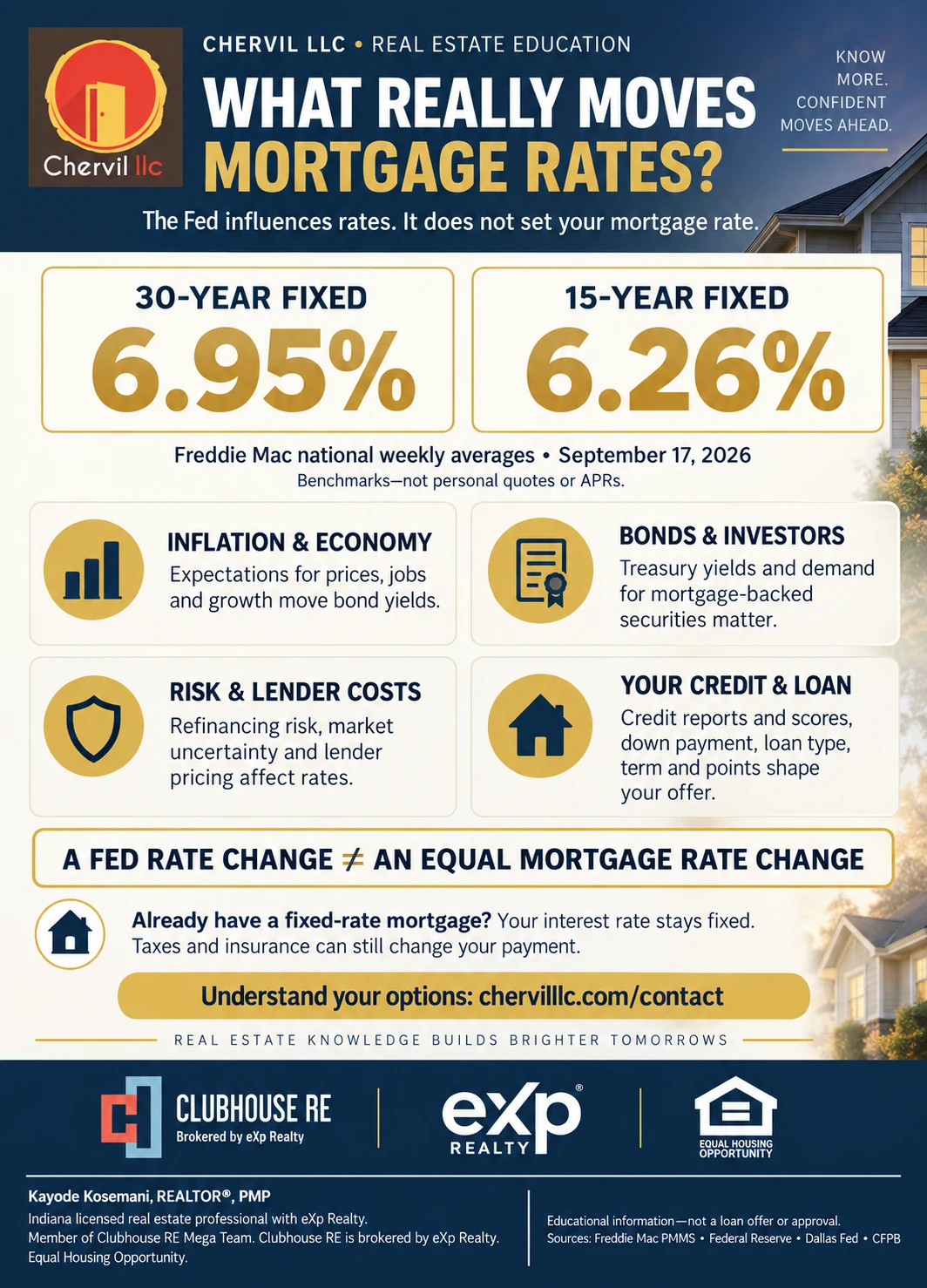
The answer begins with a distinction: the Federal Reserve influences mortgage rates, but it does not set the mortgage rate a lender offers you. Long-term borrowing costs reflect expectations about the economy and future policy, not simply the Fed’s decision at one meeting. Federal Reserve: how monetary policy works
My goal is to help you understand both the market behind the headlines and the personal factors that matter when you apply.
The latest verified mortgage-rate snapshot
Freddie Mac’s September 17, 2026 Primary Mortgage Market Survey reported:
| Mortgage | National weekly average | Previous week | Weekly change |
|---|---|---|---|
| 30-year fixed | 6.95% | 6.76% | +0.19 percentage point |
| 15-year fixed | 6.26% | 6.09% | +0.17 percentage point |
These are the latest published weekly averages available at this article’s research date. They cover application activity from September 10–16. They are national interest-rate benchmarks—not Indiana-specific rates, APRs, or guaranteed offers. Freddie Mac does not publish average points and fees with this survey. Freddie Mac: PMMS
The survey focuses on conventional, conforming purchase mortgages, with a borrower profile including good or excellent credit and approximately 20% down. It does not represent every borrower or every FHA, VA, USDA, jumbo, or refinance transaction. Freddie Mac: survey methodology
Your actual mortgage rate depends on your credit reports and scores, the loan’s characteristics, and the lender’s pricing. A national average gives you context; your lender’s written offer tells you the terms available for your application. CFPB: mortgage-rate factors
What the Federal Reserve actually changed
On September 16, 2026, the Federal Open Market Committee raised its federal-funds target range by 0.25 percentage point, to 3.75%–4.00%. Federal Reserve: September 16 statement
The federal funds rate concerns overnight borrowing of reserve balances between financial institutions. A mortgage is a different kind of loan, with a much longer horizon. Expectations for future short-term rates and economic conditions help determine long-term rates. Federal Reserve: monetary-policy transmission
A quarter-point Fed increase therefore does not instruct lenders to add a quarter point to every mortgage. Nor can we attribute the entire weekly mortgage-rate increase above to that announcement: the survey period largely preceded the decision. That is a limitation of the timing, not a claim that the Fed had no influence. Freddie Mac: survey timing
What actually moves mortgage rates?
1. Bond prices and the returns investors require
A bond is a way for an investor to lend money in exchange for payments. Its market price can change after issuance. When competing investments offer higher returns, an older bond paying less generally becomes less attractive and may need to sell at a discount. Bond prices and yields generally move in opposite directions.
Inflation matters because it reduces the purchasing power of future payments. Investors care about what their money will buy when those payments arrive. SEC Investor.gov: bond fundamentals and risks
2. Mortgage-backed securities: the closer connection to your loan
Many mortgages are pooled into mortgage-backed securities, or MBS, that investors buy. For conventional conforming loans, yields in that securities market provide a foundation for the rates offered to borrowers.
The 10-year Treasury yield is a useful comparison benchmark, but it is not a mortgage rate. The difference between mortgage rates and Treasury yields is called a spread, and it changes. There is no permanent rule that a mortgage must equal the Treasury yield plus a fixed percentage. Dallas Fed: mortgage-rate components
Lenders must also account for financing, hedging, origination, servicing, credit-related costs, and returns on their capital. This helps explain why changes in securities-market yields do not always pass immediately or identically into every lender’s quote. Federal Reserve staff research: mortgage-market pricing
3. Expectations for inflation, growth, and future Fed decisions
Long-term yields reflect expected inflation, the expected path of inflation-adjusted short-term rates, and a term premium—the additional return associated with holding longer-term debt instead of repeatedly buying short-term securities.
New information about employment, spending, and inflation matters when it changes that outlook. Stronger growth or persistent inflation can put upward pressure on yields; weaker growth or easing inflation can push the other way. These are tendencies, not reliable reactions to every individual report. Federal Reserve: long-term interest rates
Because expectations matter, markets can adjust before a Fed meeting. An anticipated decision may have limited additional impact; an unexpected message about future policy can matter more. This is an inference from the Fed’s explanation of how expectations influence long-term borrowing costs. Federal Reserve: monetary-policy transmission
4. Refinancing risk and uncertainty
Mortgage investors face a complication: homeowners can repay loans early, often by refinancing when rates fall. Investors may then receive their principal back just when reinvestment opportunities pay less.
That prepayment option has a cost. Greater uncertainty about future rates can increase its value and widen the spread investors demand. Consequently, mortgage rates can remain elevated even when Treasury yields decline. Dallas Fed research identified this mechanism in its analysis of 2022; it does not establish how much of today’s rate comes from this factor. Dallas Fed: volatility and mortgage spreads
5. Demand for bonds and the Fed’s securities holdings
Global demand for relatively safe, liquid Treasury securities can lower their yields. Changes in that demand can alter financing conditions beyond the United States. The effect of an international event depends on how it changes investors’ outlook and behavior. Federal Reserve: global demand and term premiums
The Fed also influences mortgage markets through its securities portfolio. Historical Federal Reserve staff research found that larger holdings put downward pressure on MBS yields and mortgage rates overall, although the channels were complex. This is a separate influence from the overnight policy rate—not a guarantee that any balance-sheet announcement will produce a particular mortgage quote. Federal Reserve staff research: portfolio effects
Why your credit still matters
Market conditions help establish the general rate environment. Your application determines how a lender evaluates you within it.
A credit report records information such as credit accounts and payment history. A credit score is calculated from report information using a scoring model. Lenders use both in assessing eligibility and pricing. Reviewing your reports early and disputing inaccurate information can help prevent avoidable problems when you apply. CFPB: checking credit before buying
Borrowers with stronger credit generally receive more favorable interest rates, all else equal. But credit is not the only factor:
| Factor | Why it matters |
|---|---|
| Down payment and loan-to-value | Affect risk and potentially mortgage-insurance costs; the lowest note rate is not always the lowest overall cost. |
| Loan amount and location | Available pricing can differ across loan sizes and markets. |
| Loan program | Conventional, FHA, VA, and USDA loans have different structures and eligibility requirements. |
| Repayment term | A 15-year loan generally has a lower rate than a comparable 30-year loan. |
| Fixed versus adjustable | The initial rate and future rate risk differ. |
CFPB: factors affecting mortgage rates
Income, employment, assets, and existing debts also matter to the lender’s ability-to-repay assessment. A strong credit score alone does not establish that a particular loan is affordable or approvable. CFPB: understanding loan options
A lower advertised rate may involve a trade-off
Discount points exchange an upfront cost for a lower rate. One point equals 1% of the loan amount; it does not guarantee a one-percentage-point rate reduction. The reduction depends on the lender, loan, and market. Rate-related lender credits generally reverse that trade-off: a higher rate helps offset closing costs. Compare offers using equivalent points or credits. CFPB: points and lender credits
Also distinguish the interest rate from the annual percentage rate, or APR. APR incorporates the interest rate and certain additional borrowing charges. It is useful when comparing similar loans, but it does not replace a review of fees and terms. An ARM’s APR does not show its maximum possible rate. CFPB: interest rate versus APR
What this means for existing homeowners
| Your situation | What a change in market rates means |
|---|---|
| Existing fixed-rate mortgage | The contracted interest rate stays fixed. For a standard fully amortizing fixed loan, principal and interest stay the same; taxes and insurance can still change the total payment. |
| Adjustable-rate mortgage | The rate can change after its initial fixed period according to the loan’s terms. Review the adjustment schedule and caps. |
| New purchase or refinance application | Your new loan is priced using available market conditions and your application. |
CFPB: fixed and adjustable loans
A quote is also different from a rate lock. A lock generally protects the rate through a specified closing window if the application remains unchanged. Extensions can cost money, and a lock does not automatically give you a lower rate if the market falls. Ask for the conditions in writing. CFPB: rate locks
Choosing between 30 years and 15 years
The lower 15-year average can look attractive, but a shorter repayment period generally means a higher required monthly payment for the same amount borrowed. It typically reduces lifetime interest if the loan is repaid as scheduled. A 30-year term generally provides a lower required payment while extending interest costs over more years. Compare both against your household’s cash flow. CFPB: comparing loan terms
My approach for Indiana buyers
I encourage buyers to use rate headlines as a reason to ask better questions. Start with your budget, review your credit, and ask lenders to explain the complete offer.
Compare written Loan Estimates for the same loan amount and structure, obtained close together in time. Check the interest rate, APR, points, lender charges, mortgage insurance, cash to close, and lock status. Budget for property taxes, homeowners insurance, and applicable association charges as well as principal and interest. CFPB: Loan Estimate explainer
My recommendation is to choose a payment you can support under the terms available today. A possible future refinance should be an opportunity, not the condition that makes an otherwise unaffordable purchase work.
If you are preparing to buy in Indiana, start a conversation through Chervil LLC’s contact form. I can help you organize your homebuying priorities and the questions to take to a mortgage lender.
Helping hardworking Hoosiers become homeowner-ready.
About the author: Kayode Kosemani, REALTOR®, PMP, is an Indiana licensed real estate professional with eXp Realty and a member of Clubhouse RE Mega Team. Clubhouse RE is brokered by eXp Realty. Equal Housing Opportunity.
Educational disclosure: This article provides general information, not a mortgage offer, rate lock, approval, or individualized lending advice. Published averages are dated benchmarks and are not APRs. Actual terms depend on the lender, borrower, property, loan program, fees, and market conditions. Consult a qualified mortgage lender for a written assessment of your circumstances.
CONNECT WITH CHERVIL LLC
Prepare for your next homebuying step
Let’s organize your homebuying priorities and the questions to take to a mortgage lender.