
Share this publication
Send this Chervil resource to someone who may find it useful.
If your business files 1099s, a conversation now can help prevent confusion when filing season arrives. The IRS is retiring FIRE, an electronic filing system used by businesses and their providers, and moving those filings to IRIS.
You may never log into either system yourself. Even so, it matters whether the person handling your forms is ready—and whether your recipient records are complete.
Start with one question: “Who will file our information returns, and are they ready for the transition?”
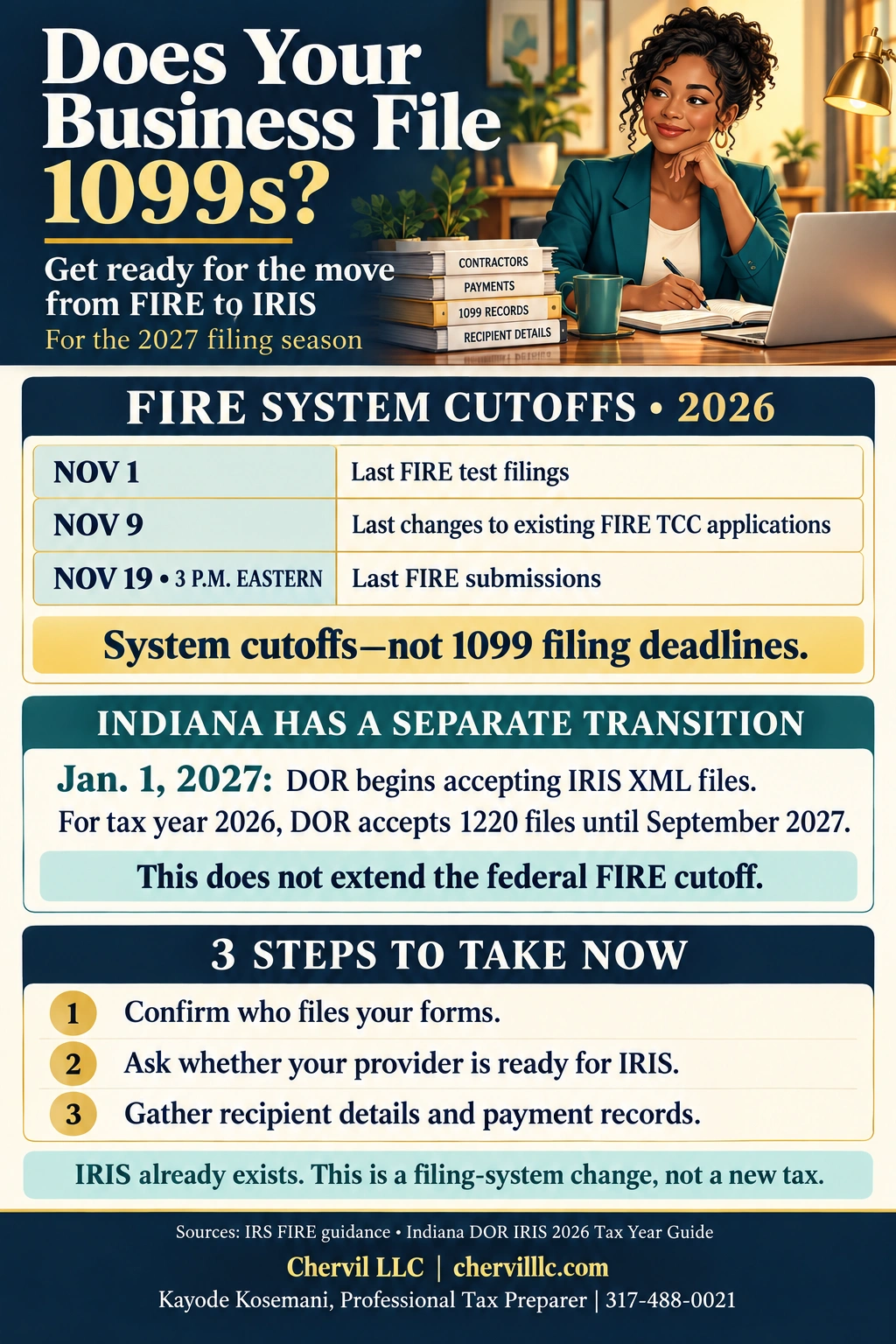
What is changing for the 2027 filing season?
FIRE stands for Filing Information Returns Electronically. Current FIRE users must move to the Information Returns Intake System, or IRIS, for tax-year 2026 information returns filed during the 2027 filing season. IRIS has operated since 2023; this transition does not create a new tax. [1]
The change also affects prior-year returns and corrections previously handled through FIRE. Ask your provider how they will handle those filings after the transition, including whether their service supports the form and tax year you need. [2]
Employee Forms W-2 continue to be filed with the Social Security Administration. The FIRE transition should not be read as moving every payroll filing into IRIS. [5]
Three November dates to keep on your calendar
The IRS lists these final dates for FIRE users: [1, 2]
| Date in 2026 | Last day to do this |
|---|---|
| November 1 | Submit test information returns through the FIRE Trading Partner Test System |
| November 9 | Change existing FIRE Information Returns applications for Transmitter Control Codes |
| November 19, at 3 p.m. Eastern | Submit information returns through FIRE |
These are system transition cutoffs, not a new universal deadline for filing 1099s. Filing and recipient-copy deadlines still depend on the particular form and applicable rules.
The November 9 date concerns existing FIRE transmitter applications. It should not be described as the deadline to apply for IRIS access.
Confirm who is responsible for your forms
Bookkeeping and information-return filing may be handled by different people. A bookkeeper might organize payment records while a payroll company, tax preparer or software provider transmits the forms.
Ask your provider:
- Are you already using IRIS, or are you moving from FIRE?
- Does your service support our forms, tax years and any corrections we may need?
- Who submits the returns and checks whether they were accepted?
- Who delivers the recipient copies?
- Who handles rejected submissions and follow-up?
- What records do you need, and when?
- Who confirms any separate Indiana filing requirements?
For example, a small business that normally emails a vendor spreadsheet to its bookkeeper in January can act earlier this year. Confirm who actually files the forms, identify missing recipient details and agree on a review date before the year-end rush.
Keep that division of responsibilities in writing so both sides know what is included.
If your business files directly
The free IRIS Taxpayer Portal allows manual entry or CSV uploads of up to 100 returns at a time. Users can download payee copies and retain filing records. The IRS also provides an Application to Application channel for software-based filing. [3]
Direct portal users need an IRIS Transmitter Control Code, or TCC. Existing FIRE users must complete the IRIS application process; a FIRE TCC does not automatically provide IRIS access. [2, 3]
If a provider files for you, ask whose access and transmitter arrangements cover the service before starting your own application. Your business may be supplying records while the provider handles transmission.
Indiana has its own transition arrangements
Indiana DOR now provides an IRIS 2026 Tax Year Guide. It says DOR will begin accepting IRIS XML files on January 1, 2027, while continuing to accept the older 1220 file format for tax year 2026 until September 2027. [4]
Indiana’s temporary acceptance of 1220 files does not extend the federal FIRE cutoff. A provider needs to distinguish the IRS submission from any required state submission.
DOR’s guide describes IRIS XML submissions through INTIME or SFTP. Indiana supports a specified set of forms and has its own procedures for corrections and withholding-return extensions. Federal acceptance alone should not be treated as proof that all state obligations are complete. [4]
Ask your provider to confirm the applicable Indiana requirements, the state filing method and how submission results will be checked.
Gather recipient records before the rush
Prepare a working checklist with the person handling your filings:
- Recipient names, mailing addresses and taxpayer-identification information.
- Applicable tax documentation, including W-9 records.
- Payment totals and how each payment was made.
- Missing or inconsistent information that needs follow-up.
- The person responsible for reviewing and approving the final forms.
- A secure place to retain accepted filings, recipient copies and correction records.
This checklist helps organize a review. Whether a particular payment requires a 1099 depends on the recipient, payment, form and tax-year rules.
Share taxpayer-identification information through a secure document-sharing method. Keep sensitive recipient records out of public website inquiry forms.
Take one practical step now
Contact whoever handles your business’s information returns and confirm three things: the filing method, the records deadline and the person responsible for follow-up.
Chervil LLC can help you organize the questions and records for a business tax-preparation conversation.
Contact Kayode Kosemani, Professional Tax Preparer, at 317-488-0021 or sayhi2ky@chervilllc.com.
Choosing a preparer as well? Read Before You Hire a Tax Preparer: Know Who Is Signing Your Return.
General educational information. Filing obligations, deadlines and state requirements depend on the form, tax year and individual circumstances.
Sources
CONNECT WITH CHERVIL LLC
Prepare for your next business tax conversation
Contact Chervil LLC to discuss your filing needs and the records to organize.