
Share this publication
Send this Chervil resource to someone who may find it useful.
Individual tax education: understand the deduction before you count the savings.
Last reviewed: September 1, 2026. Primary focus: federal tax year 2026, generally filed in 2027. The 2025 amounts below are included only for readers still completing a 2025 return.
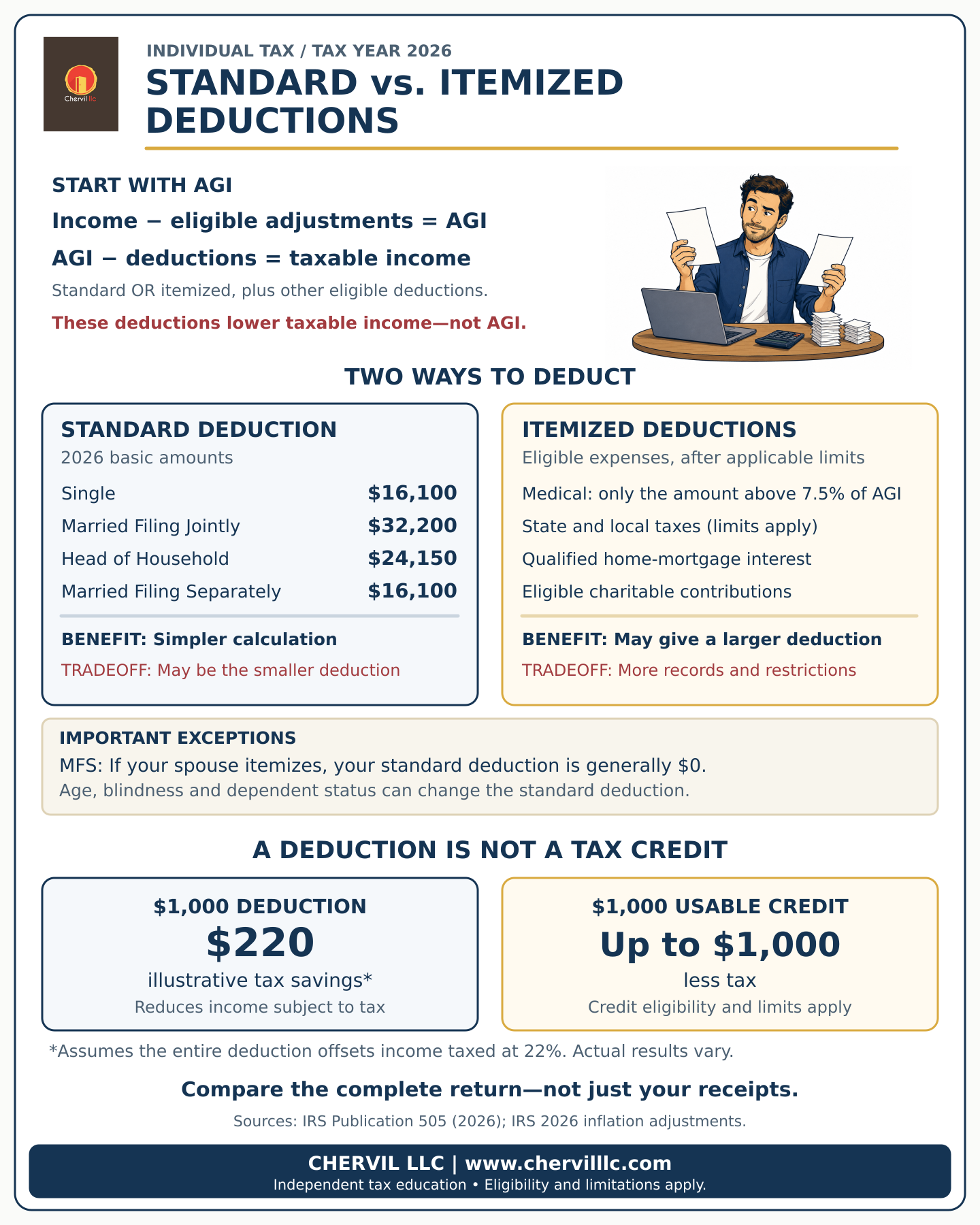
A deduction can help lower your tax bill, but a $1,000 deduction usually does not save $1,000 in taxes. Standard and itemized deductions generally reduce the income on which federal income tax is calculated. A tax credit works differently: it reduces the tax itself. IRS explanation of credits and deductions.
The practical question is not simply, “How many receipts do I have?” It is, “Which expenses qualify, what limitations apply, and which available method produces the better result on my complete return?”
1. Start with AGI, then calculate taxable income
Adjusted gross income, or AGI, is calculated before the standard or itemized deduction. Think of the federal calculation in stages:
| Stage | What happens |
|---|---|
| Total income | Combine the income that must be reported on the return. Business and rental activities have their own income-and-expense calculations. |
| Adjustments to income | Subtract eligible adjustments, such as a deductible IRA contribution or qualifying student loan interest. |
| Adjusted gross income | The result is AGI, an important starting point for many eligibility tests and deduction limits. |
| Deductions after AGI | Subtract the standard deduction or allowable itemized deductions, plus other separately permitted deductions. |
| Taxable income | Apply the applicable tax calculation, then account for credits, other taxes and payments to determine the final balance or refund. |
Standard and itemized deductions generally lower taxable income, not AGI. Do not assume a larger Schedule A deduction will help you qualify for a benefit limited by AGI. Some rules use modified AGI, or MAGI, which has a definition specific to that benefit. IRS AGI guidance; Publication 17, deductions after AGI.
An eligible taxpayer may have other deductions after AGI, such as the qualified business income deduction. The standard-versus-itemized choice is one part of the return, not a complete list of every possible tax benefit. Publication 17.
2. A deduction is not the same as a credit
Here is a simplified illustration, assuming an additional $1,000 deduction offsets income otherwise taxed entirely at 22%:
| Benefit | What it reduces | Illustrative federal income-tax effect |
|---|---|---|
| $1,000 deduction | Taxable income | $1,000 × 22% = $220 less tax |
| $1,000 usable tax credit | Tax already calculated | Up to $1,000 less tax |
The deduction example assumes eligibility, no limiting provisions and no other changes to the return. Actual savings can differ when a deduction crosses tax brackets or affects another calculation. A nonrefundable credit generally cannot reduce income tax below zero; a refundable credit can produce a refund under its own rules. IRS credits and deductions for individuals.
Practical takeaway: Spending $1,000 only to obtain a $220 tax reduction still leaves you $780 out of pocket. A tax deduction can support a sensible financial decision; it does not make an unnecessary purchase free.
3. What is the standard deduction?
The standard deduction is a set amount determined principally by filing status, with special rules for age, blindness and taxpayers who can be claimed as dependents. You do not need to prove that you spent that amount on deductible expenses. You still need accurate income records and support for your filing status and other benefits. Generally, you cannot take both the standard deduction and Schedule A itemized deductions for the same year. IRS standard-versus-itemized overview.
Basic amounts: use the correct tax year
| Filing status | Tax year 2025, generally filed in 2026 | Tax year 2026, generally filed in 2027 |
|---|---|---|
| Single | $15,750 | $16,100 |
| Married Filing Jointly (MFJ) | $31,500 | $32,200 |
| Head of Household (HOH) | $23,625 | $24,150 |
| Married Filing Separately (MFS) | $15,750 | $16,100 |
These are the basic amounts before special adjustments or restrictions. A qualifying surviving spouse generally uses the joint-return basic amount. Filing a 2025 return in September 2026 does not turn it into a 2026 return. IRS 2026 inflation adjustments, including updated 2025 amounts.
Age 65 or blindness: an additional standard deduction
For 2026, the additional amount is $1,650 for each qualifying age-or-blindness condition for a married taxpayer or qualifying surviving spouse. For Single or HOH filers, it is $2,050 per qualifying condition. Both conditions can count, and a joint return can include qualifying conditions for both spouses. Revenue Procedure 2025-32, section 4.14.
For example, a single taxpayer age 67 who is not blind generally has a 2026 standard deduction of $18,150: $16,100 plus $2,050. This example assumes the taxpayer is eligible for the full basic deduction.
Do not confuse that adjustment with the separate deduction of up to $6,000 for eligible seniors. That deduction has its own income and eligibility rules and can be available to both itemizers and non-itemizers. It is not an automatic $6,000 credit or a blanket exclusion of Social Security benefits. IRS guidance for individuals and workers.
Dependents and filing status require their own review
If someone else can claim you as a dependent, your 2026 basic standard deduction is generally limited to the greater of $1,350 or earned income plus $450, capped at the regular basic amount for your filing status. Age and blindness adjustments may also apply. A student should not automatically assume the full $16,100 Single amount. Revenue Procedure 2025-32; Publication 501.
HOH is not a status you select merely because you pay household bills or are the only adult at home. You must satisfy the unmarried-or-considered-unmarried test, pay more than half the home's upkeep, and have a qualifying person under the applicable residency and relationship rules. Special rules apply, including for a qualifying parent. Keep records supporting the actual facts. Publication 501, Head of Household.
4. What are itemized deductions?
Itemizing means claiming eligible expenses individually on Schedule A of Form 1040. The deductible total is determined after applying the relevant floors, caps and other restrictions—not by adding every payment shown on your bank statement. IRS Topic 501.
Medical and dental expenses
Generally, only qualifying unreimbursed expenses above 7.5% of AGI are deductible on Schedule A. Expenses may relate to you, your spouse or eligible dependents. Do not count amounts paid by insurance or already covered through a tax-free HSA or FSA benefit. IRS Topic 502; Publication 502.
Example: With $80,000 AGI and $9,000 of qualifying unreimbursed medical expenses, the floor is $6,000. The potential medical itemized deduction is $3,000, not $9,000. That $3,000 is then combined with your other allowable itemized deductions when comparing methods.
State and local taxes: the SALT deduction
The deduction may include qualifying state and local income taxes or general sales taxes, plus qualifying property taxes. You cannot claim both state income taxes and general sales taxes for the same year. Real estate taxes paid from escrow are different from simply depositing money into escrow. IRS Topic 503; Publication 530.
For 2026, the SALT ceiling is $40,400, or $20,200 for MFS. It is reduced when MAGI exceeds $505,000, or $252,500 for MFS, but the ceiling cannot fall below $10,000 or $5,000, respectively. These are limits on eligible taxes actually paid—not automatic deductions. Publication 505, 2026 changes.
Home-mortgage interest and mortgage insurance
Qualified home-mortgage interest can be itemized, subject to debt limits and the use of the borrowed funds. For newer acquisition debt, the general limit is interest on $750,000 of debt, or $375,000 for MFS; certain older qualifying debt has higher limits. The limits generally cover the combined qualifying debt on a main and second home, not a separate allowance for each property. A home-equity loan is not automatically deductible: the proceeds generally must buy, build or substantially improve the home securing the loan. Publication 936.
Beginning in 2026, eligible mortgage-insurance premiums can again qualify as an itemized deduction. Income limits and other conditions apply; this is not the same as ordinary homeowners insurance. Publication 505.
The mortgage-insurance deduction phases down above $100,000 AGI, or $50,000 for MFS, and is eliminated above $109,000 or $54,500, respectively. Qualifying contracts must have been issued after 2006. Internal Revenue Code section 163(h)(3)(E), including its 2026-effective amendment.
Keep Form 1098, loan and refinancing documents, and evidence showing how loan proceeds were used. Your entire mortgage payment is not deductible. Principal repayments and ordinary personal homeowners-insurance premiums are not Schedule A mortgage-interest deductions. Publication 936; Publication 530.
Charitable contributions: two different 2026 paths
For itemizers: A new floor generally allows charitable deductions only above 0.5% of the contribution base—usually AGI, with a special net-operating-loss adjustment. Other contribution limits still apply. At $80,000 AGI, a $1,000 otherwise qualifying donation leaves $600 above the $400 floor, assuming no other relevant limitation. Internal Revenue Code section 170(b)(1)(I).
For non-itemizers: Starting in 2026, an eligible taxpayer may claim up to $1,000 of qualifying cash donations in addition to the standard deduction, or $2,000 on a joint return. Donated clothing and furniture do not qualify for this cash-only provision. Donations to donor-advised funds and certain supporting organizations are excluded, and this provision is not subject to the itemizers' 0.5% floor. IRS Topic 506; Internal Revenue Code section 170(p).
Neither path makes a gift to an individual deductible. Confirm that the recipient organization qualifies, and keep the required donation records. IRS donation-record guidance.
Other cases need a closer look
Certain casualty or disaster losses and other specialized deductions may qualify, but eligibility is not automatic. For 2026, qualifying personal casualty-loss rules also cover certain state-declared disasters. A separate overall itemized-deduction limitation can affect taxpayers in the 37% bracket. Have the preparer apply all relevant worksheets rather than assuming every allowed expense produces the same percentage savings. Publication 505, 2026 changes and Worksheet 2-6.
5. Compare the full benefit—not just the headline amount
Consider a single taxpayer under 65, not blind and not claimable as a dependent, with $80,000 AGI. Assume $18,000 of allowable itemized deductions after all applicable restrictions, no charitable contributions, and no other deductions after AGI.
| Calculation | Standard deduction | Itemized deductions |
|---|---|---|
| AGI | $80,000 | $80,000 |
| Deduction | $16,100 | $18,000 |
| Taxable income | $63,900 | $62,000 |
Itemizing reduces taxable income by an additional $1,900. At an assumed 22% marginal rate applying to that entire difference, the illustrative regular federal income-tax saving is $418—not $1,900. This simplified calculation excludes state tax, alternative minimum tax and other interactions. Deduction principles.
Now change the facts: the same taxpayer has $16,400 of allowable noncharitable itemized expenses and donates $1,000 cash to an organization eligible for both charitable provisions. The donation's itemized amount is $600 after the $400 floor, giving $17,000 total itemized deductions. However, the standard deduction plus the eligible non-itemizer donation deduction totals $17,100.
In that illustration, the standard-deduction path produces $100 less taxable income even though itemized deductions exceed the basic $16,100 amount. This is why the 2026 comparison must include the non-itemizer charitable benefit where available. 2026 charitable deduction rules.
These are educational examples, not individualized refund estimates. A complete-return comparison is especially important when federal and state results differ.
6. Married Filing Separately: coordinate both returns
If spouses file separately and one itemizes, the other generally cannot claim the standard deduction. That spouse must use their own allowable itemized deductions to obtain this type of deduction, even if the amount is much smaller. Do not assume two separate $16,100 deductions remain available once one spouse itemizes. IRS Topic 501.
Spouses also cannot each deduct the same payment. Who paid, ownership, account funding and applicable state property rules can affect allocation. Compare the combined household result and other filing-status consequences before choosing MFS solely for a deduction. Publication 501, Married Filing Separately.
7. Advantages and tradeoffs
| Method | Advantages | Tradeoffs |
|---|---|---|
| Standard deduction | Simpler calculation; available without matching expense receipts; predictable starting amount when eligible. | May be smaller than allowable itemized deductions; dependent and MFS restrictions can reduce or eliminate it. |
| Itemized deductions | Can provide a larger deduction when qualifying expenses are substantial; captures certain major medical, mortgage, tax and charitable costs. | Requires expense-level documentation and limitation calculations; a large payment may produce little or no additional benefit compared with the standard-deduction path. |
Neither method is automatically “better” for everyone. Owning a home does not require you to itemize, and taking the standard deduction does not mean you have done something wrong. Revisit the decision when your income, household or eligible expenses change. IRS comparison guidance; IRS Topic 501.
8. Documents to gather and keep
Use separate folders for income, household information, deductible expenses, and payments or notices. Check online accounts as well as your physical mailbox; not every issuer sends a paper copy.
| Record | Why to bring it |
|---|---|
| W-2 forms, relevant 1099 forms, year-end income statements and prior return | Establish complete income and withholding before deciding which deductions apply. |
| Form 1098 and mortgage/refinancing closing papers | Support interest, points, qualifying mortgage insurance and loan history; include records of how borrowed money was used. |
| Property-tax receipts, escrow disbursements and state/local tax-payment confirmations | Identify eligible taxes actually paid and avoid duplicate counting. |
| Medical invoices, receipts and reimbursement records | Separate eligible out-of-pocket costs from insurance, HSA or FSA reimbursements. |
| Donation receipts, bank records and acknowledgments | Show the organization, date, amount and any benefit received in return. |
| Noncash donation descriptions, valuations and appraisals where required | Support the property and value claimed; additional reporting may be necessary. |
| Age/blindness support and dependent/household records | Support eligibility for additional amounts, dependency and filing status. |
The expense categories and supporting evidence are explained in Publication 936, Topic 503, Topic 502 and Publication 501. For a broader income-document and mailbox checklist, use our Tax Preparation Readiness guide.
For each donation of $250 or more, obtain the required contemporaneous written acknowledgment. Noncash deductions over $500 generally require Form 8283, and higher-value gifts can require qualified appraisals, subject to exceptions. A bank record alone is not enough for every donation. IRS Topic 506.
Student documents belong in your tax folder too. Form 1098-T is a tuition statement used in evaluating education benefits; it is not a mortgage form and does not automatically create an itemized deduction. Bring the school's account ledger, payment records and scholarship information. Form 1098-E reports student loan interest, which may qualify as an adjustment to income even when you do not itemize. IRS education-credit questions and answers; IRS Topic 456.
Keep filed returns and supporting records beyond filing day. The usual federal period is three years, but exceptions require longer retention. Keep property-basis and improvement records through ownership and until the limitations period expires for the disposition-year return. Check state and other legal requirements before discarding records. IRS record-retention guidance.
9. What employees and self-employed taxpayers should do now
W-2 employees: Review year-to-date pay and withholding after a marriage, divorce, new job, major income change or significant deduction change. The IRS Tax Withholding Estimator can help determine whether an updated Form W-4 is appropriate. Do not reduce withholding simply because you bought a home; first estimate your full-year tax result. IRS Tax Withholding Estimator.
Self-employed and 1099 workers: Keep business records separate from personal itemized expenses. Ordinary and necessary business expenses are generally evaluated in the business income calculation, commonly on Schedule C for a sole proprietor. Taking the standard deduction does not prevent eligible business-expense deductions. Do not claim the same cost twice. Schedule C instructions; IRS business recordkeeping guidance.
For the remainder of 2026, our practical recommendation is to reconcile records monthly, estimate year-end income and eligible deductions, and review both deduction paths before making discretionary payments. Keep a short list of questions for your preparer: “Which medical payments qualify? Are my donations documented? Does this loan qualify? Does my spouse plan to itemize?”
Avoid spending or donating solely to chase a deduction. First consider whether the payment fits your needs, your cash flow and your broader financial plans.
10. Indiana taxpayers: federal savings are not automatically state savings
Indiana starts its individual calculation with federal AGI and then applies state-specific rules. Because federal standard and itemized deductions are generally taken after AGI, they do not simply carry over as an identical Indiana deduction. Review Indiana's own deductions, exemptions, credits and add-backs separately. Indiana DOR add-backs guidance; Indiana DOR deductions.
11. Your next step
Bring complete records and ask for a comparison based on your actual return. The best-supported choice is the one that uses the correct tax year's rules, respects eligibility and limitations, and accounts for your household's full circumstances.
Chervil LLC can help you understand what belongs in your tax-preparation file and which questions need attention before filing. Start with our Tax Preparation Readiness guide or visit Chervil LLC.
Educational information only. This article is a general overview, not personalized tax or legal advice. Examples assume the stated facts and omit other return interactions. IRS forms, instructions and law can change; use the final materials for the return's tax year. Some linked publications currently cover 2025 and are cited only for continuing principles; 2026-specific changes are supported by the dated IRS guidance and statutory provisions identified above.
CONNECT WITH CHERVIL LLC
Have a question about this topic?
Use this resource as a starting point, then contact Chervil LLC when you need guidance connected to your individual circumstances.