
Share this publication
Send this Chervil resource to someone who may find it useful.
Extra hours can help a household meet its goals. They can also raise a new question: how much of that overtime qualifies for a tax deduction?
For 2026, eligible workers may deduct qualified overtime compensation when preparing their federal income tax return. Indiana also allows a related deduction for 2026 under current law. However, the phrase “no tax on overtime” can create expectations that the actual rules do not support. The benefit depends on the kind of pay, your eligibility, your income and accurate reporting.
This guide concerns income received in tax year 2026, generally reported on returns filed in 2027.
1. What the federal benefit actually provides
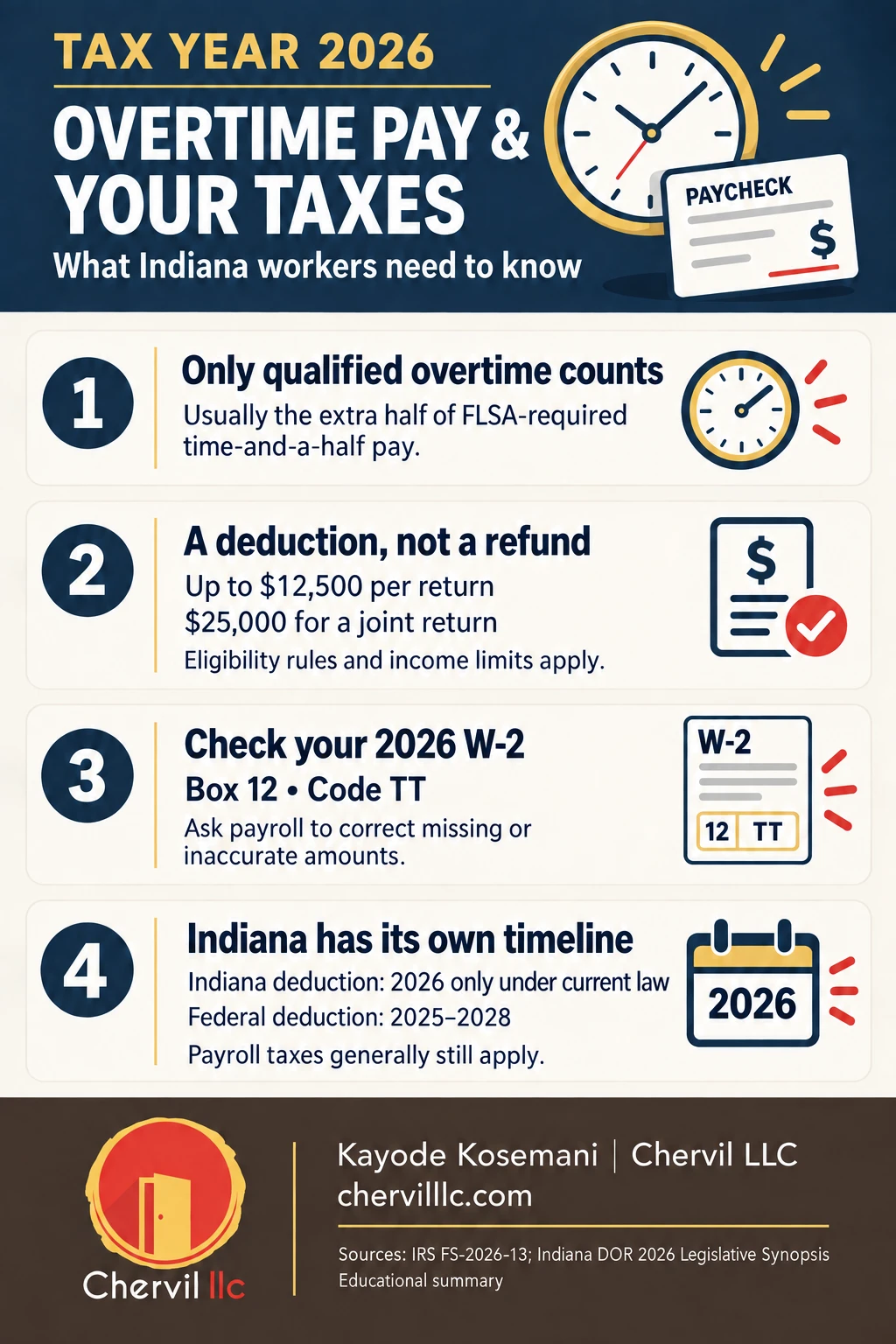
The federal overtime deduction applies for 2025 through 2028. Eligible taxpayers can claim it whether they take the standard deduction or itemize. It reduces taxable income; it is not a dollar-for-dollar credit or a guaranteed refund.
| Federal rule | Amount or requirement |
|---|---|
| Maximum deduction per return | $12,500 |
| Maximum on a joint return | $25,000 total |
| Income phaseout begins | Modified adjusted gross income above $150,000; $300,000 for joint filers |
| Married taxpayers | Generally must file jointly to claim the deduction |
| Identification | A qualifying Social Security number is required |
The annual maximum is a ceiling, not an automatic allowance. A worker with $2,000 of eligible compensation cannot claim $12,500 merely because that is the limit. IRS overview for individuals and workers
2. Only qualifying overtime compensation counts
The core test is overtime required under section 7 of the Fair Labor Standards Act, or FLSA. Generally, the deductible component is the premium above the regular pay rate. For ordinary time-and-a-half pay, that is the additional half-rate amount.
Overtime paid solely under an employer policy, union agreement or state rule does not qualify unless it also meets the federal FLSA requirement. A pay-stub label alone does not establish eligibility. Coverage and exemptions matter; special calculations can apply to certain public employees and other workers.
Illustration: Assume an eligible employee’s FLSA regular rate is $20 per hour, the employee works 45 compensable hours in one workweek, and the five overtime hours are paid at $30 per hour.
| Component of those five overtime hours | Calculation | Amount |
|---|---|---|
| Regular-rate component | 5 × $20 | $100 |
| Additional overtime premium | 5 × $10 | $50 |
| Total overtime pay | 5 × $30 | $150 |
In this simplified example, $50 is the qualified overtime amount before other deduction limits. The entire $150 is not the eligible premium. Bonuses or other compensation can affect the regular rate and change the calculation. IRS updated overtime FAQs, especially Questions 4 and 12–17
3. What a deduction can mean in dollars
Suppose an otherwise eligible worker has a fully allowable $2,000 overtime deduction. If every dollar of that deduction reduces income otherwise taxed at 12%, the illustrative federal income-tax reduction is $240. At 22%, it would be $440.
These are arithmetic examples, not refund estimates. Actual results depend on the complete return, including taxable income, applicable limits, credits, withholding and payments. A deduction can reduce a balance due, increase a refund or change neither by the illustrated amount.
Overtime remains wage income. The deduction does not generally eliminate Social Security or Medicare taxes on those wages. IRS overtime FAQs, Question 1
4. Your 2026 W-2 deserves an extra check
The 2026 Form W-2 includes Box 12, code TT, for qualified overtime compensation. Its recipient instructions direct taxpayers to use that amount in calculating the deduction on Schedule 1-A, Part III. The amount reported is not automatically the amount ultimately deductible. 2026 Form W-2 and recipient instructions
The IRS’s August 2026 FAQs draw a significant distinction from the special 2025 transition rules: for 2026, employees should not simply substitute their own larger estimate when qualified overtime is missing or understated on the W-2. Request Form W-2c from the employer. The FAQs also state that Form 4852 does not satisfy this separate-reporting requirement. IRS updated overtime FAQs, Questions 19–23
Compare the W-2 with your year-end payroll records. If something looks wrong, raise the question promptly and keep copies of your correspondence. Also verify the employment-valid SSN requirement and joint-filing rule before claiming the deduction. IRS updated overtime FAQs, Questions 24–25
5. Indiana’s deduction has a different timeline
Indiana’s 2026 legislation added an overtime deduction under Indiana Code 6-3-2-33. The Department of Revenue’s legislative synopsis describes it as available for the 2026 tax year only, tied to the qualifying federal deduction.
The rules address both state adjusted gross income tax and county local income tax. When part of the overtime is excluded from the relevant Indiana tax base, an allocation can reduce the allowable deduction. Part-year residents and people working across state lines should have the calculation reviewed.
| Tax system | Deduction timeline |
|---|---|
| Federal qualified overtime deduction | 2025–2028 |
| Indiana qualified overtime deduction | 2026 only |
Do not apply this Indiana provision to 2025 income or assume it continues in 2027 without a law change. Use the final instructions for the return being filed. Indiana DOR 2026 Legislative Synopsis, pages 16–17, SEA 243
6. Should you change your paycheck withholding?
A possible deduction is a reason to review withholding carefully. It is not a reason to claim that all your wages are exempt.
The 2026 Form W-4 includes a deductions worksheet that accounts for qualified overtime. Review your expected annual income and deductions before submitting a revised W-4 to your employer. This form changes federal withholding; it does not itself claim the deduction on your eventual return. 2026 Form W-4
The IRS recommends a withholding check after changes such as a new job, multiple jobs, marriage, a new dependent or a significant income change. Its estimator can help identify whether current withholding is too high or too low. Review both spouses’ jobs when applicable, and revisit the calculation if overtime is irregular. IRS September 4 paycheck-checkup reminder
7. A practical checklist before filing
- Ask payroll how qualified overtime is identified. Distinguish the FLSA premium from total overtime earnings.
- Keep pay statements and year-end summaries. Store them together so you can compare them with the W-2.
- Review your filing situation. Include income from other jobs and your spouse’s income when relevant.
- Check Box 12, code TT. Request a correction promptly if the amount is missing or inaccurate.
- Review federal and Indiana treatment separately. Different effective years and allocation rules can change the result.
- Bring the complete records to tax preparation. Include W-2 corrections and any payroll explanation, rather than relying on a verbal overtime total.
Chervil LLC’s recommendation is to resolve payroll questions early. A clear record of what was paid and how it was reported makes tax preparation more efficient and helps support the deduction actually allowed.
For a broader withholding review, read our paycheck withholding checkup.
General educational information. Eligibility and tax outcomes depend on individual facts. Guidance and forms may change; verify the rules when filing.
CONNECT WITH CHERVIL LLC
Have questions about overtime on your tax return?
Contact Chervil LLC to review your wage documents, filing situation and applicable federal and Indiana deductions.