
Share this publication
Send this Chervil resource to someone who may find it useful.
2026 federal tax edition. Research reviewed October 11, 2026. State and local taxes require separate analysis.
Your job and your business share a tax story
You receive a paycheck during the week and run a business after work. Someone suggests an LLC. Someone else says an S corporation will save tax. Another person points to the C corporation's 21% rate. Which advice fits your situation?
Start with three questions: who earned the money, what kind of income is it, and how will the owner receive it? The answer depends on your whole situation, including your job, business profit, work duties and plans for the money.
A business structure is not a coupon for a lower tax bill. Compare the owner and the business together, using the same facts.
This publication follows Mr. Xavier through three alternatives and explains each calculation. It builds on Chervil's earlier article about why putting personal purchases in an LLC does not make them deductible. Chervil: Put Everything in an LLC and Deduct It?
1. An LLC is a legal structure; taxation is a separate choice
A limited liability company (LLC) is created under state law. Federal tax classification tells the IRS how its income is reported. Think of the LLC as the business's legal identity and the tax classification as the reporting rules it follows. Liability protection has limits and does not replace insurance.
Open this illustration at full size
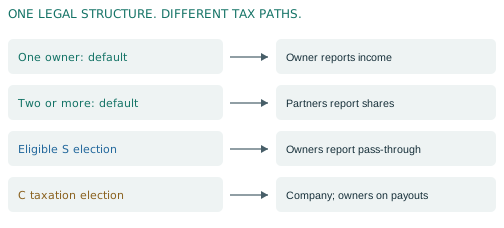
Figure: An LLC is formed under state law. Ownership and valid elections determine its federal income-tax treatment.
With one individual owner, the default is usually a disregarded entity: the IRS generally includes the activity on that owner's income-tax return. An operating business commonly uses Schedule C; rental or farming activities may use other schedules. With two or more owners, a domestic LLC normally uses partnership taxation unless an election changes that treatment. IRS Publication 3402: Taxation of LLCs
An eligible LLC can elect corporate taxation. S corporation status generally passes income to eligible owners; C corporation taxation generally makes the business a separate income-tax payer. Forming an LLC alone does not make an S election. IRS Publication 3402: Taxation of LLCs
| Arrangement | Who normally pays federal income tax on profit? |
|---|---|
| Default single-member LLC | The individual owner. |
| Default partnership LLC | The partners on their allocated shares. |
| S corporation | The shareholders; special entity-level taxes can apply. |
| C corporation | The corporation; shareholders may also owe tax on dividends. |
Pass-through means tax items move to the owners' returns. Keeping cash in a pass-through business usually does not postpone the owners' tax. A distribution is a payment to an owner; it is not automatically the amount of taxable profit. IRS Publication 541: Partnerships; IRS: S corporations
2. Tax brackets work in layers
Revenue is money the business brings in. Profit is revenue minus allowable business costs. Taxable income is the amount left for income-tax purposes after applicable deductions. The tables below apply to taxable ordinary income, not automatically to sales or gross pay. Revenue Procedure 2025-32: 2026 tax adjustments
A marginal rate is the rate on the next dollar in a particular tax category. An effective rate is total tax divided by a clearly identified income amount. Always say which tax and which income you are comparing.
Open this illustration at full size
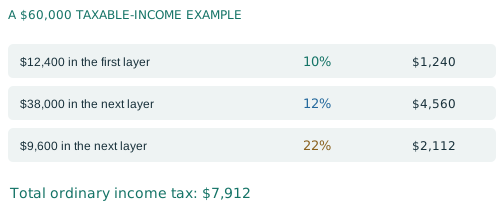
Figure: Single filer, 2026. The 22% rate touches only the top $9,600 in this illustration. Before credits and other taxes.
The illustration uses $60,000 of taxable ordinary income for a single filer. Only the last $9,600 falls in the 22% bracket. Tax is $7,912, not 22% of the entire $60,000. That is about 13.19% of this taxable-income amount, before other taxes or credits.
| 2026 rate | Single | Married filing jointly* |
|---|---|---|
| 10% | $0 to $12,400 | $0 to $24,800 |
| 12% | Over $12,400 to $50,400 | Over $24,800 to $100,800 |
| 22% | Over $50,400 to $105,700 | Over $100,800 to $211,400 |
| 24% | Over $105,700 to $201,775 | Over $211,400 to $403,550 |
| 32% | Over $201,775 to $256,225 | Over $403,550 to $512,450 |
| 35% | Over $256,225 to $640,600 | Over $512,450 to $768,700 |
| 37% | Over $640,600 | Over $768,700 |
| 2026 rate | Head of household | Married filing separately |
|---|---|---|
| 10% | $0 to $17,700 | $0 to $12,400 |
| 12% | Over $17,700 to $67,450 | Over $12,400 to $50,400 |
| 22% | Over $67,450 to $105,700 | Over $50,400 to $105,700 |
| 24% | Over $105,700 to $201,750 | Over $105,700 to $201,775 |
| 32% | Over $201,750 to $256,200 | Over $201,775 to $256,225 |
| 35% | Over $256,200 to $640,600 | Over $256,225 to $384,350 |
| 37% | Over $640,600 | Over $384,350 |
*Qualifying surviving spouses use the joint rate schedule. Filing status follows eligibility rules; it is not simply a choice of the best table. Basic 2026 standard deductions are $16,100 single or married filing separately, $32,200 joint, and $24,150 head of household. Special rules can change the deduction. A deduction reduces income subject to tax; a credit reduces the tax itself, subject to its rules. Revenue Procedure 2025-32: 2026 tax adjustments
3. Several different taxes can apply
Income tax and employment taxes do different jobs. FICA is the Social Security and Medicare tax system for employees and employers. Self-employment tax generally provides corresponding taxes for people working for themselves. Do not simply add a 24% income-tax bracket to 15.3% and apply the result to all revenue. IRS Publication 15: 2026 employer tax guide; IRS Topic 554: Self-employment tax
| Tax | 2026 rule and tax base |
|---|---|
| Employee Social Security | 6.2% of covered wages up to $184,500 per person. |
| Employer Social Security | 6.2% on covered wages, generally with its own wage-base obligation for each unrelated employer. |
| Employee / employer Medicare | 1.45% each on covered wages; no earnings cap. |
| Regular self-employment tax | 12.4% Social Security plus 2.9% Medicare, generally on 92.35% of covered net profit. The Social Security portion is limited by the remaining wage base after covered wages. |
| Additional Medicare Tax | 0.9% on applicable combined wages and self-employment earnings above the filing-status threshold. No employer matching amount. |
| Regular C corporation income tax | 21% of corporate taxable income, not gross receipts. |
| Net Investment Income Tax (NIIT) | 3.8% of the smaller of net investment income or excess modified adjusted gross income over the applicable threshold. |
For Additional Medicare Tax and NIIT, the usual thresholds are $200,000 for single or head of household, $250,000 joint, and $125,000 married filing separately. They tax different income categories. NIIT does not apply to wages. Modified adjusted gross income starts with income after certain adjustments, with modifications required for that tax. IRS Topic 560: Additional Medicare Tax; IRS Topic 559: Net Investment Income Tax
A qualified dividend is a corporate dividend meeting special requirements, including relevant holding-period rules. Its federal rate is generally 0%, 15% or 20%. Ordinary taxable income uses up lower-rate space before qualified dividends are stacked on top. Nonqualified dividends generally use ordinary income-tax rates. IRS Topic 404: Dividends and distributions; IRS Topic 409: Capital gains and losses
| Filing status | 0% through | 15% through; 20% above |
|---|---|---|
| Single | $49,450 | $545,500 |
| Married filing jointly* | $98,900 | $613,700 |
| Head of household | $66,200 | $579,600 |
| Married filing separately | $49,450 | $306,850 |
These 2026 dividend boundaries refer to total taxable income, including qualified dividends and net capital gain; they are not separate allowances for dividends. *Also qualifying surviving spouses. NIIT may be additional. Revenue Procedure 2025-32: 2026 tax adjustments
4. Meet Mr. Xavier: one business, three tax treatments
Mr. Xavier, age 40 and single, earns $50,000 at an unrelated employer. Form W-2 is the employer's annual statement of wages and taxes withheld. He also owns a small specialty-products business. After inventory costs and ordinary operating expenses, it earns $100,000 before his own salary and related employer payroll taxes. This is profit, not sales.
He materially participates, meaning he is sufficiently involved under the tax participation rules. He is the only owner, has no dependents or other income, takes the $16,100 standard deduction, and has no credits, retirement contributions or health-insurance deductions in this model. His outside wages are fully subject to Social Security and Medicare.
For both corporate alternatives, assume $60,000 is supportable compensation for his actual work after reviewing hours, duties, comparable pay and the role of employees and capital. That is a modeling assumption, not an IRS safe harbor. His part-time schedule alone does not establish a reasonable salary. IRS: S corporation compensation and health insurance
We include federal ordinary income tax, qualified-dividend tax, regular Social Security and Medicare taxes, and regular corporate income tax where applicable. We exclude state/local taxes, unemployment taxes, extra payroll/accounting fees and special industry taxes. Those costs must be added before a real decision.
Assume full eligibility for the qualified business income (QBI) deduction where shown. This can deduct up to 20% of eligible pass-through business income, subject to limits. Employee wages and C corporation operating income do not qualify. The deduction reduces income tax, not self-employment tax. IRS: Qualified business income deduction
We use rate-schedule mathematics without intermediate rounding. Filed-return tax tables and whole-dollar rounding may give slightly different results. There is no Additional Medicare Tax or NIIT under these facts. With only his $50,000 job, taxable income would be $33,900 and ordinary income tax about $3,820. His own outside-job FICA is $3,825. This $7,645 baseline is constant across the alternatives.
5. Xavier keeps default single-member LLC taxation
His business profit goes on his personal return. He cannot turn his owner draw into deductible wages to himself. Taking out $40,000 or the full $100,000 does not change the starting $100,000 profit. IRS Publication 3402: Taxation of LLCs
| Step | Calculation / result |
|---|---|
| Self-employment earnings | $100,000 x 92.35% = $92,350 |
| Regular self-employment tax | $92,350 x 15.3% = $14,129.55 |
| Income adjustment for half that tax | $14,129.55 / 2 = $7,064.775 |
| Adjusted gross income | $50,000 + $100,000 - $7,064.775 = $142,935.225 |
| QBI deduction in this example | 20% x ($100,000 - $7,064.775) = $18,587.045 |
| Taxable ordinary income | $142,935.225 - $16,100 - $18,587.045 = $108,248.18 |
| Ordinary income tax | $17,966 + 24% x $2,548.18 = $18,577.56 |
| Additional federal tax from the business | $18,577.56 - $3,820 + $14,129.55 = $28,887.11 |
His job wages plus self-employment earnings total $142,350, below the $184,500 Social Security base, so the full regular self-employment calculation applies. The deduction for half the tax does not refund half the tax; it reduces income used for the income-tax calculation. IRS Topic 554: Self-employment tax; Social Security: 2026 contribution and benefit base
Combined modeled tax, including his $3,825 outside-job FICA, is $36,532.11. From $150,000 of wages and pre-owner-pay profit, about $113,467.89 remains after the included federal taxes. The business itself does not generally pay separate federal income tax under this default classification.
6. Xavier elects S corporation taxation
The business pays him wages for his work. The remaining profit passes to his personal return. A Schedule K-1 is the form reporting his share of the business's tax items. Qualified nonwage profit generally avoids self-employment tax, but still faces income tax. IRS: S corporations; IRS: S corporation compensation and health insurance
| Step | Calculation / result |
|---|---|
| Owner wages | $60,000 |
| Employer FICA | $60,000 x 7.65% = $4,590 |
| Employee FICA withheld from owner pay | $60,000 x 7.65% = $4,590 |
| Remaining business profit | $100,000 - $60,000 - $4,590 = $35,410 |
| QBI deduction | 20% x $35,410 = $7,082 |
| Taxable ordinary income | $50,000 + $60,000 + $35,410 - $16,100 - $7,082 = $122,228 |
| Ordinary income tax | $17,966 + 24% x $16,528 = $21,932.72 |
| Additional federal tax from the business | $21,932.72 - $3,820 + $9,180 = $27,292.72 |
The employer contribution reduces corporate profit. The employee contribution comes from Xavier's salary; it is not a second corporate wage deduction. His salary is not QBI. Assume sufficient stock basis and no old C corporation earnings, so paying out the current $35,410 profit causes no second income tax. Basis is a tax tracking amount used to determine whether withdrawals or losses create additional consequences. IRS Publication 15: 2026 employer tax guide; IRS: Qualified business income deduction; IRS: S corporation stock and debt basis
Combined modeled tax, including outside-job FICA, is $34,937.72; about $115,062.28 remains personally if all available business cash is distributed. His regular business employment taxes fall by $4,949.55 versus the default LLC, but income tax rises by $3,355.16. The net modeled federal saving is only $1,594.39, before extra costs.
Payroll software, preparation fees, unemployment taxes, different reasonable wages or state taxes could reduce or eliminate this saving. A smaller payroll-tax number alone does not prove that an S election is worthwhile.
7. Xavier uses C corporation taxation
Use the same $60,000 salary and $4,590 employer FICA. The corporation has $35,410 of taxable profit after those deductions. Unlike an S corporation, it generally pays its own income tax. Xavier pays personal tax on his wages and on any taxable dividend he receives. IRS Publication 542: Corporations
| Step | Calculation / result |
|---|---|
| Corporate income tax | $35,410 x 21% = $7,436.10 |
| After-tax corporate profit | $35,410 - $7,436.10 = $27,973.90 |
| Personal taxable ordinary income | $50,000 + $60,000 - $16,100 = $93,900 |
| Personal ordinary income tax | $5,800 + 22% x $43,500 = $15,370 |
| Qualified dividend if all profit paid out | $27,973.90; assume qualification requirements met |
| Dividend tax | $27,973.90 x 15% = $4,196.09 |
| Business-related employer + employee FICA | $4,590 + $4,590 = $9,180 |
| Additional federal tax from the business | $15,370 + $4,196.09 - $3,820 + $9,180 + $7,436.10 = $32,362.19 |
All the dividend falls in the 15% band because ordinary taxable income already exceeds the single 0% boundary, and total taxable income remains below the 20% boundary. Corporate dividends are not deductible by the corporation. The QBI deduction does not apply to this corporate profit or to the owner's wages. IRS Topic 404: Dividends and distributions; Revenue Procedure 2025-32: 2026 tax adjustments; IRS: Qualified business income deduction
If all remaining profit is distributed, combined modeled tax is $40,007.19, including outside-job FICA. Personal after-tax cash is about $109,992.82. Calculations use unrounded values; displayed rounded amounts may differ by a cent when added.
What if he keeps the profit in the company?
Without a current dividend, modeled tax is $35,811.10, of which $28,166.10 is additional to his W-2-only baseline. The corporation retains $27,973.90; Xavier has $86,215 personally after the included taxes on wages. The combined $114,188.90 is split between two taxpayers. A later dividend can add tax, so this is not comparable to receiving all the money now.
Retaining cash for a documented business need can postpone shareholder dividend tax. It does not cancel corporate income tax, and unreasonable accumulation to avoid shareholder tax can trigger an additional tax. IRS Publication 542: Corporations
8. Compare the whole result, not a headline rate
Open this illustration at full size
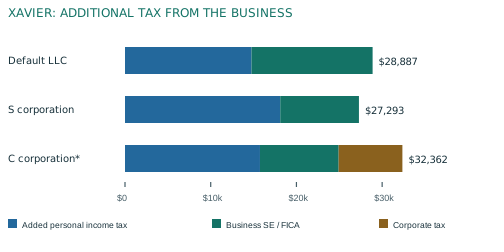
**Figure: Same $50,000 outside W-2 and $100,000 business profit before owner pay. Corporate owner salary: $60,000. *C corporation pays all remaining profit as a qualified dividend. Excludes state/local tax, unemployment tax and extra fees. See calculations and assumptions in the text.**
| Same $100,000 starting business profit | Default LLC | S corporation | C corporation* |
|---|---|---|---|
| Additional modeled federal tax | $28,887.11 | $27,292.72 | $32,362.19 |
| Tax as % of starting business profit | 28.89% | 27.29% | 32.36% |
| Total included tax with W-2 baseline | $36,532.11 | $34,937.72 | $40,007.19 |
| Personally available cash after included taxes | $113,467.89 | $115,062.28 | $109,992.82 |
*C corporation distributes all after-tax profit as a qualified dividend. Figures follow Xavier's assumptions; these percentages are scenario results, not statutory entity rates. The outside employer's own payroll tax is excluded because it is unchanged and is not paid by Xavier or his business. Business employer payroll tax is included.
The lesson is not that one structure always wins. Xavier's result depends on his salary, deductions, filing status, business activity and distribution plan. Changing those facts changes the comparison. State and local tax and real operating costs still need to be modeled.
9. Your other paycheck can change the answer
An outside job usually fills some lower income-tax brackets before business income is added. It can also affect QBI limitations and other deductions. Withholding is money sent to the IRS in advance; it is not the final tax rate. IRS Publication 505: Withholding and estimated tax; IRS: Qualified business income deduction
Now imagine $190,000 of covered outside wages instead of $50,000. Those wages already exceed the 2026 Social Security base. A default LLC owner generally has no remaining Social Security self-employment-tax base, although Medicare and possibly Additional Medicare Tax remain. IRS Topic 554: Self-employment tax; Social Security: 2026 contribution and benefit base; IRS Topic 560: Additional Medicare Tax
An S or C corporation paying the owner wages generally still owes its own employer Social Security tax. Unrelated employers normally withhold independently. The owner can generally claim a credit for excess employee Social Security from multiple employers; that does not ordinarily refund the corporation's employer share. Special common-paymaster or successor rules need separate review. IRS Publication 15: 2026 employer tax guide; IRS Topic 608: Excess Social Security withholding
Two partners, equal profit, different tax
Consider a separate partnership LLC owned equally by Ana and Ben. Each receives $40,000 of business profit assumed fully subject to self-employment tax. Both are single, active owners. Ana has $100,000 of outside covered wages; Ben has $190,000. Their individual employment-tax results differ:
| On each $40,000 profit share | Ana | Ben |
|---|---|---|
| Regular self-employment tax | $5,651.82 | $1,071.26 |
| Additional Medicare Tax caused by LLC earnings | $0 | $242.46 |
Both use $36,940 of self-employment earnings. Ana pays 15.3% on that amount. Ben has no remaining Social Security base, so pays 2.9% Medicare, plus 0.9% on $26,940 above his $200,000 combined threshold. Ordinary income tax is additional and depends on each return. LLC member self-employment treatment can be fact-sensitive; these shares are expressly assumed covered. IRS Publication 541: Partnerships; IRS Topic 554: Self-employment tax; IRS Topic 560: Additional Medicare Tax
10. When S corporation treatment may help
It may fit an eligible operating business with reliable profit left after reasonable owner wages and enough expected savings to justify payroll and tax-return costs. The election has ownership restrictions, generally including no more than 100 shareholders, allowable shareholder types and one class of stock. Nonresident alien shareholders generally are not eligible. IRS: S corporations
An outside W-2 job does not remove the need for reasonable compensation for services to the S corporation. The right wage depends on the work and the business, not a fixed percentage. A solo service business whose revenue largely comes from its owner's labor may need a much larger wage than Xavier's assumed amount. IRS: S corporation compensation and health insurance
An S corporation still requires payroll records, timely filings, a separate business return and ownership-basis records. Some health-benefit and retirement rules depend on wages and ownership. Lower wages can mean less retirement contribution capacity. Review employer retirement plans together rather than assuming separate jobs always create separate employee contribution limits. IRS: S corporation retirement contributions; IRS Publication 560: Small business retirement plans; IRS: S corporation compensation and health insurance
11. When C corporation treatment may help
A company seeking outside equity investors or multiple stock classes may find C corporation ownership more suitable than S status. The decision should connect financing needs with tax costs. More complicated ownership is not itself a tax saving. IRS: S corporations; IRS Publication 542: Corporations
A growing business may reinvest after-tax earnings in staff, equipment, inventory or expansion. Deferring a dividend can leave capital in the business, but that capital belongs to the corporation. Include the eventual cost of taking it out. IRS Publication 542: Corporations
Qualifying employee health and other fringe benefits may be attractive when the applicable plan and nondiscrimination rules are met. A fringe benefit is a benefit supplied in addition to cash wages. Paying an owner's personal bills does not automatically create a tax-free benefit. IRS Publication 15-B: 2026 fringe benefits
Certain stock sales may qualify for the qualified small business stock (QSBS) exclusion under Section 1202. For qualifying stock acquired after July 4, 2025, potential exclusions are 50% after three years, 75% after four, and 100% after five or more. Issuance, asset-size, business-activity, holding-period and gain limits apply. Many service businesses, including accounting, law and consulting, are excluded. Earlier stock has different rules. This concerns qualifying stock-sale gain, not everyday profits or a corporate asset sale. 26 USC 1202: Qualified small business stock
C corporation treatment can support a business plan even when it is not the cheapest way to withdraw this year's profit. Assess the financing, benefits, ownership and eventual exit together.
Corporate operating losses generally remain with the company rather than offsetting the owner's outside wages. Dividends can create a second tax layer. Selling appreciated assets and then distributing the proceeds can also be costly. IRS Publication 542: Corporations; 26 USC 311: Gain on corporate property distributions
12. A business name does not turn personal use into a deduction
Open this illustration at full size
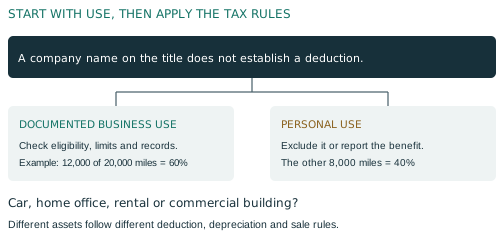
Figure: Illustrative mileage split, not a universal allocation. Corporate personal use can create taxable compensation or a distribution.
Suppose Xavier drives 20,000 miles, of which 12,000 are documented qualifying business miles. Business use is 60%. Under an eligible actual-cost method, $10,000 of qualifying mixed-use running costs would generally support a $6,000 business allocation. The personal 40% is not a business deduction. Vehicle purchase cost, interest and depreciation require their own rules. IRS Topic 510: Business use of car
An eligible taxpayer may instead use the standard mileage method. Keep a dated business-mileage log and total miles; do not deduct the same costs again under both methods. Ordinary travel from home to a regular workplace is generally personal commuting. A qualifying principal home office can change some trip classifications. IRS Topic 510: Business use of car; IRS Publication 463: Travel, gifts, cars and reimbursements
If an S or C corporation owns a car, personal use generally creates a taxable employee benefit or another owner-level consequence. Alternatively, the owner may use a personal car and receive substantiated reimbursement under an accountable plan: a business reimbursement arrangement requiring a business connection, timely evidence and return of excess advances. IRS Publication 15-B: 2026 fringe benefits; IRS Publication 463: Travel, gifts, cars and reimbursements
Depreciation means recovering an asset's cost through tax deductions, sometimes over years and sometimes faster under special rules. A loan payment is not automatically deductible: principal pays for the asset, while allowable interest and cost recovery are separate. A large vehicle write-off depends on classification, business use, timing and deduction limits. A later sale or drop in business use may produce taxable recapture, meaning earlier deductions are partly brought back into income. IRS Publication 946: Depreciation
A $6,000 deduction does not mean a $6,000 refund. At a 24% income-tax margin, its isolated income-tax effect would be $1,440 before interactions. At the regular 21% corporate rate, it would be $1,260. QBI, employment taxes and other limits can change the full result.
13. A home, an office and a rental are different situations
Your personal residence
Moving a personal home into an LLC does not make household costs business expenses. A wholly owned disregarded LLC can preserve individual treatment for the home-sale exclusion when the relevant requirements are met. Corporate ownership ordinarily does not preserve the same personal exclusion. Financing, title, insurance and state-law consequences also need review. Treasury Regulation 1.121-1: Principal-residence exclusion; IRS Publication 523: Selling your home
A qualifying home office
A self-employed owner generally needs regular, exclusive qualifying business use, subject to specific exceptions. A desk occasionally used at the family dining table usually does not satisfy exclusive use. Under the simplified method, an eligible 200-square-foot office can produce a $1,000 deduction at $5 per square foot, subject to the applicable limit and rules. This does not make the entire mortgage deductible. IRS Publication 587: Business use of your home; IRS: Simplified home-office deduction
A shareholder-employee may instead evaluate corporate reimbursement of qualifying actual home-office costs through an accountable arrangement. Do not simply use the self-employed simplified deduction as a corporate reimbursement formula. IRS Publication 463: Travel, gifts, cars and reimbursements; IRS Publication 587: Business use of your home
Rental or commercial property
Income-producing property can have deductible operating costs and depreciation. Land is not depreciable. A $300,000 residential rental with $60,000 allocated to land leaves $240,000 for the building; a full-year straight-line amount over 27.5 years is about $8,727. First and final years follow convention rules. Commercial buildings normally use a different recovery period. Rental losses may be limited even when the owner has a W-2 job. IRS Publication 527: Residential rental property; IRS Publication 925: Passive activity and at-risk rules
Think about the exit before transferring real estate. A corporation distributing a building worth $500,000 with a $250,000 adjusted basis can recognize $250,000 of gain even without selling it to an outsider. In a C corporation, shareholder-level tax may also follow; in an S corporation, the gain normally passes through and affects basis. 26 USC 311: Gain on corporate property distributions; IRS: S corporation stock and debt basis
14. Turn the comparison into a useful conversation
Bring your filing status, outside pay statements, expected business revenue and expenses, ownership details, work duties, desired cash withdrawals, benefits, asset records and growth plans. Ask for the owner and business returns to be modeled together.
| Bring this | Why it matters |
|---|---|
| Outside W-2 wages and withholding | Income brackets, employment taxes and payments already made. |
| Profit forecast, not just sales | The amount available before owner pay and tax. |
| Owner duties and hours | Support for reasonable corporate compensation. |
| Current tax election and ownership records | Which reporting rules actually apply. |
| Vehicle logs and property records | Business-use evidence, basis and future sale effects. |
| Cash needs and investor plans | Whether retaining profit or corporate ownership fits. |
Estimated tax is a pay-as-you-go payment toward the final bill. Additional W-2 withholding may help cover tax on a side business; quarterly estimates may be appropriate. A larger payment reduces the balance due, not necessarily the underlying tax. Corporations have separate payment rules. IRS Publication 505: Withholding and estimated tax; IRS Publication 542: Corporations
General federal education for individual U.S. owners; this is not a personal recommendation, a complete return calculation or a promise of savings. State and local taxes require a separate review. Rates, elections and results must be checked for the taxpayer and year involved.
Keep a guide handy
Download these free resources to read or print. Each includes explanations, examples, a preparation worksheet and Chervil contact details.
- Complete article (PDF)
- LLC reader guide: single-member and partnership LLCs (PDF)
- S corporation reader guide (PDF)
- C corporation reader guide (PDF)
Quick glossary
Adjusted gross income (AGI) — Income after certain adjustments, before the standard or itemized deduction.
Basis — A tax tracking amount, often starting with cost or investment and changing with later events.
Capitalization — Recording a cost as part of an asset rather than deducting it immediately.
Deduction / credit — A deduction reduces taxable income; a usable credit reduces tax.
Distribution / dividend — A distribution pays an owner. A dividend is a particular kind of corporate distribution with its own tax rules.
Effective / marginal rate — An average tax percentage on a stated base / the rate on the next relevant dollar.
FICA / self-employment tax — Social Security and Medicare taxes for employment / corresponding taxes on covered self-employment income.
Pass-through / K-1 — Income reported by owners / the schedule showing an owner's allocated tax items.
QBI — Qualified business income: eligible business income used for a potentially available deduction.
Reasonable compensation — Pay supportable for the services actually performed.
Recapture — Rules that can bring earlier tax benefits back into taxable income.
Withholding / estimated tax — Advance payments toward a final tax bill, not separate deductions.
Sources and scope
Research reviewed October 11, 2026. Older publication editions support continuing rules; annual figures use current authorities. This federal educational resource does not replace individualized advice.
- Chervil: Put Everything in an LLC and Deduct It?
- IRS Publication 3402: Taxation of LLCs
- IRS Publication 541: Partnerships
- IRS: S corporations
- Revenue Procedure 2025-32: 2026 tax adjustments
- IRS Publication 15: 2026 employer tax guide
- IRS Topic 554: Self-employment tax
- Social Security: 2026 contribution and benefit base
- IRS Topic 560: Additional Medicare Tax
- IRS Topic 559: Net Investment Income Tax
- IRS Publication 542: Corporations
- IRS Topic 404: Dividends and distributions
- IRS Topic 409: Capital gains and losses
- IRS: S corporation compensation and health insurance
- IRS: Qualified business income deduction
- IRS: S corporation stock and debt basis
- IRS Publication 505: Withholding and estimated tax
- IRS Topic 608: Excess Social Security withholding
- IRS: S corporation retirement contributions
- IRS Publication 560: Small business retirement plans
- IRS Publication 15-B: 2026 fringe benefits
- 26 USC 1202: Qualified small business stock
- 26 USC 311: Gain on corporate property distributions
- IRS Topic 510: Business use of car
- IRS Publication 463: Travel, gifts, cars and reimbursements
- IRS Publication 946: Depreciation
- Treasury Regulation 1.121-1: Principal-residence exclusion
- IRS Publication 523: Selling your home
- IRS Publication 587: Business use of your home
- IRS: Simplified home-office deduction
- IRS Publication 527: Residential rental property
- IRS Publication 925: Passive activity and at-risk rules
CONNECT WITH CHERVIL LLC
Chat with Chervil LLC
Bring your questions, expected profit and ownership plans. Call 317-488-0021 or email sayhi2ky@chervilllc.com to start a conversation.