
Share this publication
Send this Chervil resource to someone who may find it useful.
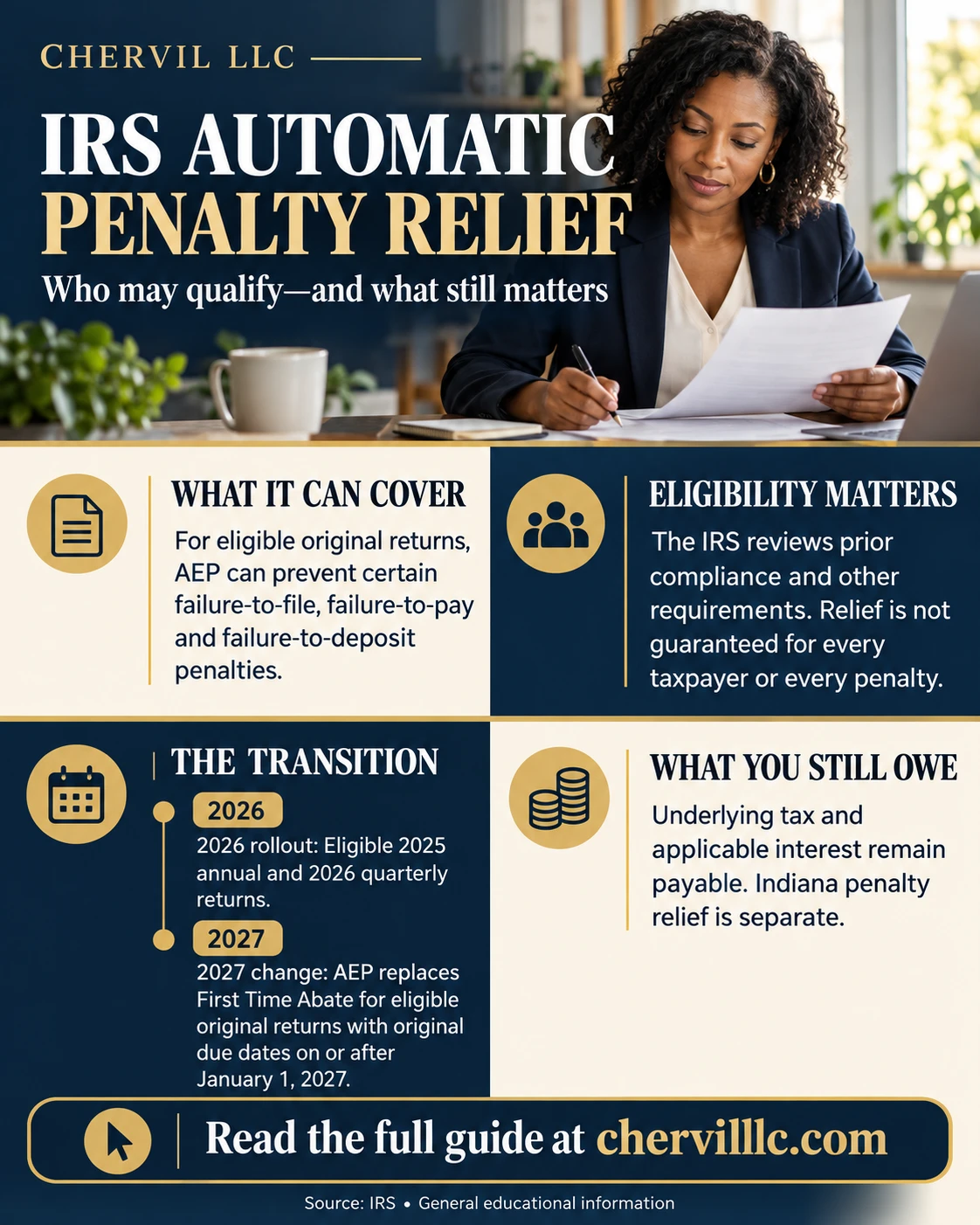
A late tax return or payment can leave you worried about more than the original balance. For qualifying taxpayers, the IRS’s Automatic Exemption from Penalty (AEP) can prevent certain penalties from being assessed.
The program rewards a qualifying compliance history. It does not erase unpaid tax or make every late filer eligible. Understanding the return type, tax period and prior filing record is essential before relying on relief.
What automatic relief means
Under AEP, the IRS checks eligibility while processing an original return. Qualifying taxpayers do not submit a separate application; the IRS sends confirmation that relief was applied.
Covered categories include certain penalties for filing late, paying late and failing to make required federal tax deposits. These are different obligations: filing a return does not itself pay the tax, and an employer may have deposit deadlines separate from its return deadline.
Information-return penalties, accuracy-related penalties and other excluded penalties are not automatically forgiven. The program is not a general tax amnesty. [1]
The dates that matter
The IRS announced a summer 2026 transition, beginning with eligible 2025 tax-year returns and 2026 quarterly returns. “Starting with 2025 returns” refers to the tax period, not a requirement that the return was filed during calendar year 2025.
| Return or period | Relief route to review |
|---|---|
| Eligible 2024 annual returns, 2025 quarterly returns and earlier periods | First Time Abate may remain available by request. |
| Eligible 2025 annual and 2026 quarterly returns during the transition | AEP may apply; some returns not considered for AEP may still qualify for requested First Time Abate. |
| Eligible original returns with original due dates on or after January 1, 2027 | AEP replaces First Time Abate. |
The January 2027 change concerns the original due date, not simply the day someone submits a late return. [1, 2]
Who should check eligibility
The IRS reviews the relevant return type’s prior three years, or 12 consecutive quarters. Its rules look at filing history and prior penalties; an estimated-tax penalty is treated differently when evaluating that history. A penalty removed for reasonable cause or IRS error may not have the same effect as one removed under First Time Abate.
Eligible return categories include individual income-tax returns and various business income and employment-tax returns. Employers have additional deposit-compliance requirements. A good personal filing history should not be assumed to establish eligibility for every business return. [3]
Several additional details matter:
- The eligible original return must be filed within three years of its original due date. An extension does not restart that window.
- For a joint return, both spouses must meet the compliance-history requirements.
- Records showing no filing requirement can count in the history review.
- Prior AEP or First Time Abate within the lookback can prevent qualification. After AEP, a fresh three-year or 12-quarter qualifying history is generally needed.
- An otherwise eligible return missed because of IRS error can require manual correction. [4]
These are eligibility checks, not a recommendation to delay filing.
What you still owe
AEP does not cancel the underlying tax or interest on unpaid tax. Penalties outside its coverage can also remain.
An important distinction from First Time Abate is that, when AEP applies, the covered failure-to-pay penalty is not assessed or allowed to continue accruing on that tax-period account. That protection does not stop interest on unpaid tax. If an assessed penalty is reduced or removed, the related penalty interest is adjusted separately. [2, 3]
What to do with an IRS notice
Read the notice even if you expect automatic relief. Confirm the tax period, return type, penalty category and response deadline.
If a penalty appears and you believe you qualify, contact the IRS using the number on the notice. During the transition, ask whether First Time Abate remains available for the return involved. Keep the relief confirmation with your tax records. [2, 3]
If AEP does not apply, reasonable-cause relief may still be available for certain penalties. Serious illness, a disaster or unavailable records can be relevant, but the IRS examines the circumstances and your efforts to comply. Lack of money alone generally does not establish reasonable cause.
Prepare a dated explanation of what happened, how it prevented compliance and what you did to correct the problem. Keep supporting records. If payment is the obstacle, pay what you can and review payment-plan options; a relief request does not settle the balance. [5]
Indiana penalties need a separate review
A federal relief decision should not be treated as a waiver of an Indiana notice. Indiana DOR has its own penalty-abatement process.
Taxpayers can submit a request through INTIME or use Form PEN-1. Review the state notice and provide the explanation and supporting evidence required for the state request. [6]
Prepare before asking for help
Gather the notice, return copy, filing confirmation, payment records, prior penalty-relief letters and relevant account transcripts. For a joint return, include both spouses’ relevant history.
Chervil LLC can help you organize the facts, understand the notice and identify the next steps to review. Call 317-488-0021 or email sayhi2ky@chervilllc.com.
Related reading: Missing Tax Returns Don’t Disappear.
General educational information. Eligibility depends on the return, tax period and individual facts. Federal and state relief must be reviewed separately.
Sources
CONNECT WITH CHERVIL LLC
Need help understanding a tax notice?
Chervil LLC can help you organize the facts, understand the notice and identify the next steps to review.