
Share this publication
Send this Chervil resource to someone who may find it useful.
By Kayode Kosemani, Professional Tax Preparer | Chervil LLC For tax year 2026 and the 2027 filing season
A W-2 may arrive in the mail, your bank may put a 1099 in its online portal, and a letter from the IRS may be sitting among household bills. By the time you sit down to prepare your return, those records can be spread across several places.
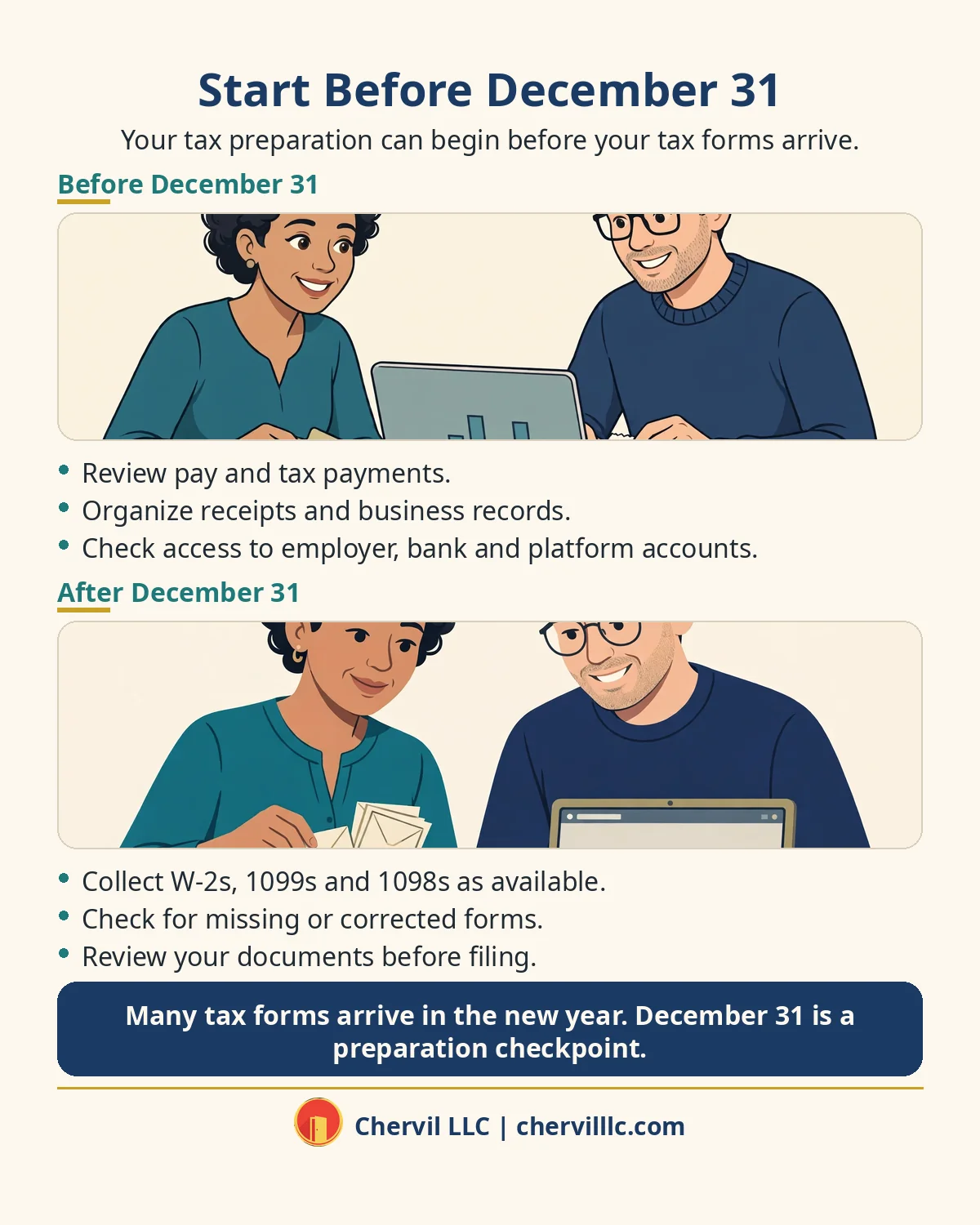
Preparing before December 31 gives you time to find those places, review your payments and identify questions while the year is still underway. You do not need every form in hand to begin.
In an October 23, 2026 announcement, the IRS encouraged taxpayers to prepare for the 2027 filing season by reviewing withholding, organizing records, using online tools and protecting personal information. [1]
Use December 31 as a planning checkpoint—not a universal tax-filing or payment deadline. Different obligations have different due dates. The goal is to begin these five steps while there is still time to ask questions and address gaps.
Many forms for tax year 2026—including W-2s, many 1099s and 1098 statements—will arrive or become available online after December 31, 2026, during the 2027 filing season. Prepare your folders and account access now, then collect and review the forms as issuers release them. Do not assume every document has the same delivery date. [8]
1. Review what is being withheld from your pay
If you receive wages, compare your current withholding with your expected tax situation. A second job, a change in income or a change in your household can make last year’s arrangements a poor fit for this year.
The IRS Tax Withholding Estimator can help eligible employees and pension recipients review federal withholding. Gather current pay statements, your spouse’s pay statements if filing jointly, and information about other income. If a change is appropriate, give the relevant updated withholding form to your employer or pension provider. [2]
The estimator requires wage income or a pension or annuity with federal withholding. Someone whose only income is self-employment should use the appropriate estimated-tax guidance instead. [2]
Your next step: Set aside time to review your latest pay statement. If you change withholding late in the year, check it again for the new year so a short-term adjustment does not become an unintended long-term setting.
Worked overtime? Check with your employer
Ask payroll or human resources whether your overtime qualifies under the federal Fair Labor Standards Act (FLSA), how the qualifying amount is tracked and where you can find supporting payroll records.
For tax year 2026, employers must separately report qualified overtime compensation on Form W-2, box 12, code TT. Keep your pay statements and year-end payroll summary, then compare them with your W-2 when it arrives in 2027. Ask payroll about a missing or questionable amount and whether a corrected W-2 is needed. [14]
Qualified overtime generally means the additional premium required by the FLSA—the “half” portion of time-and-a-half. It does not mean that every dollar earned during overtime hours qualifies, and weekend or holiday premium pay does not automatically qualify. The amount reported is not necessarily your allowable deduction; eligibility rules, income limits and deduction limits still apply. Overtime remains generally subject to Social Security and Medicare taxes. [14][15]
2. Review estimated payments and income outside your paycheck
Business income, gig work, investments and other income without sufficient withholding may require estimated payments. These payments can cover income tax and, where applicable, self-employment tax. [3]
Bring together the amounts already paid, payment dates and an updated income estimate. Individuals commonly use Form 1040-ES to work through estimated-tax calculations. The correct approach depends on the facts; business entities can have different requirements.
Do not assume that paying a balance when you file automatically resolves earlier underpayments. The IRS considers payment timing, and an underpayment penalty may apply even when the eventual return shows a refund. [3]
Your next step: Ask your preparer to review payments made so far, what remains due and the applicable deadlines.
For example, an employee who started weekend delivery work should consider that income alongside wages. The review may involve additional paycheck withholding, estimated payments or both.
3. Check your mail, online accounts and tax notices
An IRS Individual Online Account can provide access to payment information, balances, certain notices and tax records. It can also be used to request an Identity Protection PIN. Available features depend on the account. [1]
Give tax notices their own attention
A tax form reports information used to prepare a return. A tax notice is correspondence about your account or a particular issue. An IRS notice may concern a balance, a changed refund, an adjustment, identity verification or a processing delay. Read the whole notice and identify its tax year, notice number and any response deadline. Some require action; others are informational. [6]
Do not put a notice aside until your next tax appointment if a response is due sooner. Send your preparer a complete copy, including all pages, and explain any payments or responses you have already made. If you disagree with an IRS notice, follow its dispute instructions and deadline. Keep a copy of your response and proof of submission. [6]
Use the same organized approach for correspondence from your state revenue department: identify the issue, verify the sender and follow that agency's instructions. A federal account review does not resolve a separate state matter.
Make a list of the accounts you need to check
List your current and former employers, banks, investment firms, retirement providers, mortgage and student-loan servicers, schools and any platforms through which you earned money. Check your mailing address, electronic-delivery preference and ability to sign in. A paperless account may require you to download the form yourself.
Look for sections called Tax Documents, Statements, Documents or Reports; labels vary by provider. Download the complete document for the correct tax year, including attachments. A transaction screenshot may leave out information found in the full statement.
An IRS online account can supplement your records, but do not assume it already contains every current-year document. For a missing or incorrect form, contact the employer, payer or issuing organization. [7]
Your next step: Start at IRS.gov, find the Individual Online Account service and check that you can access your own information securely.
Keep your login credentials and authentication codes private. If a preparer needs a record, agree on a secure way to share the document rather than sharing account access.
4. Build a usable tax folder—and bring your books up to date
Start with your prior federal and state returns, payment confirmations and a list of changes in your household or business. Add current-year forms as they become available. Many arrive in January or February; other documents may arrive later. December 31 is the time to prepare your collection system, not a reason to file before the necessary information is available. [8]
Common tax forms and what they mean
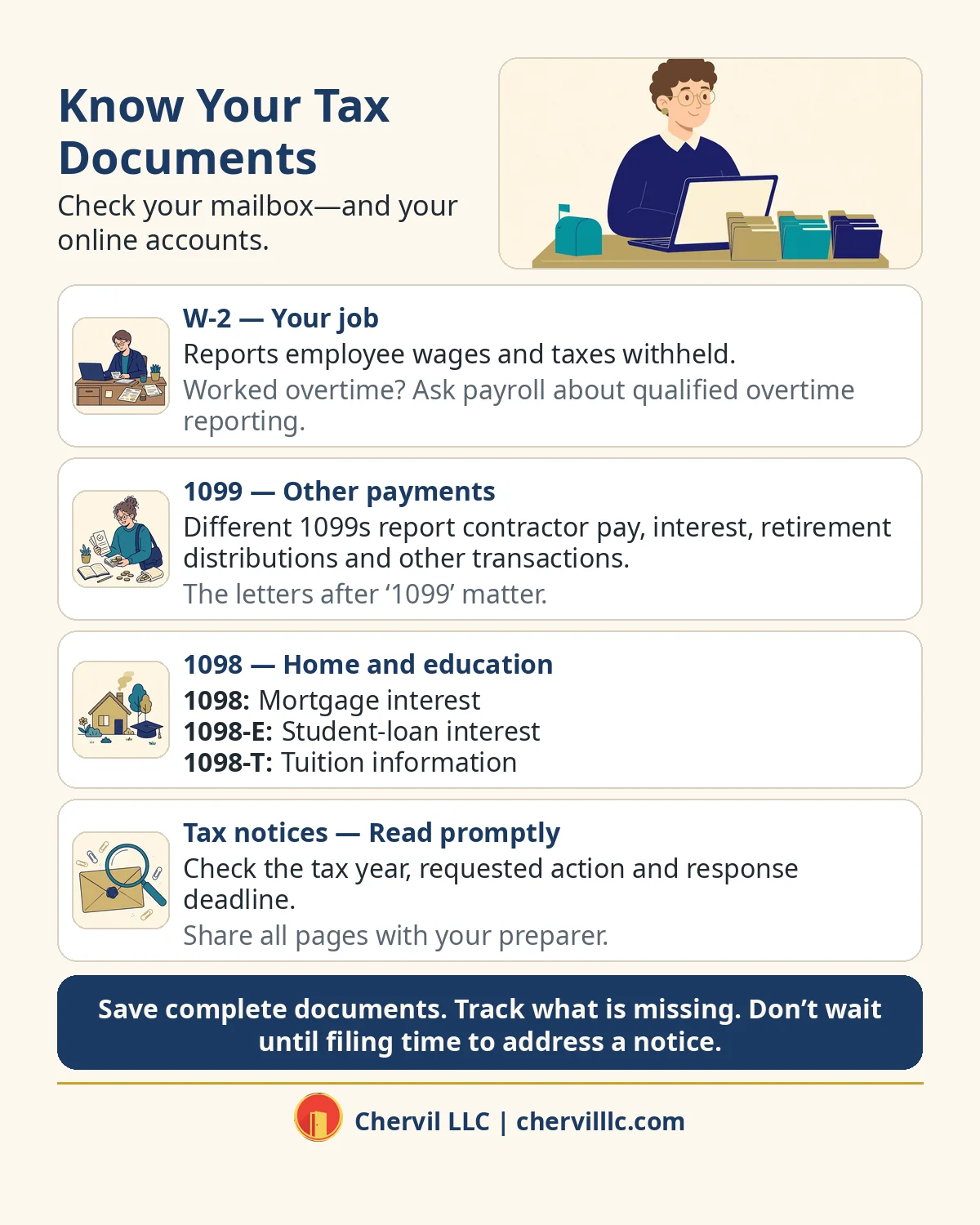
You will not receive every form below. Use the list to identify the ones that fit your circumstances. “1099” describes a family of forms; the letters after the number tell you what kind of payment or transaction was reported.
| Form | What it tells you | Where to look |
|---|---|---|
| W-2 — Wage and Tax Statement | Your employee wages and taxes withheld. Gather one from every employer, including a job you left. | Employer, payroll portal or mailed statement. |
| 1099-NEC — Nonemployee Compensation | Payments for services as a nonemployee, such as freelance or contractor work. | Client, payer or its document-delivery service. |
| 1099-MISC — Miscellaneous Information | Certain payments such as rents, royalties or other reportable amounts. The box used matters. | Business or organization that paid you. |
| 1099-INT — Interest Income | Interest reported by a bank, credit union or other payer. | Financial institution's tax documents or mail. |
| 1099-DIV — Dividends and Distributions | Dividends and certain investment distributions. | Brokerage or investment provider. |
| 1099-B — Proceeds from Broker and Barter Exchange Transactions | Sales and other reportable transactions handled by a broker or barter exchange. Bring cost and purchase records too; sale proceeds alone do not establish your gain. | Brokerage tax package and transaction records. |
| 1099-R — Retirement Distributions | Distributions from retirement arrangements, including pensions and IRAs. Tell your preparer about any rollover. | Plan administrator, custodian or insurer. |
| SSA-1099 — Social Security Benefit Statement | Social Security benefits paid during the year. | Social Security Administration. |
| 1099-G — Certain Government Payments | Payments such as unemployment compensation or a state income-tax refund. The tax treatment depends on what was paid and your circumstances. | Issuing government agency or its online account. |
| W-2G — Certain Gambling Winnings | Reportable gambling winnings. Keep your own gambling records as well. | Casino or other payer. |
These are common examples from IRS document guidance; Form 1099-B has its own broker-reporting guidance. [7][8][9]
Forms connected with a home, education and health coverage
| Form | What it means | What else to gather |
|---|---|---|
| 1098 — Mortgage Interest Statement | Mortgage interest reported by your lender or loan servicer. It does not mean your entire mortgage payment is deductible. | Mortgage statements, property-tax payment records and closing documents if you bought, sold or refinanced. |
| 1098-E — Student Loan Interest Statement | Student-loan interest reported by your lender or servicer. | Payment history and records from each servicer if your loan moved. |
| 1098-T — Tuition Statement | Information about reportable education payments and related items from an eligible school. | Student account ledger, scholarship details and receipts for relevant education expenses. |
| 1095-A — Health Insurance Marketplace Statement | Marketplace coverage information used in working out the premium tax credit and reconciling advance credit payments. | Statements for everyone in the tax household who had Marketplace coverage, including any corrected form. |
You may find these in a lender, school or Marketplace account rather than an envelope. Receiving a form does not by itself establish eligibility for a deduction or credit. Your preparer needs the supporting facts as well. [7][10][11][12]
If you receive a Schedule K-1, cancellation-of-debt form, real-estate sale statement or another unfamiliar tax document, keep it and flag it for review. Do not discard a form because it is absent from this checklist.
Small business owners: connect the forms to your books
A business needs more than a stack of 1099s. Bring together sales records, invoices, receipts, bank and credit-card statements, payroll reports and records of business purchases. Your records should explain both the income reported and the expenses claimed. [4]
For each payment processor, marketplace or gig-work platform you used, check for annual tax forms and downloadable transaction reports. Examples might include PayPal, Square, Stripe, Etsy, Uber or DoorDash, depending on your activity. Available documents and delivery methods vary; using a platform does not mean it must issue you a particular form.
Form 1099-K — Payment Card and Third Party Network Transactions reports gross payments processed through covered payment channels. Gross payments are not automatically your business profit. Compare the form with platform reports and your books, including fees, refunds and other adjustments. Income still needs to be considered even when no 1099-K arrives. [13]
For example, suppose a customer payment is included in a platform report, a 1099-K and a bank deposit. Those can be different records of the same transaction. Match the records before adding totals so the receipt is not counted repeatedly. If a form appears incorrect or duplicates income reported elsewhere, ask the issuer and your preparer to help resolve it.
Create a short list of items your preparer should review: transfers between your accounts, owner contributions or withdrawals, loan proceeds, equipment purchases, personal expenses paid from the business account and business expenses paid personally. These transactions should not all be treated as ordinary sales or expenses simply because money moved.
If you used a vehicle for business, gather your mileage log and related records. For equipment or property, retain purchase documents, the date it began business use and details of any sale. Ask which supporting records apply before assuming an item is deductible. [4]
Track what has arrived and what is missing
Use three folders: Ready, Missing and Questions for my preparer. Give time-sensitive notices a separate Action needed folder so they do not disappear among routine forms.
A simple tracker can look like this:
| Expected item | Source | Status | Next action |
|---|---|---|---|
| W-2 from a former job | Former employer | Awaiting issuance | Confirm mailing address and portal access |
| 1099-INT | Bank account | Available | Download the complete tax-year statement |
| 1098 | Mortgage servicer | Missing | Check account and contact servicer |
| IRS or state notice | Mail or agency account | Response requested | Record deadline and send all pages to preparer |
| Platform annual report and any 1099-K | Payment platform | Needs reconciliation | Match transactions with bookkeeping records |
These are examples, not assumptions about which documents you personally need.
Use clear filenames, such as 2026_W2_EmployerName.pdf or 2026_1098_MortgageServicer.pdf. Keep corrected documents clearly marked and tell your preparer when a replacement arrives. Do not silently substitute a new form after the return has been prepared or filed.
Also gather records that may never arrive on an official tax form: charitable-gift acknowledgments, childcare provider details and payments, relevant medical expenses, rent or property-tax records, and documentation of household changes. Your preparer can determine which records matter for your federal and state returns. [8]
Your next step: Review the records month by month and make a short list of missing items. Ask your preparer what additional documentation your activities require.
Before December 31, organize what you already have and list what you expect. After December 31, revisit the list as W-2s, 1099s, 1098s and other statements arrive by mail or appear online. Check for corrected versions and resolve missing documents with your preparer before filing. A tax notice with a response deadline needs attention on its own timetable.
If your business issues information returns, also confirm who handles them. Our FIRE-to-IRIS guide explains the filing-system transition and questions to ask your provider.
5. Protect your information and choose help carefully
Be cautious about unexpected messages promising refunds, demanding immediate payment or asking for sensitive information. The IRS identifies pressure tactics, misleading refund claims and suspicious website links as scam warning signs. [5]
A message that looks official still deserves verification. Open the agency’s website independently or use a contact method you have verified before responding.
Choosing a preparer deserves the same care. Ask how records will be shared securely, what the engagement includes and how you will review the completed return.
Your next step: Read Before You Hire a Tax Preparer: Know Who Is Signing Your Return before committing to a service.
Make your year-end conversation productive
You do not need every answer before contacting a preparer. Bring a clear list of changes, the records you have and the questions you cannot yet resolve.
| Bring to the conversation | What it helps clarify |
|---|---|
| Recent pay statements and other income records | Whether your income picture has changed |
| Estimated-payment dates and confirmations | What has already been paid |
| Prior return and current notices | Issues needing attention |
| Business records and a missing-items list | What remains to be organized |
| Questions about your household or business changes | Which facts need closer review |
Ask about applicable state and local obligations separately from the federal review.
Chervil LLC can help you organize a tax-preparation conversation around your circumstances.
Contact Kayode Kosemani, Professional Tax Preparer, at 317-488-0021 or sayhi2ky@chervilllc.com, or visit our Tax Services page.
This article provides general educational information. Filing obligations, payment deadlines and eligibility for tax benefits depend on individual circumstances and applicable rules. Preparation does not guarantee a refund or eliminate penalties.
Sources
CONNECT WITH CHERVIL LLC
Ready to organize your tax preparation?
Contact Chervil LLC to discuss the records and questions that apply to your household or small business.